New Patient Flow Rate: What to Look for When Buying a Practice

Co-Founder, Minty Dental

In Summary
- New patient flow rate measures how many first-time patients a practice attracts each month or year — and it's one of the strongest indicators of long-term revenue sustainability.
- A healthy established general practice typically attracts 20–30 new patients per month; below 15/month often signals decline; growth-oriented practices target 40+/month.
- Practices generating fewer than 150–200 new patients per year are generally considered below the minimum viable threshold for acquisition.
- Every dental practice loses patients naturally each year through moves, insurance changes, and attrition — new patients aren't just growth, they're replacement.
- The raw monthly number only tells part of the story; it must be read alongside active patient count, practice size, and attrition rate to mean anything.
New Patient Flow Tells You More About a Practice Than Almost Any Other Metric
New patient flow rate is the number of first-time patients a practice attracts over a defined period — typically measured monthly or annually — and it functions as one of the clearest forward-looking signals available during a dental practice acquisition. Unlike collections or overhead ratios, which reflect what already happened, new patient flow tells you what's likely to happen next.
It carries so much diagnostic weight because it reflects several systems at once: location viability, community reputation, marketing health, and competitive positioning. A practice generating strong new patient numbers is, almost by definition, doing something right across multiple dimensions. One that isn't — even if collections look fine today — may be quietly running down a finite resource.
That finite resource is the existing patient base. Dental practices lose patients every year through completely natural causes: people move, change insurance, age out of the practice, or simply drift away. Industry estimates suggest practices typically lose 15–20% of their active patient base annually through attrition. A practice with 1,500 active patients needs to replace roughly 225–300 patients per year just to stay flat. New patients aren't a growth metric — they're a maintenance metric first.
This is the core tension worth understanding before you look at any specific number: a practice with strong collections but declining new patient flow is living off its existing base. That base will shrink. The question is how fast, and whether the price you're paying reflects that trajectory.
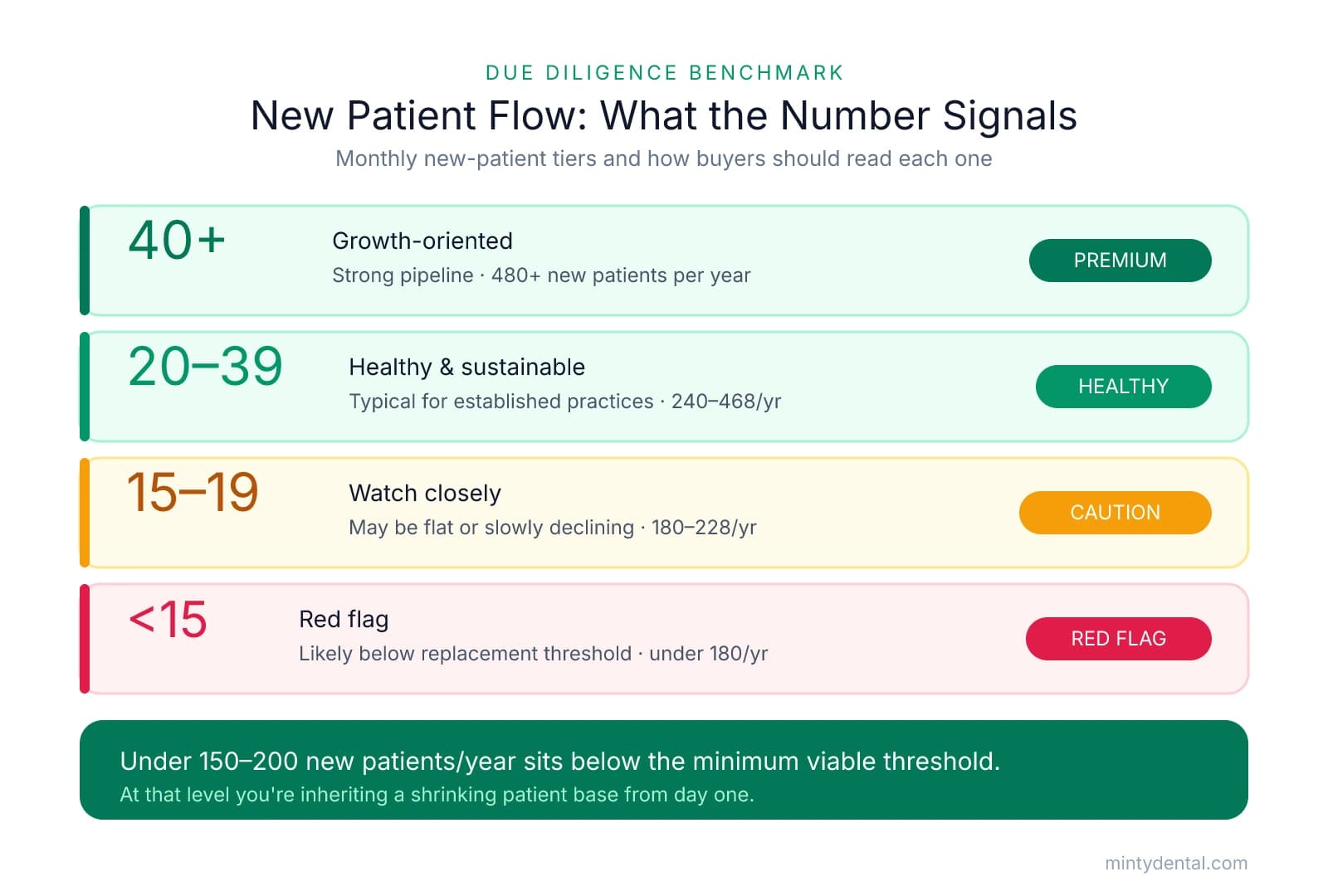
According to Overjet, most dental practices need between 20–40 new patients monthly, but the right target depends heavily on practice size, provider capacity, and local market conditions. As a starting framework, here's how different rate tiers tend to read during acquisition due diligence:
| Monthly New Patients | Annual Rate | Signal |
|---|---|---|
| 40+ | 480+/year | Growth-oriented; strong pipeline |
| 20–39 | 240–468/year | Healthy; sustainable for most established practices |
| 15–19 | 180–228/year | Watch closely; may be flat or slowly declining |
| Below 15 | Under 180/year | Red flag; likely below replacement threshold |
A practice generating fewer than 150–200 new patients per year sits below what most advisors consider a minimum viable threshold for acquisition — at that level, you're likely inheriting a shrinking base from day one.
The raw monthly number is where most buyers start — and where many stop. But the number alone doesn't reveal whether the practice is growing, holding, or quietly declining. Understanding what the patient base is actually worth requires layering in attrition rate, active patient count, and the trend over time. The sections that follow walk through each of those layers.
How to Calculate Net New Patient Growth — and Why It's the Number That Actually Matters
The raw new patient count gets most of the attention during due diligence — but the number that actually predicts whether a practice is growing, holding, or shrinking is net new patient growth. The calculation is straightforward once you have the right data.
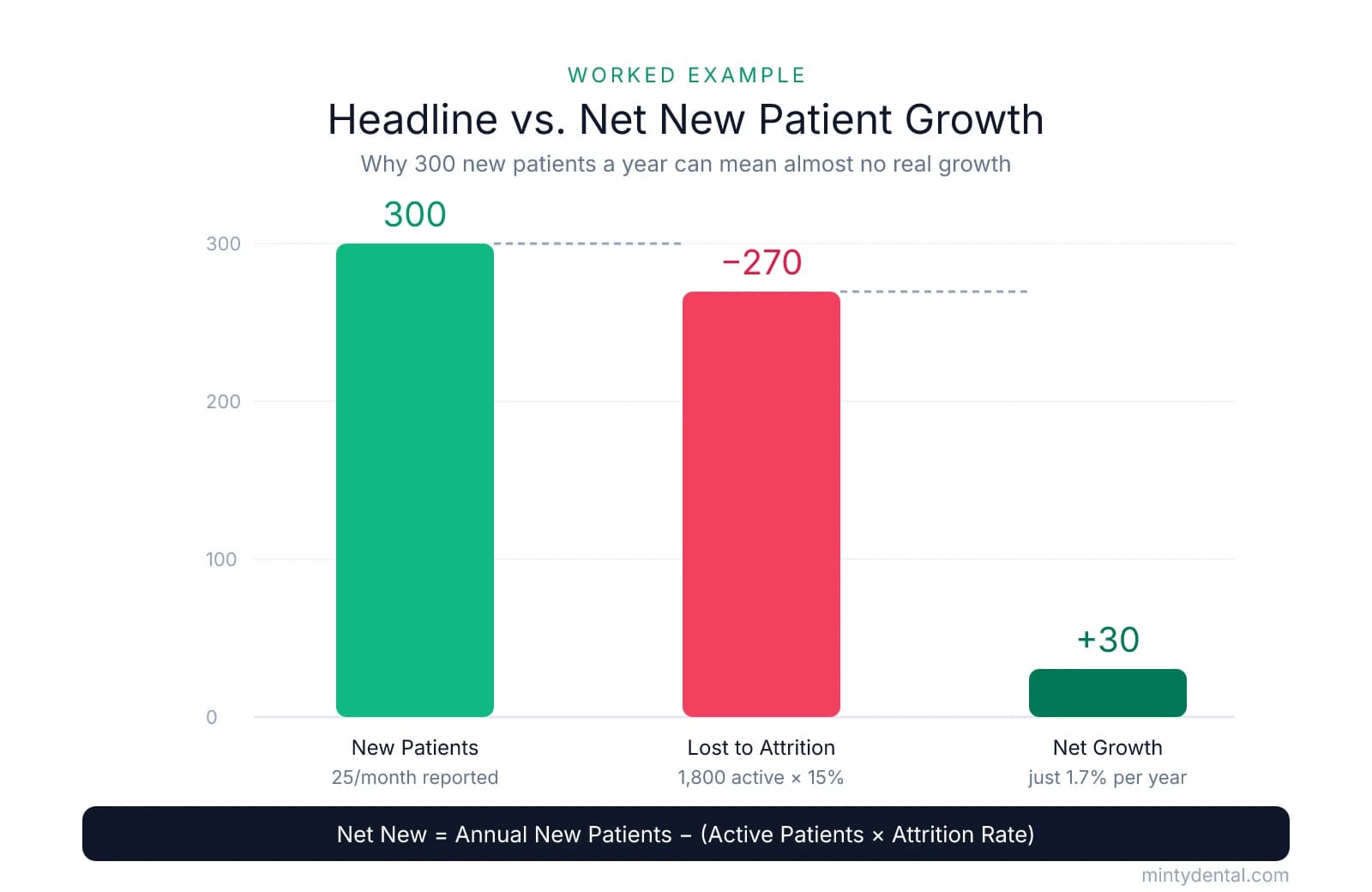
The formula: Net New Patient Growth = Annual New Patients − (Active Patient Count × Attrition Rate)
Step 1: Establish the attrition baseline. According to The Dental Business School, the average dental practice loses 15% of its active patient base each year — practices losing more than 18% annually have a systemic problem worth investigating before closing. Use 15% as your default unless the seller can demonstrate otherwise.
Step 2: Calculate the replacement threshold. Multiply the active patient count by the attrition rate. A practice with 1,600 active patients loses roughly 240 patients per year to natural causes — moves, insurance changes, deaths, dissatisfaction. Those 240 patients need to be replaced before a single net-new patient is added.
Step 3: Subtract to find true growth. Take the annual new patient count and subtract the replacement number. What's left is actual growth — or loss.
Worked example: A practice reports 25 new patients per month — 300 per year. On the surface, that sounds healthy. But if the practice has 1,800 active patients, the 15% attrition rate means it's losing approximately 270 patients annually. Net new patient growth: 300 − 270 = 30 patients per year. That's a 1.7% growth rate — modest, and far less impressive than the headline number suggested.
That gap between perceived and actual growth is where many buyers get surprised post-close. A practice can report consistent new patient flow for years while its active base quietly stagnates.
Step 4: Compare against active patient count trends. If active patients are flat or declining despite consistent new patient numbers, attrition is outpacing acquisition — a pattern worth examining alongside other growth signals before making an offer.
Step 5: Request the source data. Ask for a three-year monthly new patient report pulled directly from the practice management software — Dentrix, Eaglesoft, and Open Dental all generate this as a standard report. Hesitation here is itself a data point.
One detail worth clarifying before running any of these numbers: ask the seller how their system defines a "new patient." Some practices count emergency-only visits in that total, which inflates the figure without reflecting genuine patient acquisition. A patient who came in once for an extraction and never returned isn't a new patient in any meaningful sense — and including them can make a declining practice look considerably healthier than it is.
Reading the 3-Year Trend: What Growth, Plateau, and Decline Each Signal
A single year's new patient count is close to meaningless in isolation. What matters — and what most buyers don't ask for until late in due diligence — is the direction of that number over three years. The trend tells you something the snapshot never can: whether the practice is building momentum, holding steady, or quietly running down.
| Trend Pattern | What It Signals | Key Question to Ask |
|---|---|---|
| Consistent growth | Healthy demand; transferable systems | Is growth driven by marketing, referrals, or organic reputation? |
| Plateau (near capacity) | Scheduling ceiling, not demand weakness | Is hygiene utilization above 85%? Are patients waiting 3+ weeks? |
| Plateau (below capacity) | Marketing stagnation or early decline | What changed 2–3 years ago? Staff turnover? Reduced hours? |
| Gradual decline | Practice living off existing base | Is the cause fixable or structural? |
| Sudden spike pre-sale | Possible valuation inflation | Is the marketing spend sustainable post-close? |
A consistent 3-year decline in new patients is the most important red flag in patient flow analysis. A practice in decline isn't just growing slowly — it's drawing down a finite asset. Collections may look stable today, but the trajectory is already set.
When you see a decline, the diagnostic question isn't whether it's happening — it's why. Two practices can show identical downward trends for completely different reasons:
- Fixable declines often trace back to the seller's behavior: reduced hours before retirement, zero investment in digital marketing, no online presence, or a front desk that stopped following up on missed appointments. These are operational gaps a new owner can close relatively quickly — and they can represent genuine undervalued opportunity.
- Structural declines are harder. A practice in a neighborhood experiencing demographic shift, a location with a new DSO two blocks away, or a market that's simply oversaturated with providers may face headwinds no amount of marketing can fully overcome.
Cross-referencing the new patient trend with the seller's marketing spend history is one of the most useful things you can do here. Declining new patients alongside zero marketing investment looks very different from a practice spending $3,000/month on Google Ads and still declining. The first may be a growth opportunity; the second is a warning sign.
A plateau deserves its own read. If a practice is running near capacity — hygiene booked out three weeks, providers at 85%+ utilization — flat new patient numbers may simply reflect a scheduling ceiling, not demand weakness. But a plateau in a practice with open chair time and no waitlist is worth probing: something changed, and the seller may not volunteer what.
One pattern worth scrutinizing carefully is a sudden spike in new patients in the year immediately before listing. A marketing push timed to a sale isn't inherently dishonest, but it raises a fair question: is that spend sustainable, and will those patients return? Ask for the marketing budget by year alongside the new patient data. The ADA notes that collections and cash flow are central inputs to practice valuation — which is precisely why a pre-sale spike that inflates near-term collections deserves careful scrutiny before it shapes the purchase price.
Finally, look at where new patients have been coming from over time. A practice where flow is heavily driven by the seller's personal referral network carries referral concentration risk that won't show up in the trend line. Those relationships may not transfer when ownership changes.
The Questions to Ask Before You Decide What the Number Means
Everything covered so far — the raw count, the net growth calculation, the trend pattern — feeds into one question that matters more than any of them individually: how many new patients will this practice get after I own it? That's a different question from how many it gets today, and the gap between those two answers is where acquisition risk actually lives.
Start with the source breakdown. Ask the seller to pull a new patient source report — most practice management systems can generate this. What percentage came from patient referrals, online search, insurance directories, and paid marketing? Referral-heavy flow tied to the seller's personal relationships is the most fragile source in any acquisition. When that person leaves, the referral network often leaves with them.
Then evaluate the marketing infrastructure. A practice with strong new patient flow despite minimal marketing investment is often sitting on untapped upside — an active Google Business Profile, recent reviews, and a locally-ranking website signal that location and reputation are doing the heavy lifting. A practice that's been running paid ads for years to maintain flat numbers is a different story.
Factor in the cost of building what isn't there. If new patient flow is low but the cause is fixable — no digital presence, no review strategy, a front desk that stopped following up — that's a negotiating point, not a dealbreaker. But it needs to be priced in. First-year marketing spend for a practice rebuilding new patient flow runs meaningfully higher than for an established practice, and that cost belongs in your acquisition math, not your post-close surprise budget.
Consider an earnout if new patient flow is a genuine concern. Structuring part of the purchase price around patient retention metrics aligns the seller's incentives with a successful transition — they have a financial reason to support continuity. This is especially worth exploring when referral-dependent flow is a material part of the picture.
From there, most practices fall into one of three categories:
- Strong flow, diverse sources, 3-year growth trend — worth paying a premium for. The location and reputation will outlast the seller, and you're buying a system, not a personality. A large, loyal patient base in a growing community is one of the clearest signals that a practice will command — and justify — a higher valuation.
- Weak flow, fixable causes — negotiate the price down or structure an earnout. Budget aggressively for patient acquisition from day one, and treat unexpected first-year costs as real line items, not contingencies.
- Structural decline — price it as a startup or walk away. You're not acquiring a patient base; you're acquiring a lease, equipment, and a name.
The new patient number is never just a number. It's a signal about what the practice has been, what it is now, and — most importantly — what it's likely to become once the seller is gone. Buyers who read it that way make better offers, negotiate from a stronger position, and walk into ownership with a clearer picture of what the first year actually requires.
Sources & References
The data and claims in this article are drawn from the following sources. We prioritize government data, peer-reviewed research, and established industry publications to ensure accuracy.
- How Many Patients Should a Dental Practice Attract Per ...— overjet.com
- [PDF] Active Patient: A person that has been in the dentist's office at least ...— thedbscompanies.comIndustry
- Buying or Selling a Dental Practice, Start with an Accurate Valuation— www.ada.orgIndustry
- 7 Key Factors of Dental Practice Value— legacypracticetransitions.com
Find Your Next Practice With Strong Patient Flow
Understanding new patient metrics is crucial during acquisition due diligence. Minty's marketplace connects you with vetted dental practices nationwide, complete with transparent patient flow data to inform your buying decision.