Negotiating a Patient Retention Guarantee When Buying a Practice

Co-Founder, Minty Dental

In Summary
- Goodwill — the expectation that patients will return — represents 60–85% of a typical dental practice purchase price, making patient retention the central financial risk in any acquisition
- A 25% patient loss on an $800K practice bought on $1.2M collections can collapse EBITDA from $200K to roughly $75K — below most debt service thresholds — because fixed costs don't shrink with patient volume
- Well-managed transitions average less than 10% patient attrition; poorly managed ones can reach 20–30%+ within 18 months of closing
- The gap between those outcomes is largely determined before closing day — through due diligence, contract language, and transition structure
- Patient retention is a negotiation problem, not a personality problem — how likable you are on day one matters far less than the protections built into the deal
The Patient Base Is What You're Actually Buying — and It's Not Guaranteed
When you buy a dental practice, the equipment, the lease, and the staff are almost incidental. What you're really paying for is a patient base — the reasonable expectation that the people who trusted the previous dentist will extend that trust to you. Dental practice goodwill, which represents exactly that expectation, accounts for 60–85% of the total purchase price in most transactions. The tangible assets — chairs, X-ray units, leasehold improvements — make up the rest.
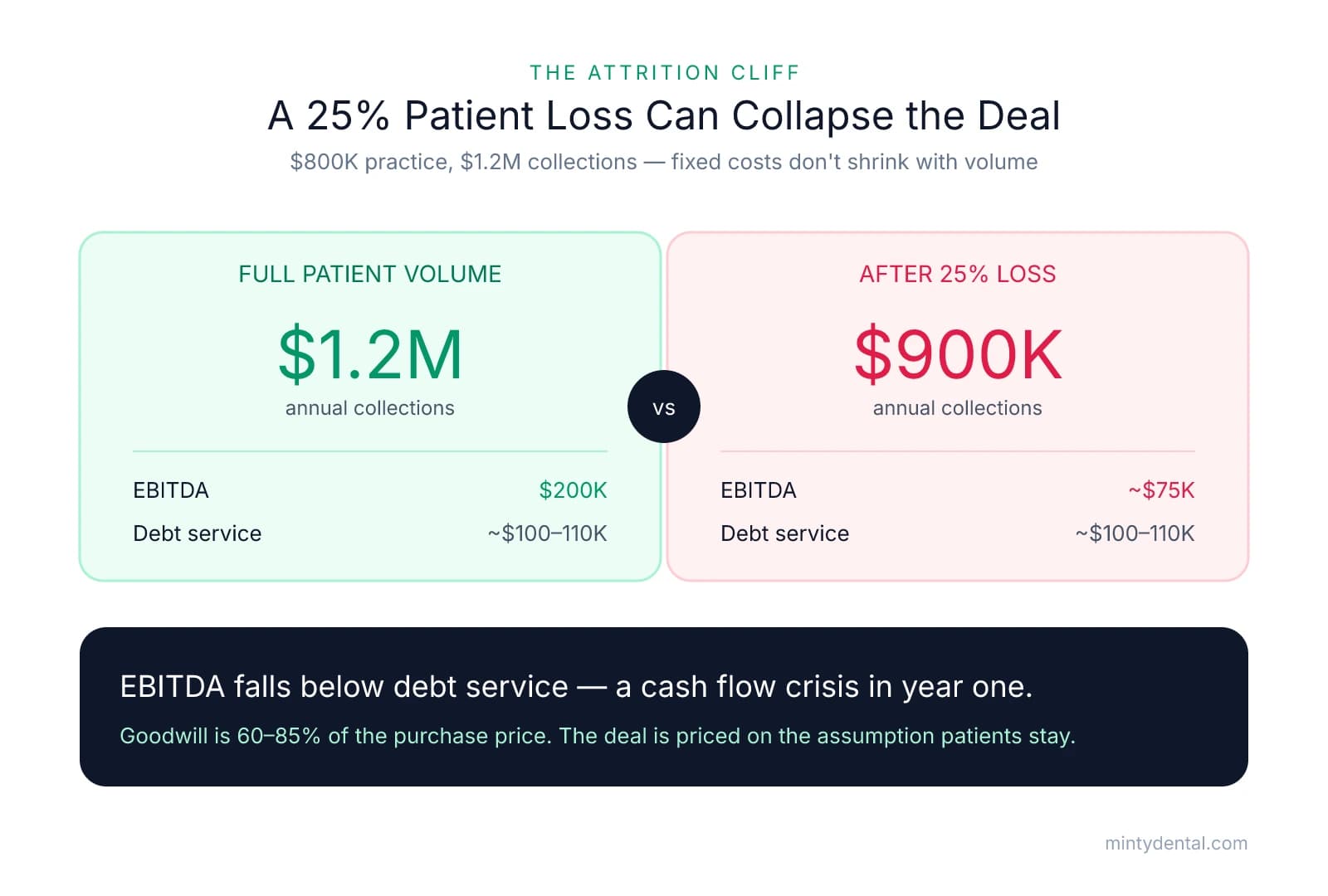
That math has a direct implication most buyers don't fully sit with until after closing: the practice is priced on the assumption that patients stay.
Consider a concrete scenario. A practice sells for $800K, built on $1.2M in annual collections and $200K in EBITDA. Annual debt service on a 10-year SBA loan runs roughly $100–110K. The deal works — until patients start leaving. A 25% patient loss doesn't reduce revenue by a tidy 25% and leave everything else intact. Fixed costs — the lease, the staff, the loan payment — don't move. If collections drop from $1.2M to $900K, overhead that was manageable at full volume now consumes nearly everything. EBITDA can fall from $200K to around $75K, well below debt service. What looked like a viable acquisition becomes a cash flow crisis within the first year.
The industry's baseline offers some reassurance: well-managed transitions average less than 10% patient attrition, while poorly managed ones can reach 20–30% or more within 18 months of closing. That spread isn't primarily explained by the new owner's chairside manner or how warm the introduction letter was.
The gap between a 7% attrition rate and a 28% one is largely determined before closing day — in the due diligence you run on the patient base, the transition structure you negotiate with the seller, and the contract language that creates accountability if patients don't stay. Understanding what that patient base is actually worth on a per-patient basis is a useful starting point, but the more important question is what you're doing to protect it.
Patient retention isn't something you hope for after the keys change hands. It's something you negotiate for, starting the moment due diligence begins.
What to Audit Before You Negotiate: Reading the Patient Base Honestly
Before you can negotiate meaningful retention protections, you need an honest picture of what the patient base actually looks like — not the version in the broker package. The six metrics below form a working due diligence checklist. Request each one directly from the practice management software, not from a summary the seller or broker prepares.
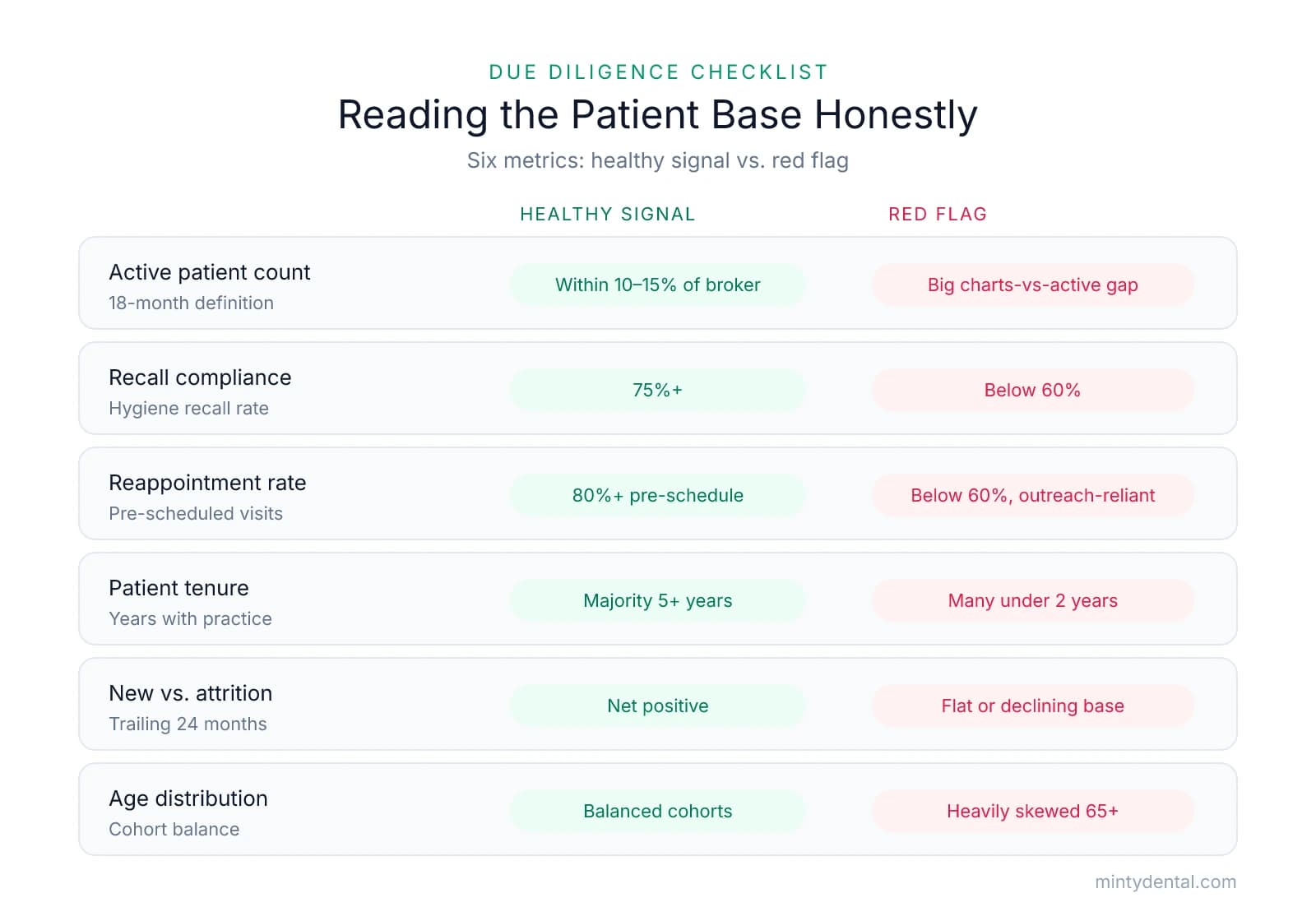
1. Active patient count (18-month definition) Ask for patients seen within the last 18 months, not total charts. Most practice management systems can run this report in minutes, but broker packages routinely cite total chart counts — a figure that often includes patients who haven't visited in three to five years. A practice marketed as having "2,400 active patients" may have closer to 1,400 when filtered correctly. That gap changes the valuation math significantly.
2. Hygiene recall compliance rate Practices above 75% recall compliance have patients who are engaged and habitual — the kind most likely to survive a transition. Below 60%, patients are already drifting before the sale, and a change in ownership gives them a natural exit point. According to Henry Schein One, the average practice retains just 57% of its patients annually — meaning many practices you'll evaluate are already operating below a healthy recall threshold.
3. Hygiene reappointment rate The percentage of patients who schedule their next hygiene visit before leaving the office is a leading indicator of future retention that rarely appears in standard broker packages. A high reappointment rate means patients are already committed to returning. A low one means the practice is relying on recall outreach to pull patients back — a weaker retention signal that often degrades after a transition.
4. Patient tenure histogram Request a breakdown of how long current active patients have been with the practice. A base where most patients have been coming for 5–10+ years is far more durable than one with high annual turnover. Long-tenure patients have demonstrated loyalty through previous disruptions — staff changes, location moves, fee increases. New patients have no established relationship to carry forward.
5. New patient acquisition vs. attrition balance (trailing 24 months) A practice can look stable in collections while quietly losing ground. Tracking new patient flow against attrition over the trailing 24 months reveals whether the active base is genuinely growing, holding flat, or eroding. A practice adding 30 new patients per month while losing 25 is barely treading water — and that math gets harder after closing.
6. Patient age distribution A base skewed heavily toward patients 65 and older carries accelerating natural attrition that no transition strategy fully offsets. Older patients move, enter care facilities, or pass away at higher rates — and that attrition compounds regardless of how well the handoff goes.
| Metric | Healthy Signal | Red Flag |
|---|---|---|
| Active patient count | Matches broker's "active" figure within 10–15% | Large gap between total charts and 18-month actives |
| Hygiene recall compliance | 75%+ | Below 60% |
| Hygiene reappointment rate | 80%+ pre-schedule before leaving | Below 60%, reliant on outreach |
| Patient tenure | Majority 5+ years | High proportion under 2 years |
| New patient vs. attrition balance | Net positive over 24 months | Flat or declining active base |
| Age distribution | Balanced across age cohorts | Heavily skewed 65+ |
Running this audit before you negotiate puts you in a fundamentally different position. If the data is clean, you can proceed with reasonable confidence and negotiate transition protections as a backstop. If it surfaces red flags — low recall compliance, a shrinking active base, an aging patient population — those findings become leverage: for a price adjustment, a more structured earnout, or stronger contractual protections around retention.
How to Structure the Guarantee: Contract Language That Actually Protects You
With a clear picture of the patient base in hand, the next step is translating those findings into contract language — protections that create real accountability if patients don't stay. There are three main tools buyers use, and each works differently depending on the deal structure.
1. Price Adjustment Clause
This is the most direct form of retention protection. The clause reduces the final purchase price if active patient count falls below a defined threshold — typically 85–90% of the baseline established at closing — measured at 6 or 12 months post-close.
Here's how a well-drafted version works in practice:
- Set the baseline at closing. Run an active patient report (18-month definition) from the practice management software on or just before closing day. That number becomes the contractual baseline — not the broker's figure, not total charts.
- Define the measurement date. Agree on a specific date — 6 or 12 months post-close — when the same report will be run again under the same parameters.
- Set the threshold. A common floor is 85% retention. If the closing-day baseline is 1,400 active patients, the threshold is 1,190.
- Define the adjustment formula. One approach: for every percentage point of retention below the threshold, the purchase price is reduced by a defined dollar amount or a proportional share of the goodwill allocation.
The baseline definition is where deals often go sideways — sellers and brokers sometimes propose tying the guarantee to total chart count rather than 18-month actives, because it's a larger number that's harder to see decline. Insist on the 18-month active definition established during due diligence.
2. Seller Holdback / Escrow
A portion of the purchase price — typically 5–15% — is held in escrow at closing and released only if retention targets are met at the measurement date. This structure tends to work best when seller financing is already part of the deal, since the mechanics are similar and the seller is already accustomed to deferred payment. The holdback creates a direct financial incentive for the seller to support the transition actively, not nominally.
3. Earnout Tied to Post-Closing Collections
Rather than patient count, some deals tie a portion of the price to collections over 12–24 months post-close. This captures both retention and production — a patient who returns but accepts less treatment still shows up in the numbers. As Oral Health Group notes, earnouts work best when both sides agree on the measurement metric upfront, because disputes over what counts tend to surface later. Per healthcare M&A attorneys, they're also harder to enforce cleanly — they work best when the seller is staying on clinically and both parties have aligned incentives.
Two Things to Watch For in Any Structure
Introduce these terms at the LOI stage. By the time due diligence is complete and both sides are emotionally committed, adding a price adjustment clause reads as renegotiation. Seeding the concept in the letter of intent costs nothing and sets expectations early.
Reject vague transition language. "Best efforts" from the seller creates no enforceable obligation. The seller's transition duties should be specific: defined days per week, defined duration, defined patient introduction responsibilities. A well-structured seller employment or transition agreement is where those specifics live — worth negotiating with the same care as the price adjustment clause itself.
After the Contract: The Transition Moves That Actually Keep Patients
The contract protections above are real — but they're a fallback, not a plan. A price adjustment clause or holdback is there for scenarios outside your control. What you actually want is to never invoke them.
Most buyers don't have to. According to Dental Transitions, well-managed transitions average less than 10% patient attrition. The buyers who land in that range aren't necessarily more charismatic — they're more deliberate about four moves that drive retention in the first 90 days.
1. Structure the seller's transition with specifics, not goodwill
A seller who agrees to "be available for 60–90 days" without defined responsibilities is almost worse than a clean departure. What tends to protect retention is a structured arrangement: specific days per week, defined patient introduction duties, co-treatment sessions for complex cases, and explicit staff endorsement. Clarity matters more than duration. The mechanics — compensation, scheduling, scope — belong in a formal seller transition or employment agreement, negotiated with the same care as the purchase price itself.
2. Send the endorsement letter before or on closing day
The seller's written endorsement to all active patients is the single highest-leverage retention move available — and it's nearly free. A letter that introduces you, expresses genuine confidence in the transition, and asks patients to give you a chance does more than any marketing campaign in the first 90 days. Sent on or before closing day, it arrives while patients still associate the practice with the seller's name — and that association transfers. Sent weeks later, it feels like an afterthought.
3. Treat staff retention as patient retention
As the ADA notes, patients often have closer relationships with their hygienist and front desk staff than with the dentist. Familiar faces reduce the perceived disruption of ownership change in ways no introduction letter fully replicates. Losing a long-tenured hygienist in the first 60 days can trigger more patient attrition than almost any other single event.
4. Make the first visit the retention moment
Patients who have a positive first appointment are highly likely to stay long-term. That first visit is where the abstract transition becomes real — where your clinical approach, communication style, and the staff experience either confirm or contradict what the seller's letter promised. The guarantee exists for what happens outside your control. The first visit is entirely within it.
The framework this article has built — audit the patient base honestly, negotiate protections into the contract, then execute a deliberate transition — reflects a simple underlying logic: the guarantee is insurance; the transition plan is the actual strategy. Most buyers will retain the vast majority of their patients without ever referencing the retention clause. But the buyers who negotiated it are the ones who closed with confidence, knowing the downside was defined.
Sources & References
The data and claims in this article are drawn from the following sources. We prioritize government data, peer-reviewed research, and established industry publications to ensure accuracy.
- Dental Practice Goodwill: How It's Valued and Why It Matters— usdentalpractices.comIndustry
- Dental Acquisition Due Diligence: Patient Retention Red— mybcat.comIndustry
- Dental Practice Growth: Top 10% Secrets— www.henryscheinone.comIndustry
- Earnouts in dental practice acquisitions: What you need to ...— www.oralhealthgroup.comIndustry
- How to Draft Enforceable Earn-Out Clauses in Dental ...— djholtlaw.comIndustry
- Patient Retention Following a Dental Practice Sale— dentaltransitions.comIndustry
- How to Retain Patients When Buying or Joining a Practice— www.ada.orgIndustry
Ready to acquire your ideal dental practice?
Navigating practice acquisitions involves complex negotiations around patient retention and practice valuation. Minty's acquisition experts guide you through every step—from identifying the right practice to closing the deal—ensuring you understand all terms and protections.