Chart Audit Billing Irregularities: What Dental Buyers Should Do

Co-Founder, Minty Dental

In Summary
- A chart audit in the acquisition context means cross-referencing clinical notes, billed CDT codes, and collections reports — not just reviewing treatment philosophy or patient retention
- Most dental practice purchase prices are calculated as a multiple of reported collections, meaning inflated billing directly inflates the price you pay
- Government and private payor dental audits rose sharply in 2024 and continued increasing through 2025, with further growth expected in 2026 — making billing irregularities a more common due diligence finding than ever
- A meaningful chart audit requires sampling 100–200 active patient charts; practice management software summary reports alone won't surface irregularities
- Billing irregularities discovered post-closing can become the buyer's liability — making the chart audit one of the highest-leverage steps in the entire acquisition process
A dental practice chart audit, in the acquisition context, is the process of cross-referencing a practice's clinical notes, billed CDT codes, and collections reports to verify that what was documented, what was billed, and what was actually paid all tell the same story. When those three data points align, the financials are trustworthy. When they don't, the purchase price may be built on a foundation that doesn't hold up.
That matters because dental practice valuations are almost entirely derived from reported collections — typically a multiple of one to three years of production and collections data. If those collections include revenue from improperly billed procedures, the number you're being asked to pay a multiple of is wrong. Not a rounding error — a structural problem in how the practice's value was calculated.
A meaningful review requires pulling a sample of 100–200 active patient charts, as industry practice consistently recommends — not relying on the summary reports your practice management software generates. Those reports show you what was entered. They don't show you whether what was entered was accurate.
The review itself runs two layers deep. First: do the clinical notes actually support the codes that were billed? A billed D4341 (scaling and root planing) should be backed by documented periodontal charting, probing depths, and a diagnosis. If the notes show a routine prophylaxis, that's a mismatch worth flagging. Second: do the billed codes match what was actually collected and deposited? Discrepancies between billed amounts and deposit records can point to write-off manipulation, ghost billing, or payor-specific upcoding patterns.
This dual-layer check is increasingly important given the enforcement environment buyers are stepping into. According to Liles Parker, government and private payor audits of dental claims rose sharply in 2024 and continued increasing through 2025 — with Medicaid Fraud Control Units, Medicare contractors, and private payor Special Investigation Units all actively expanding their dental audit activity heading into 2026. A practice with billing irregularities today carries audit exposure tomorrow — and after closing, that exposure transfers to you.
Understanding what those irregularities look like, and what they mean for the price you're negotiating, is where the real due diligence work begins. If findings do surface, knowing how to use them in price negotiations is the logical next step.
The Four Billing Irregularities Most Likely to Surface — and What Each One Signals
Not every billing irregularity carries the same weight. Some reflect sloppy record-keeping by a front desk that never got proper coding training. Others reflect a deliberate pattern that's been running for years. The distinction matters enormously — because one is a price negotiation, and the other may be a reason to walk away entirely.
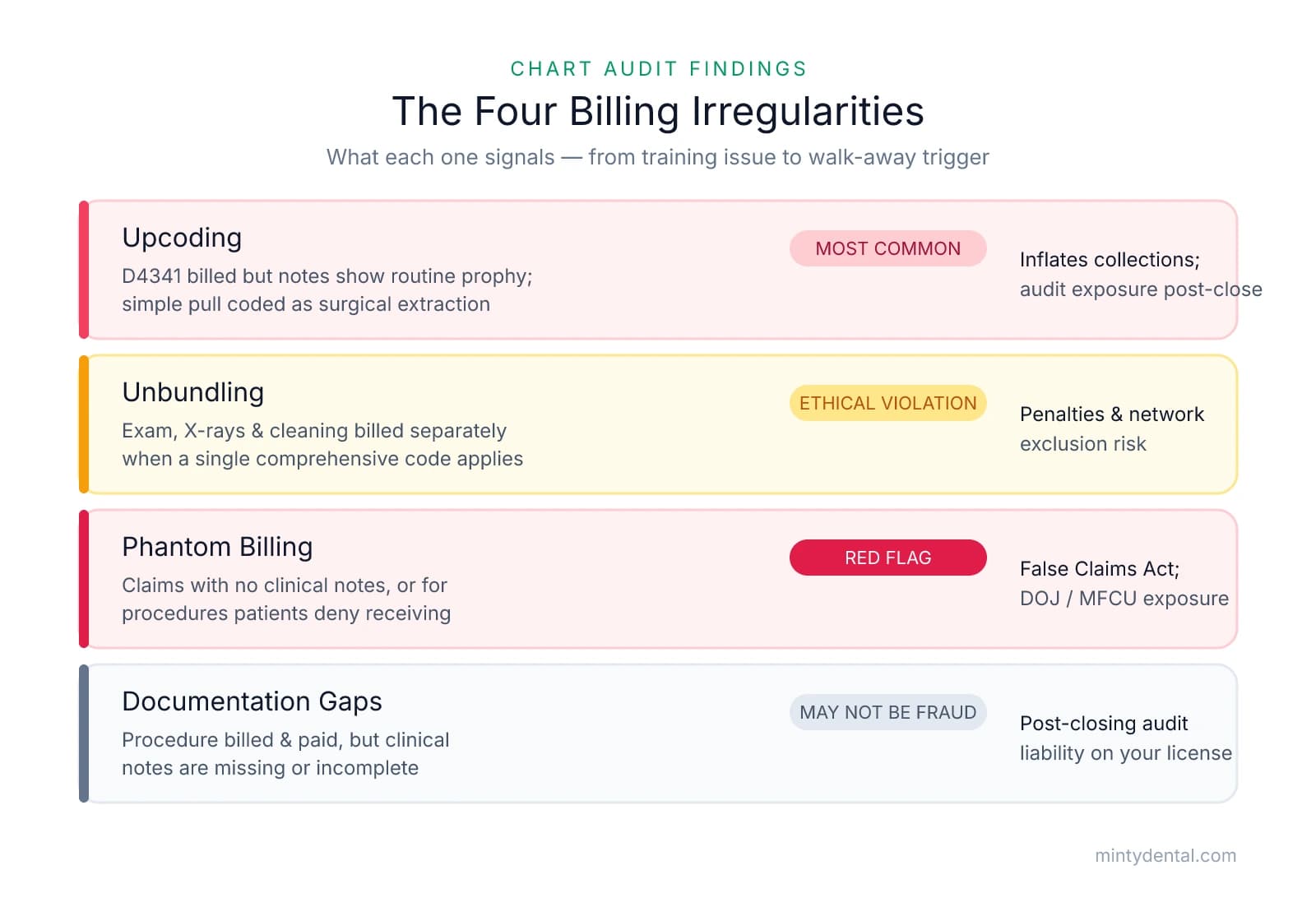
Here's a practical taxonomy for triaging what your chart audit uncovers:
| Irregularity | What It Looks Like in Charts | Severity Signal | Buyer Implication |
|---|---|---|---|
| Upcoding | D4341 billed, but notes show routine prophy; surgical extraction coded for a simple pull | Isolated = likely error; recurring across procedure types = systemic | Inflated collections figure; audit exposure under your NPI post-closing |
| Unbundling | Exam, X-rays, and cleaning billed as separate codes when a single comprehensive code applies | Pattern across multiple patients = intentional | ADA considers this a serious ethical and legal violation; financial penalties and network exclusion risk |
| Phantom billing | Claims submitted with no corresponding clinical notes, or for procedures patients deny receiving | Any instance is serious; multiple instances = immediate red flag | Direct False Claims Act exposure; most likely to trigger DOJ or Medicaid Fraud Control Unit involvement |
| Documentation gaps | Procedure billed, payment collected, but clinical notes are missing or incomplete | May reflect poor record-keeping rather than fraud | Creates post-closing audit liability under your license, even if the billing was clinically appropriate |
Reading the Pattern, Not Just the Instance
Upcoding is the most common billing irregularity flagged in dental audits — and the easiest to rationalize as a coding mistake. What changes the interpretation is frequency. One instance across 150 charts is a training issue. Fifteen instances across three procedure categories is a revenue strategy.
Unbundling tends to be less visible because each individual code may be technically valid — the problem is billing them separately when a bundled code exists. The ADA treats this as a serious ethical and legal violation, and insurance payers are increasingly sophisticated at detecting it through claims pattern analysis.
Phantom billing is the most serious category. When procedures appear in the billing record with no clinical documentation — or when patients have no recollection of receiving them — you're looking at potential False Claims Act exposure. According to EisnerAmper, the DOJ recouped $2.5 billion in healthcare fraud in a single year under the False Claims Act, with dental billing fraud among the actively pursued categories.
Documentation gaps occupy a different risk tier — they may not reflect fraud at all. But a buyer who closes on a practice with incomplete records inherits the audit exposure. If a payor later questions a claim from two years prior and the notes don't exist to defend it, the investigation lands on your license.
The Inheritance Problem
Insurance payers now use predictive algorithms and data mining to flag statistical outliers in real time. A billing pattern that existed under the seller's NPI doesn't disappear at closing — it continues under yours. If the practice has been billing D4341 at twice the regional rate, that flag follows the practice. The diagnostic question worth asking for every irregularity you find: is this isolated, or does it recur across multiple patients and procedure types? Pattern equals systemic risk — and systemic risk changes the conversation from price adjustment to deal structure, or exit.
How Billing Irregularities Inflate the Purchase Price — and How to Recalculate
Once you've identified what billing irregularities exist and how serious they are, the next question is mechanical: what do they actually do to the number you're being asked to pay?
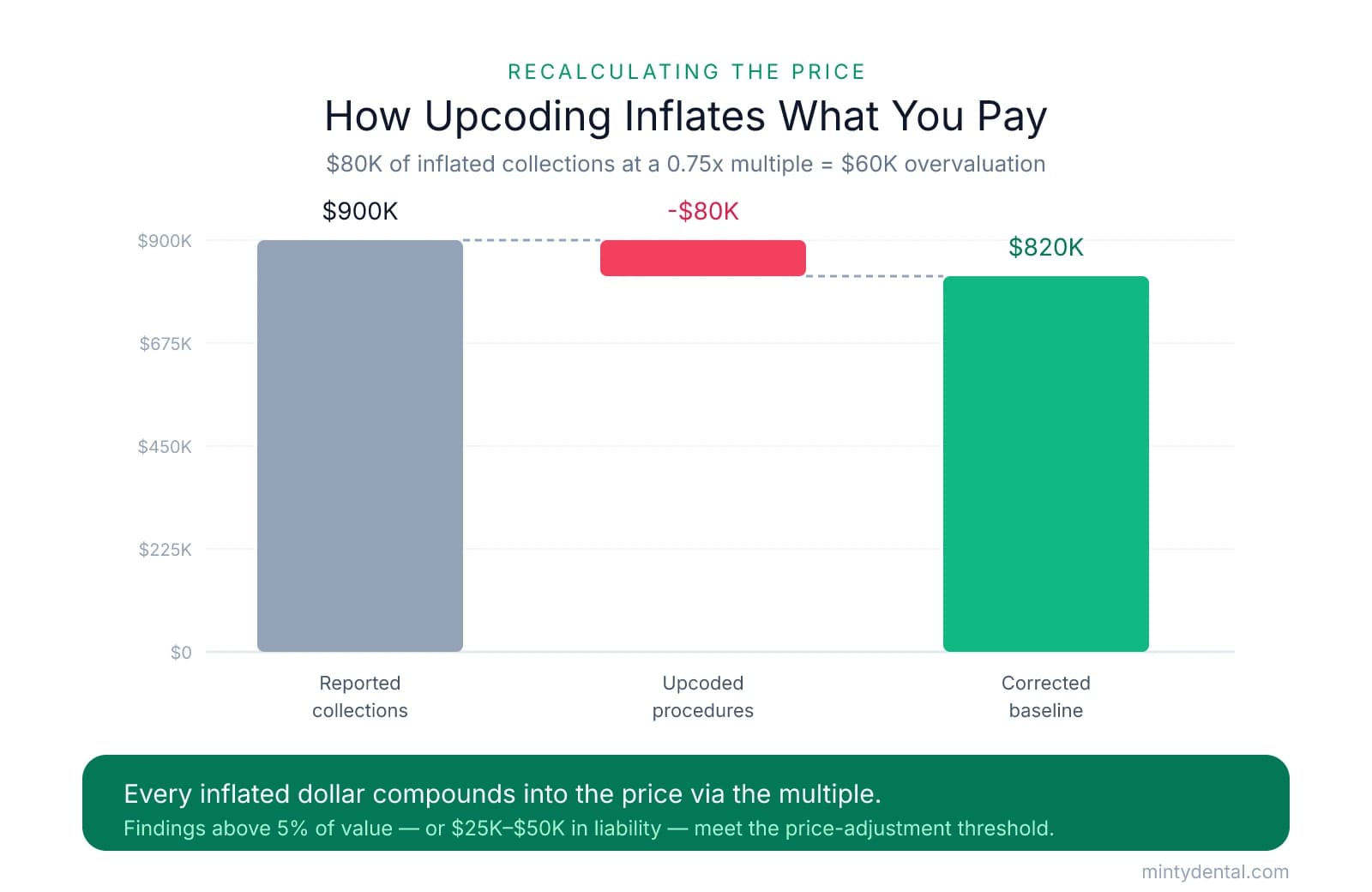
Most acquisitions price a practice at a multiple of annual collections — commonly 0.6x–0.8x for general practices, though EBITDA-based multiples are increasingly common in larger transactions. Every dollar of inflated collections doesn't just misrepresent revenue — it compounds into the purchase price. A $900,000 reported collections figure with $80,000 attributable to upcoded procedures puts the true baseline closer to $820,000. At a 0.75x multiple, that's a $60,000 overvaluation before accounting for any post-closing liability exposure.
The recalculation framework is straightforward:
- Identify the dollar volume of improperly billed procedures from your chart audit sample — then extrapolate to the full patient base proportionally
- Subtract that amount from reported collections to establish a corrected baseline
- Apply the agreed valuation multiple to the corrected figure — the difference is your starting point for renegotiation
This is also where the accounts receivable picture matters. A healthy practice tends to carry total receivables approximately equal to one month's production — an A/R ratio of roughly 1.0, as dental-specific due diligence practice consistently benchmarks it. A practice producing $75,000 monthly with $150,000 in outstanding receivables carries a ratio of 2.0 — which can signal collection problems, billing irregularities, or both. Ratios significantly above 1.0 warrant a line-by-line review of what's actually collectible before you accept the A/R as part of the deal's value.
One cross-check many buyers find valuable: pull three years of production reports from the practice management software and compare collected totals against actual bank deposits for the same periods. A consistent gap between what the software shows as collected and what hit the bank can indicate write-off manipulation, ghost billing, or revenue that was recorded but never actually received.
Spotting these discrepancies requires someone who knows what normal looks like in a dental context. A dental-specific CPA brings industry benchmarks that a general accountant typically won't apply — staff costs running 20–28% of gross, occupancy near 5%, and collections-to-production ratios that vary meaningfully by specialty and payor mix. Buyers new to that exercise may find it useful to work through how those statements are structured before sitting down with a seller's financials.
Materiality threshold: Findings that affect valuation by 5% or more — or that create post-closing liabilities exceeding $25,000–$50,000 — generally meet the threshold for a formal price adjustment conversation. Below that, findings may still be worth flagging, but they're more likely addressed through representations and warranties in the purchase agreement than through a headline price reduction.
What to Do With Billing Findings: Renegotiate, Protect, or Walk Away
Once your chart audit is documented and the financial impact is quantified, you're facing one of three paths. Which one fits depends on what you found — and how the seller responds.
Path 1: Renegotiate
When findings are isolated, quantifiable, and don't suggest a deliberate pattern, a price adjustment is usually the right move. The recalculation framework above gives you the starting point: corrected collections, applied to the agreed multiple, produces a defensible revised offer. Most sellers who've priced honestly will engage with documented findings.
Path 2: Proceed With Contractual Protection
If you're moving forward despite findings — because the practice is otherwise strong and the irregularities appear correctable — the purchase agreement becomes your primary protection. Three provisions matter most:
- Seller representations and warranties covering billing accuracy: the seller should explicitly warrant that all claims submitted during the lookback period were supported by clinical documentation and compliant with payor requirements
- Indemnification clauses with defined caps and baskets: as dental practice attorneys consistently structure these, a basket sets the minimum threshold before indemnification triggers, and a cap limits the seller's maximum exposure — both are negotiable and should reflect the specific risk profile your audit uncovered
- Escrow holdbacks tied to pre-closing billing liability: a portion of the purchase price held in escrow for 12–24 months provides real recourse if a payor audit surfaces after closing
One risk that purchase agreement language alone can't fully neutralize: insurance payers can report a practice to the National Practitioner Data Bank, which triggers reviews by other payor networks. That consequence follows the practice's location and patient base — not the seller's NPI.
Asset purchase structure deserves a clear-eyed look here too. Asset purchases generally protect buyers from inheriting pre-closing liabilities — but the "continuation of business" exception is real, and dental acquisitions fit it almost exactly. When you operate in the same location, treat the same patients, and retain the same staff, courts have found successor liability even in asset deals. That makes indemnification language a financial backstop, not a formality. Buyers navigating this complexity benefit from having their own attorney — not shared counsel — reviewing the purchase agreement.
Path 3: Walk Away
Some findings don't support a price adjustment — they support an exit. Walk-away triggers include:
- Phantom billing across multiple patients with no supporting clinical documentation
- Evidence of False Claims Act exposure — billing under a deceased provider's NPI, billing for services on days the practice was closed, or Medicaid claims with no corresponding records
- A billing pattern so pervasive that corrected collections can't support the debt service on the acquisition loan
One thing worth resisting post-closing: the instinct to retroactively "fix" documentation gaps discovered after you take ownership. Altering EHR records after the fact creates worse legal exposure than the original error — it converts a billing irregularity into potential obstruction. The right path is prospective correction with counsel. Similar dynamics apply when undisclosed liabilities surface after closing — how you respond matters as much as the response itself.
Buyers who find and document billing irregularities during due diligence are in a fundamentally stronger position than those who discover them post-closing. Before closing, you have leverage — the ability to renegotiate, require contractual protection, or walk away. After closing, the same findings become your problem to manage, often without recourse. The chart audit isn't just a clinical exercise. It's the moment in the transaction when you still have options.
Sources & References
The data and claims in this article are drawn from the following sources. We prioritize government data, peer-reviewed research, and established industry publications to ensure accuracy.
- Chart Audits are Critical before Purchasing a Dental Practice— www.fluenceportland.comIndustry
- Dental claim audits and investigations will increase in 2026— www.lilesparker.comIndustry
- 10 Illegal Dental Billing Practices Every Practice Must Avoid— www.teero.comIndustry
- False Claims Act— justice.gov
- Dental Insurance Claims Audits Are on the Rise— www.eisneramper.comIndustry
- Financial Due Diligence for Dental Practices— duckettladd.comIndustry
- What Practice Owners Need to Understand About Post ...— ddslawyers.comIndustry
- National Practitioner Data Bank— npdb.hrsa.gov
Ready to acquire a practice with confidence?
Understanding billing irregularities is crucial during practice acquisition. Minty's acquisition experts guide you through comprehensive due diligence, helping you identify red flags and negotiate from a position of strength.