Dental Practice Used as Collateral: What Buyers Must Check

Co-Founder, Minty Dental
In Summary
- A blanket UCC lien gives a lender a security interest in "all assets" of the borrower — which can legally include a dental practice even if the underlying loan funded a completely unrelated business.
- UCC-1 financing statements are public records filed with the Secretary of State, but sellers are not required to disclose them proactively — the burden of finding them falls entirely on the buyer.
- Cross-collateralization (dragnet) clauses can extend a single lien to cover multiple loans with the same lender, compounding the risk beyond what a single filing might suggest.
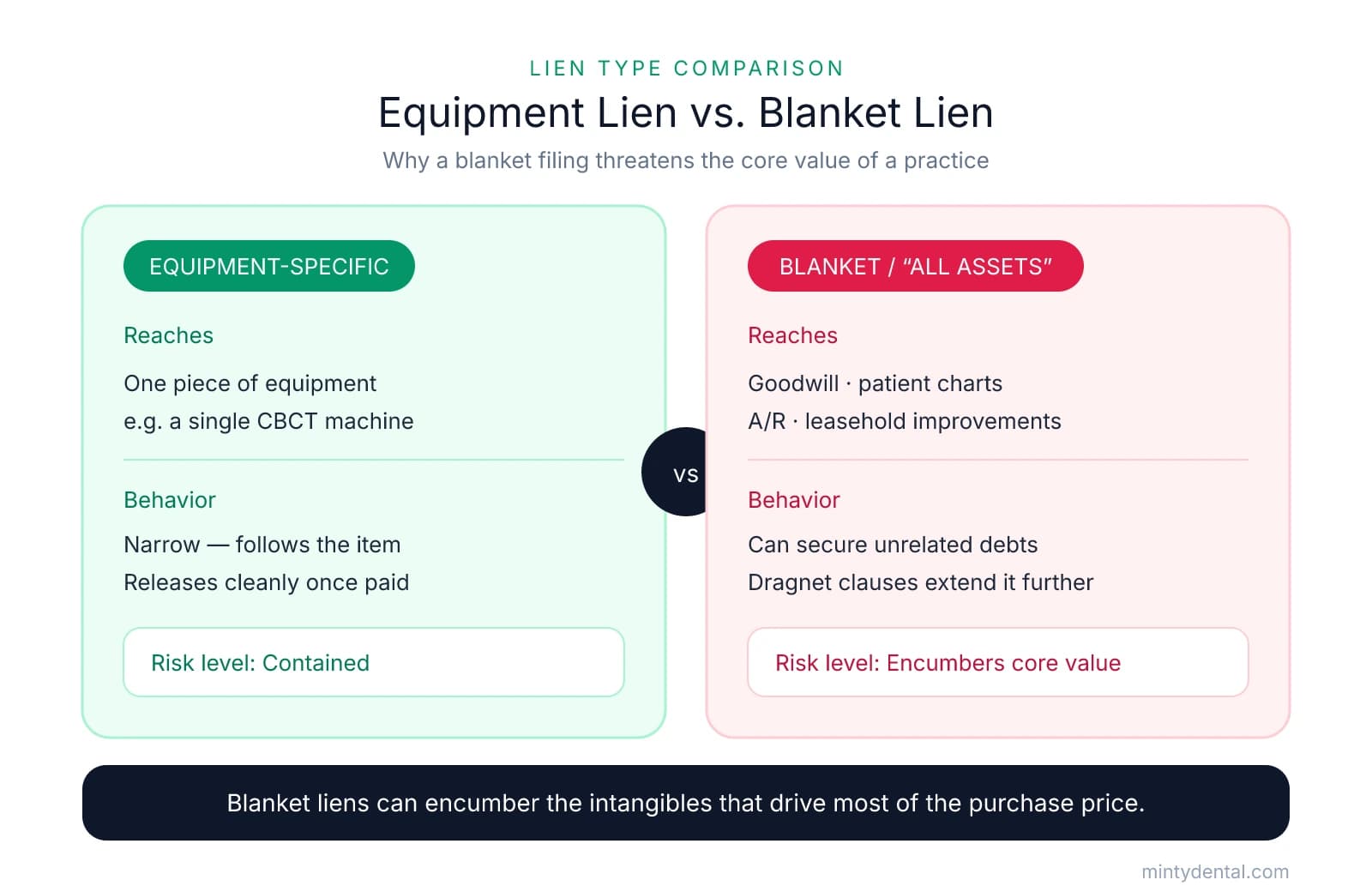
- Blanket liens are far more dangerous than equipment-specific liens because they can encumber goodwill, accounts receivable, and leasehold improvements — the core value drivers of a dental practice.
- Sellers who own side businesses represent the highest-risk profile, since a practice's strong cash flow makes it attractive collateral for unrelated loans.
A Blanket Lien Can Reach Your Practice Even When the Debt Has Nothing to Do with Dentistry
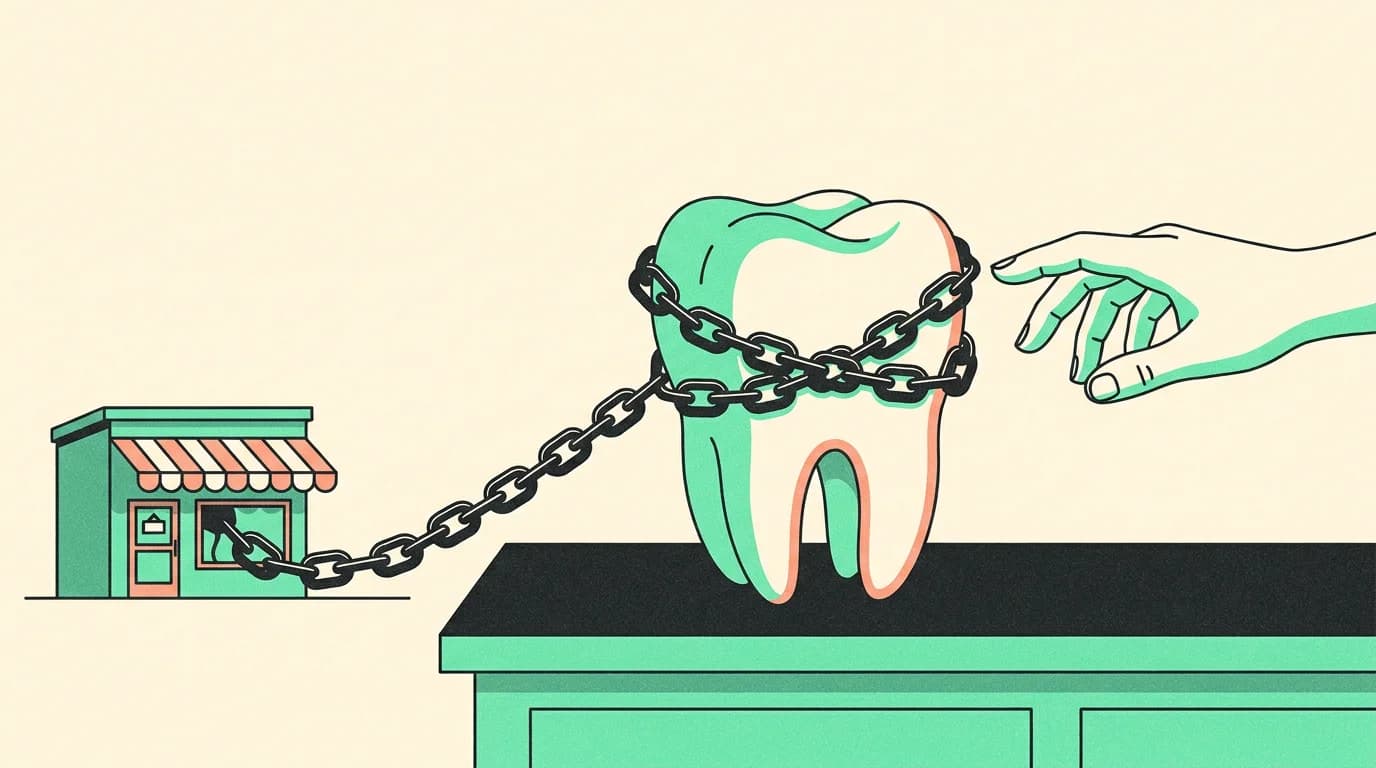
A blanket UCC lien is a security interest that gives a lender a legal claim over all — or substantially all — of a borrower's business assets, not just the specific item a loan was used to purchase. Under UCC Article 9, which governs personal property liens across all U.S. states, a lender can file a UCC-1 financing statement with the Secretary of State that encumbers everything from equipment and inventory to accounts receivable and goodwill — in a single filing, with a single collateral description.
That filing doesn't have to have anything to do with the dental practice itself.
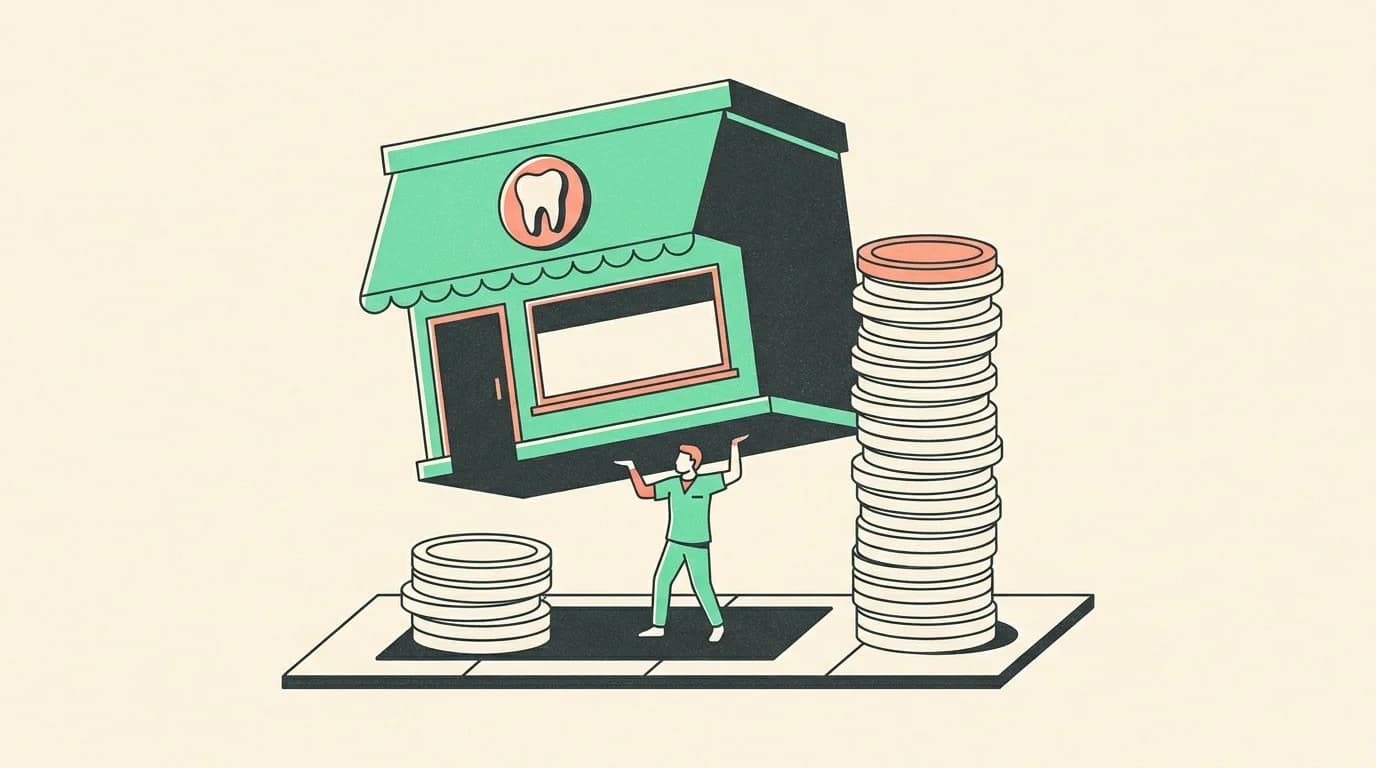
Picture a dentist who opens a restaurant on the side. To finance the buildout, they take out a business loan — and the lender, following standard practice, files a UCC-1 against "all assets" of the borrower. Lenders use that broad language routinely because itemizing specific collateral creates gaps; a blanket description closes them. The result: the dentist's practice — its patient charts, leasehold improvements, accounts receivable, goodwill — is legally encumbered by a debt that has nothing to do with dentistry. As Menlo Transitions describes it, it's the lender's way of putting an invisible "reserved" sticker on assets so other creditors and buyers can see those assets are tied up.
This is meaningfully different from the equipment-specific liens most buyers watch for. A lien tied to a specific CBCT machine is narrow — it follows that piece of equipment and releases cleanly once satisfied. A blanket lien sweeps in the intangible assets that often represent the majority of a practice's purchase price: the patient base, the brand, the lease rights, the revenue pipeline. If that lien isn't resolved before closing, the buyer can inherit a practice where the seller's lender has a superior claim to its most valuable components.
The risk compounds further with cross-collateralization clauses — sometimes called dragnet clauses — buried in loan agreements. These provisions extend a lien filed for one loan to automatically cover all debts the borrower owes the same lender, including future borrowing. A seller might have satisfied the original restaurant loan, but if they later took out a line of credit with the same bank, the original UCC-1 filing may still be active and now securing that new debt.
What makes this easy to miss is that sellers aren't legally required to disclose UCC filings. The filings are public record, but finding them falls entirely on whoever is doing due diligence. Many first-time buyers — reasonably focused on financials, equipment condition, and patient retention — never think to run a lien search against the seller's name, especially when the practice itself appears debt-free. Understanding the full scope of what a UCC search should cover is something the buyer's guide to equipment liens addresses in detail, but blanket liens require a broader lens than equipment checks alone.
Sellers with side ventures — real estate holdings, restaurants, retail businesses — represent the highest-risk profile here. A dental practice generating strong, predictable cash flow is exactly the kind of asset a lender wants in a blanket filing. That's not a flaw in the seller's character; it's just how business lending works. But it's a pattern worth knowing before you reach the closing table.
How to Run the Lien Search That Most Buyers Skip
The good news: this search is entirely doable without a law degree, and most of it costs nothing. The harder part is knowing where to look — because a clean equipment lien search won't catch the blanket filings described above.
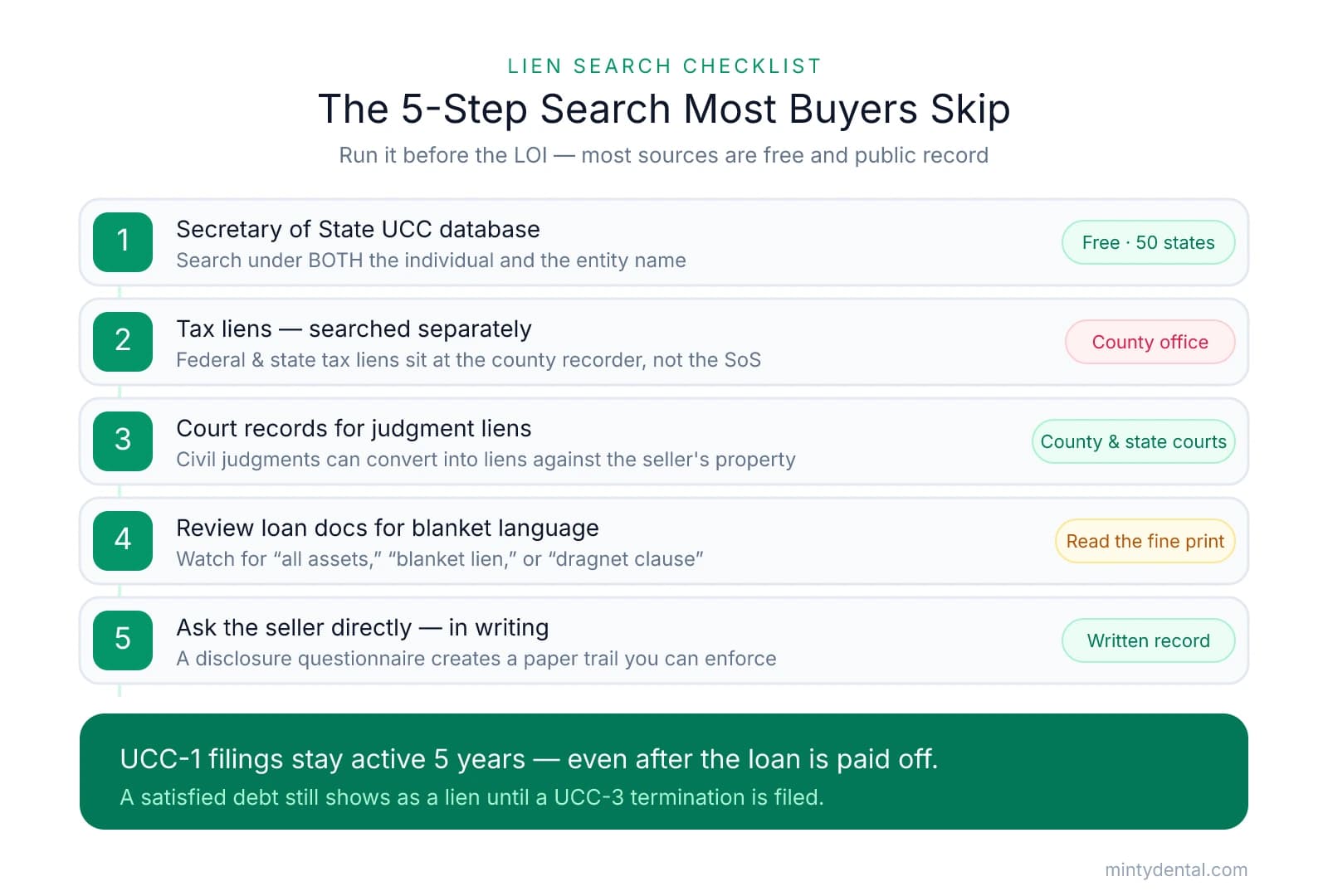
1. Search the Secretary of State's UCC database — under both names
Start with the state where the seller's business is registered. NASS.org links directly to all 50 state UCC search portals, most of which are free. Run the search twice: once under the seller's individual name and once under the business entity name (e.g., "Smith Dental LLC"). Blanket filings tied to a side business may appear under the individual, while practice-specific filings often appear under the entity — you need both.
One thing many buyers don't realize: UCC-1 filings remain active for five years from the filing date and don't automatically terminate when the underlying loan is paid off. If a lender never filed a UCC-3 termination statement, a satisfied debt can still appear as an active lien. When you see a filing, request written confirmation from the seller, and if needed, ask the lender directly to file the UCC-3.
2. Search for tax liens separately
Tax liens don't appear in the Secretary of State's database. The IRS files federal tax liens with the county recorder's office where the debtor lives or operates; state tax liens follow a similar but jurisdiction-specific process. A seller with unresolved payroll tax issues — a risk worth understanding in its own right — may have liens that only surface through these separate searches.
3. Check court records for judgment liens
Civil judgments can be converted into liens against a debtor's property. Search the relevant county and state court records for any judgments entered against the seller or their business entities — judgment liens are commonly missed when buyers focus only on UCC filings.
4. Review the seller's loan documents for blanket language
Ask for copies of all outstanding loan agreements. In the collateral description section, look for phrases like "all assets," "blanket lien," or "dragnet clause" — signals that a single filing may reach further than the loan it was written for.
5. Ask the seller directly — in writing
A disclosure questionnaire should require the seller to list every outstanding loan, the collateral pledged, and the lender's name. This doesn't replace the searches above, but it creates a paper trail. Discrepancies between what they disclose and what the searches reveal are worth taking seriously.
Run this search early. Discovering a blanket lien the week before closing is a genuine timeline risk — lender consent, payoff coordination, and UCC-3 filings can each take weeks to resolve. Before the LOI is ideal; certainly before due diligence closes.
What Happens at Closing — and What Can Go Wrong
Understanding the lien landscape is one thing — knowing how it plays out at the closing table is where the stakes become concrete.
The standard path works cleanly when the lien is practice-specific. If a seller borrowed to purchase equipment or finance a prior acquisition, the mechanics are well-understood: the lender receives a payoff from closing proceeds, files a UCC-3 termination statement, and the buyer takes clean title. The complications multiply when the lien is tied to something else entirely.
If a seller's dental practice was swept into a blanket filing securing a restaurant or rental property loan, the lender has no particular reason to release the dental practice assets just because the practice is being sold. What tends to happen is one of three things: the lender demands full payoff of the unrelated loan before releasing any collateral; they agree to a partial release but charge a fee and require documentation that can take weeks; or — when the unrelated business is struggling — they decline to release at all, because the dental practice may be the strongest asset securing their position.
Cross-default provisions add another layer. As Messerli & Kramer explains, cross-default clauses are standard in commercial lending — a default on one loan can trigger default status across all loans with the same lender. If the seller's other business runs into trouble after closing but before the lien is formally terminated, the lender could theoretically pursue assets that were supposed to transfer free and clear.
Many commercial loan agreements also require lender consent before collateral can be sold or transferred. If the seller didn't obtain that consent, the sale itself could constitute a default on the unrelated loan — putting both parties in a difficult position at exactly the wrong moment.
Then there's the buyer's own financing. Acquisition lenders — SBA or conventional — will require clean title to practice assets before funding. An unresolved third-party lien from a creditor with no connection to the dental practice can block the buyer's loan from closing. This is one of the more frustrating scenarios in dental acquisitions: a deal fully negotiated, a buyer fully qualified, a financing package ready — held up because a lender on a restaurant loan won't release its claim on the practice's goodwill.
One structural note: buying assets rather than stock (the standard approach in dental acquisitions) does reduce lien exposure in meaningful ways, but it doesn't eliminate it. Liens that attach to specific assets being transferred must still be resolved before those assets can pass to the buyer with clean title. Asset purchase structure is a layer of protection, not a complete shield — which is why the agreement language matters so much.
The Purchase Agreement Protections That Actually Hold Up
Finding a blanket lien during due diligence isn't a reason to walk away — in most cases, it's a negotiating point and a solvable problem. What determines whether it stays solvable is how the purchase agreement is structured. The right contractual language converts a discovered lien from a closing-day crisis into a managed condition with clear resolution steps.
1. Lien-free title representation with no carve-outs The seller should represent and warrant, explicitly, that all assets being transferred are free and clear of encumbrances at closing — with no exceptions for "known" or "disclosed" liens. A carve-out for known liens is essentially permission for the problem to survive closing.
2. UCC-3 termination as a condition precedent to closing Making lien termination a closing condition rather than a post-closing obligation shifts the incentive structure entirely. Post-closing obligations are promises — and promises are harder to enforce once the seller has their money. A condition precedent means the buyer's funds don't move until the lien is formally released.
3. Escrow holdback when termination is delayed Lenders don't always file UCC-3 terminations on the same day as payoff — processing can take days or weeks. When the lien can't be confirmed terminated before closing, a portion of the purchase price held in escrow until the UCC-3 is filed keeps the buyer protected without killing the deal. The holdback amount should reflect the lien exposure, not a token figure.
4. Indemnification language covering non-practice debts Standard indemnification clauses cover practice-specific liabilities. The language needs to explicitly extend to pre-closing liens tied to the seller's unrelated businesses — the restaurant loan, the rental property line of credit, any obligation that swept practice assets into its collateral description. As ddslawyers.com notes, indemnification provisions are where post-closing risk gets allocated, and vague drafting tends to favor the seller.
5. Seller disclosure of all pledged collateral The representations and warranties section should include a specific question: have any practice assets been pledged as collateral for non-practice debts? Requiring this in writing creates a paper trail and puts the seller on record. If a lien surfaces later that contradicts their answer, the indemnification clause has teeth.
On the question of who reviews this language — the broker's attorney and the seller's attorney both have interests that don't fully align with yours. Retaining your own dental-specific attorney to review the purchase agreement isn't a formality; it's where these protections actually get negotiated into the document rather than assumed to be there.
A blanket lien caught early, with the right agreement structure in place, is a manageable problem. The negotiation leverage it creates can even work in the buyer's favor — a seller motivated to close has every reason to resolve the lien cleanly. What makes the difference is catching it before closing day, not after.
Sources & References
The data and claims in this article are drawn from the following sources. We prioritize government data, peer-reviewed research, and established industry publications to ensure accuracy.
- UCC Security Agreements Guide: Blanket Liens & Filing How-To— thelangelfirm.com
- Liens, Loans & Lost Sleep: Avoid Surprises When Selling a Practice— www.menlotransitions.com
- UCC Filings— www.nass.orgIndustry
- Hot Topics in Commercial Lending: Cross-Default and Cross ...— messerlikramer.comIndustry
- What Practice Owners Need to Understand About Post ...— ddslawyers.com
Navigate Liens Before Buying Your Practice
Discovering liens during due diligence is critical, but navigating the acquisition process requires expert guidance. Minty's acquisition specialists help you identify and address collateral issues from initial search through closing.