Referral-Dependent Revenue Risk in Dental Specialty Practices

Co-Founder, Minty Dental

In Summary
- In specialty dental practices, up to 90% of revenue can originate from GP referrals — meaning you're often buying the seller's relationships as much as the practice itself
- A referral source report (24–36 months, broken down by referring dentist) is the most important due diligence document in a specialty acquisition — more revealing than the P&L
- High referral concentration (top 3 referrers accounting for more than 50% of revenue, or any single source above 25%) warrants a price reduction, earnout structure, or both
- A structured seller transition of 6–12 months — with defined introduction obligations — is one of the highest-leverage protections a buyer can negotiate
- Referral risk is measurable and manageable; buyers who audit it carefully and execute a deliberate transition plan can turn it into a competitive advantage
Specialty Practice Revenue Is Only as Durable as the Referral Relationships Behind It
When you evaluate a general dental practice, the patient base is largely self-sustaining. Patients return for hygiene, respond to recall systems, and develop loyalty to the office itself — not just the dentist. Specialty practices work differently. In endodontics, oral surgery, periodontics, and orthodontics, the majority of new patients don't find the practice on their own. They arrive because a general dentist sent them.
That distinction matters enormously when you're considering an acquisition.
According to the AAE's 2026 Referral Patterns Survey, approximately 90% of root canal treatments performed by endodontists originate from GP referrals, with the average endodontist drawing from a referring network of just 20–30 general dentists. That's a narrow foundation for a practice generating hundreds of thousands — or millions — in annual collections.
Referral dependency in specialty practices: In endodontics, approximately 90% of procedures originate from GP referrals — which means the practice's revenue is, in effect, a vote of confidence in the selling dentist, not the practice itself.
The same structural reality plays out across specialties, though the degree varies. Oral surgeons depend on GPs for implant placements and extractions. Periodontists rely on referrals for surgical and maintenance cases. Even orthodontics — which has more direct-to-consumer marketing than most specialties — still leans heavily on GP relationships, particularly for younger patients. If you're evaluating an orthodontic acquisition as a general dentist, the referral dynamics involved deserve specific attention.
Here's where the due diligence gap opens up: standard financial review tells you what revenue looked like over the past three years. It doesn't tell you why that revenue existed — or whether it will continue once the seller is no longer the one returning calls, attending study clubs, and maintaining relationships built over a decade.
Referral relationships are personal and informal by nature. A GP refers to a specialist they trust, whose clinical communication they respect, and whose patients come back with good outcomes and a kind word. None of that transfers automatically with a bill of sale.
What tends to happen in poorly structured acquisitions isn't a sudden drop in referrals — it's a slow erosion. A few GPs quietly start sending cases elsewhere. Collections dip 10–15% in the first year. By the time the pattern is undeniable, it's been 18 months since closing, and the connection to the ownership change is easy to rationalize away. That's the risk worth understanding before you make an offer — not to avoid specialty acquisitions, but to approach them with the right questions.
How to Audit Referral Concentration Before You Make an Offer
Understanding that referral risk exists is one thing — measuring it before you commit is another. The good news is that this risk is largely quantifiable if you know what to request and how to interpret what you receive.
Step 1: Request the Referral Source Report
The single most important document in a specialty acquisition isn't the P&L — it's a referral source report broken down by individual referring dentist, showing patient volume and revenue contribution for the past 24–36 months. As MedBridge Capital notes, referral concentration is one of the first risk metrics buyers examine in healthcare M&A, and requesting this data is standard practice in these transactions.
If a seller or broker resists providing it, that resistance is itself informative.
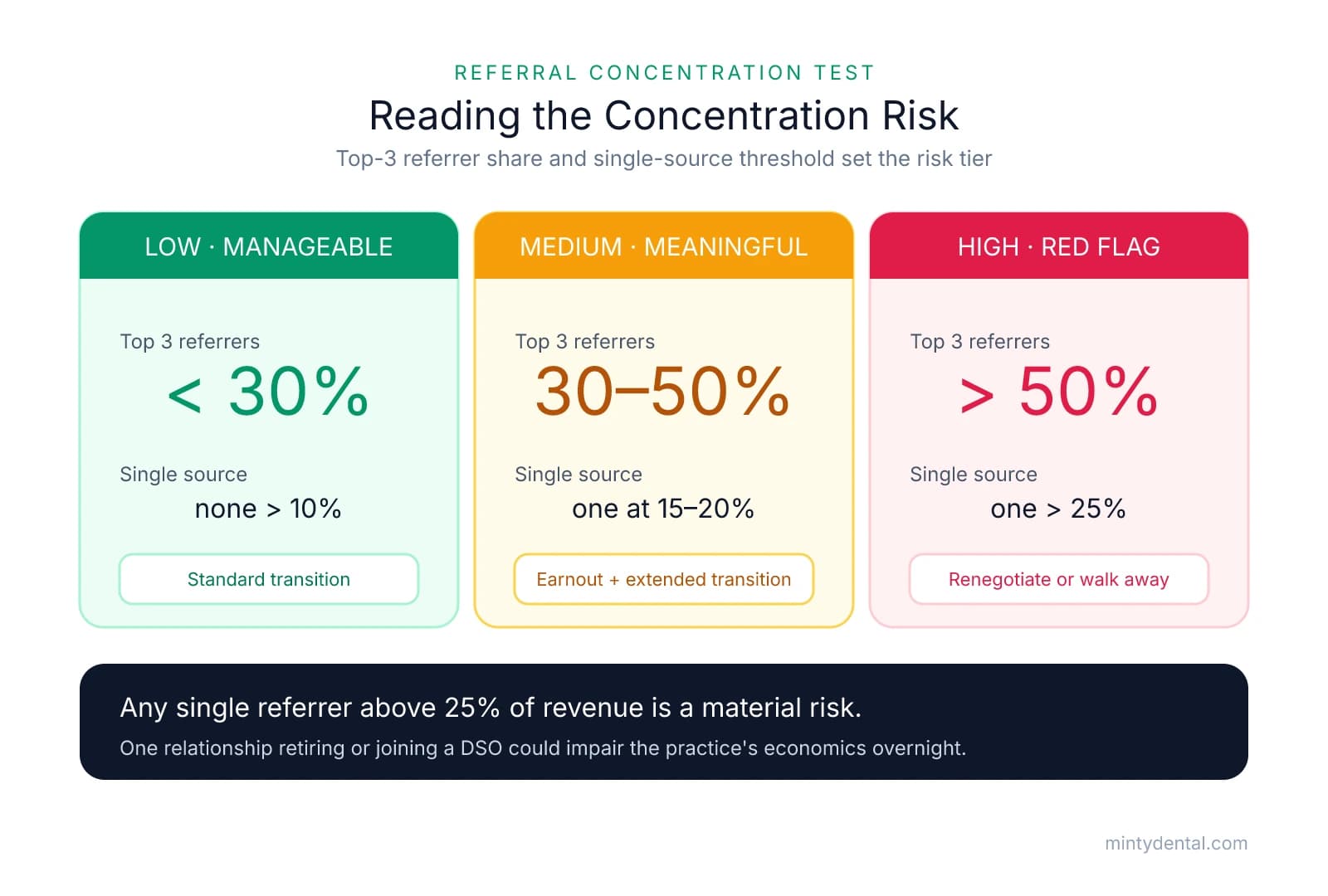
Step 2: Apply a Concentration Test
Once you have the data, run a simple concentration analysis:
| Concentration Level | Revenue from Top 3 Referrers | Single-Source Threshold | Risk Level | Suggested Response |
|---|---|---|---|---|
| Low | < 30% | No single source > 10% | Manageable | Standard transition planning |
| Medium | 30–50% | One source at 15–20% | Meaningful | Structured earnout; extended transition |
| High | > 50% | One source > 25% | Red flag | Renegotiate price or walk away |
A single referring practice accounting for more than 20–25% of revenue warrants serious scrutiny. That one relationship retiring, joining a DSO, or simply cooling off post-transition could materially impair the practice's economics.
Step 3: Analyze Trend Lines, Not Just Totals
A three-year referral report tells you more than a snapshot. Look at whether the referral base is growing, stable, or quietly contracting. According to the AAE's 2026 Referral Patterns Survey, 80% of endodontists gain new referring dentists in a given period — but 65% also lose at least one. Referral churn is normal; what matters is the net direction. A practice with flat collections but a shrinking referral base is a different risk profile than one where new relationships are replacing old ones.
Step 4: Investigate the Nature of Key Relationships
For any referring practice contributing more than 10–15% of revenue, dig into the relationship itself:
- How long has the relationship existed, and did it predate the current owner?
- Has the seller ever successfully introduced an associate or locum to those referring dentists — or does every referral flow through the seller personally?
- Is the relationship based on friendship, or on systems, clinical reputation, and proximity that would survive a transition?
The last question is worth raising directly in seller conversations. A seller who struggles to articulate why a key referrer sends cases — beyond "we go way back" — is telling you something important.
Step 5: Check for DSO Affiliation Among Top Referrers
Run a quick check on whether any top referring practices are DSO-owned or part of a group with in-house specialty capabilities. DSOs increasingly consolidate referrals within their own networks or negotiate preferred arrangements with affiliated specialists. A referring practice that gets acquired post-closing could redirect volume overnight — with no bad intent and no recourse for you.
This connects to a broader structural headwind worth factoring into any specialty acquisition: the trend of GPs bringing basic specialty procedures in-house. In endodontics and orthodontics especially, more "basic" specialty services are being absorbed across the general practitioner pool — a slow-moving but real compression on referral volume that affects long-term projections regardless of who owns the practice.
How Referral Risk Should Change Your Valuation and Deal Structure
Once you've mapped the referral concentration picture, the next question is what to do with it — and the answer isn't necessarily to walk away. It's to make sure the deal structure reflects the risk you've just measured.
Referral Concentration Is a Valuation Discount Factor
In healthcare M&A broadly, predictability drives price. When referral concentration is high, predictability weakens — and sophisticated buyers adjust accordingly. As MedBridge Capital notes, buyers routinely apply lower multiples or require earnout structures when referral durability is uncertain. In physical therapy transactions, referral concentration below 25% from any single source is commonly cited as a condition for top-of-band valuations. The same logic applies in dental specialty acquisitions.
A practice where three referring dentists account for 60% of revenue isn't worth the same multiple as one where that revenue is spread across 30 relationships — even if the collections figures are identical. The headline number looks the same; the durability doesn't.
The Earnout as a Risk-Sharing Tool
An earnout structures a portion of the purchase price as contingent on post-closing performance — typically over 12–24 months. In the context of referral risk, this is less a punitive tactic than a fair mechanism for bridging a valuation disagreement. As Oral Health Group explains, earnouts allow buyers and sellers to disagree on value but still complete a transaction — the seller captures upside if referrals hold; the buyer is protected if they don't.
A reasonable structure might tie 15–25% of the purchase price to referral retention benchmarks: if collections from the top referring practices remain within a defined range at 12 and 24 months post-closing, the earnout pays out. If they erode, the buyer's effective purchase price adjusts downward.
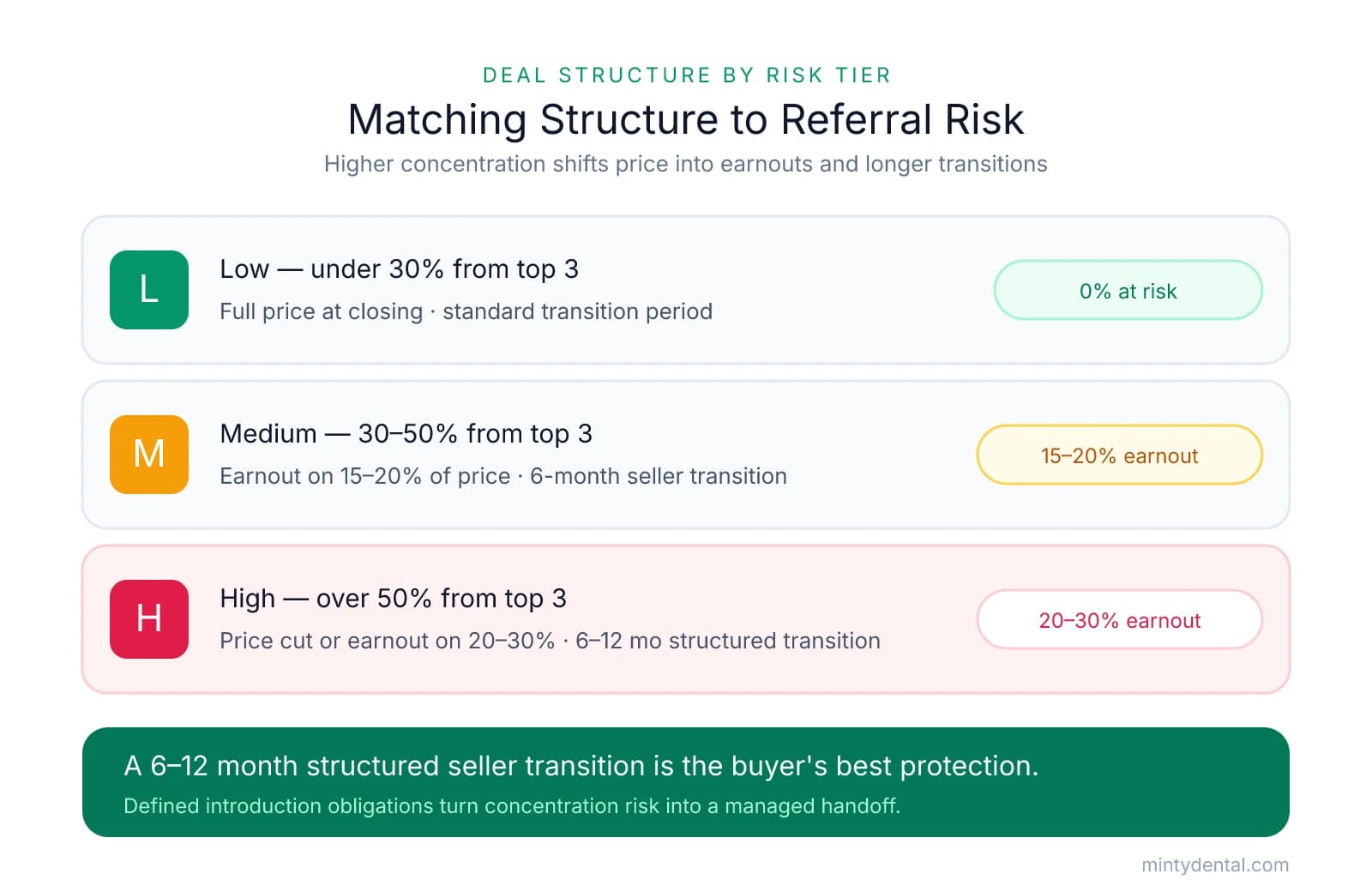
Deal Structure by Concentration Level
| Referral Concentration | Suggested Structure |
|---|---|
| Low (< 30% from top 3) | Full price at closing; standard transition period |
| Medium (30–50% from top 3) | Earnout on 15–20% of price; 6-month seller transition |
| High (> 50% from top 3) | Price reduction or earnout on 20–30%; 6–12 month structured transition with defined referral introduction obligations |
The Seller Transition Period Is Worth More Than Most Buyers Realize
For a specialty practice with concentrated referrals, a structured seller transition — ideally 6–12 months — during which the seller actively introduces the buyer to key referring dentists is one of the most valuable protections available. This isn't just a courtesy period; it should carry defined obligations: joint visits to referring offices, co-signed clinical communications, and explicit handoff milestones. The terms of a seller employment agreement are worth negotiating carefully with this goal in mind.
Personal Goodwill vs. Enterprise Goodwill
Not all goodwill transfers equally. As CBIZ outlines, dental practice goodwill includes both enterprise goodwill — tied to systems, location, and brand — and personal goodwill tied to the individual practitioner's relationships and reputation. In a referral-dependent specialty practice, a meaningful share of the purchase price may reflect personal goodwill that doesn't automatically transfer. Understanding that distinction helps calibrate what you're actually paying for.
How Lenders View Referral Concentration
Lenders evaluate referral durability too. A practice with high referral concentration may face tighter loan terms, additional documentation requirements, or closer scrutiny of post-closing cash flow projections. Understanding what banks look for when financing a dental practice acquisition can help you anticipate these conversations and prepare accordingly.
Building Your Own Referral Base After Closing
The referral audit, the concentration analysis, the earnout negotiation — all of that work is preparation. What actually determines whether the practice thrives is what happens in the first 90 days after you take ownership.
Referring GPs are watching during that window, whether they say so or not. They want to know whether the new specialist is clinically sharp, whether their patients come back with good experiences, and whether they'll get a timely case report. As Specialized Dental outlines, the factors GPs weigh most heavily — clinical outcomes, communication quality, accessibility, and patient experience — are all within your control from day one. Referral retention isn't a passive outcome; it's something you can actively shape.
A structured introduction plan during the seller's transition period is one of the highest-leverage things a buyer can do. Joint visits to key referring offices, co-signed letters introducing you to the referring dentist community, and a clear protocol for case updates signal continuity and competence at exactly the moment when referring dentists are forming their first impressions. If you've negotiated a meaningful seller transition period, use it deliberately for this purpose.
Beyond protecting what you've inherited, think about growth from day one. Map the referring practices in your market that currently send cases to competitors — these aren't just fallback options if a legacy relationship cools, they're genuine growth opportunities. A buyer who is relationship-focused and clinically strong can expand the referral base even while some older relationships are still finding their footing.
The data supports this optimism. Industry surveys consistently show that most endodontists gain new referring dentists in any given period — referral relationships are dynamic, built and rebuilt continuously, which means a motivated new owner isn't starting from a fixed position.
For orthodontics and implant-related specialties, direct-to-patient marketing offers a longer-term path to reducing referral dependency. It won't replace GP relationships in year one, but budgeting for it early — even modestly — starts building a parallel acquisition channel. Thinking through how much to allocate in your first year is worth doing before closing, not after.
The buyer who completes a thorough referral audit, structures the deal to reflect what they find, and executes a deliberate transition plan is in a fundamentally different position than one who treats referral revenue as a given. The risk is real — but it's also measurable, manageable, and, with the right approach, something you can turn into a competitive advantage.
Sources & References
The data and claims in this article are drawn from the following sources. We prioritize government data, peer-reviewed research, and established industry publications to ensure accuracy.
- More Dentists Are Referring to Endodontists, New AAE Survey Finds— newsroom.aae.orgNews
- How Referral Concentration Impacts Healthcare Practice ...— medbridgecapital.com
- Dental Specialist Marketing and The State of Specialty Referrals— themcanallysellingsystem.comIndustry
- Earnouts in dental practice acquisitions: What you need to ...— www.oralhealthgroup.comIndustry
- Dental Practice Goodwill: How to Identify, Measure, and ...— www.cbiz.com
- How Endodontists Earn Referrals from General Dentists— specializeddental.comIndustry
Ready to diversify your specialty practice revenue?
Referral concentration creates real financial vulnerability for specialty practices. Whether you're evaluating a practice acquisition or strengthening an existing one, understanding revenue stability is critical to long-term success.