Dental Practice Rent Too High? What Percentage Is Normal

Co-Founder, Minty Dental

In Summary
- Facility cost percentage is your rent divided by gross collections, and it's the metric that actually tells you whether your space is affordable.
- The normal range for facility costs runs 7 to 10% of collections; above 12% is a warning sign that requires action.
- Rent is a fixed cost, so when collections drop, your facility cost percentage rises automatically, even if your lease hasn't changed.
- On a NNN lease, your true facility cost includes base rent plus CAM charges, property taxes, and building insurance, not just the number on your monthly invoice.
- The same dollar amount of rent can be perfectly manageable at one collection level and genuinely damaging at another.
Rent Feels High Because It's Fixed While Collections Fluctuate
Facility cost percentage is the share of your gross collections consumed by the cost of occupying your space. The formula: total annual facility costs divided by gross annual collections, multiplied by 100. That single ratio is the right lens for this problem, because the raw dollar amount of your rent tells you almost nothing on its own.
A $7,500 monthly rent check feels very different depending on what's coming in. At $900,000 in annual collections, that rent runs $90,000 per year, which is exactly 10% of collections, sitting at the high end of the normal range. Industry benchmarks place the average facility cost at 7 to 10% of collections, with a warning threshold above 12%. Now suppose your hygienist leaves mid-year, a few crown cases get deferred, and collections slip to $700,000. Your rent hasn't moved. You're still paying $90,000 a year, but now that number represents 12.9% of collections. Nothing changed in your lease, and you're already into warning territory.
That's the core dynamic. Rent is a fixed cost: it doesn't scale down when a provider calls out sick, when a major payer cuts reimbursement rates, or when case acceptance softens in a slow month. Every other revenue-related metric on your P&L can shift, and your lease stays exactly where it is. This is why a practice can feel like it has a rent problem when the real issue is underperforming collections, and why the percentage matters far more than the dollar figure. A $12,000 monthly rent is entirely manageable at $1.8 million in annual collections (8%); the same lease at $900,000 puts you at 16%, which is a serious structural problem.
One place owners get tripped up is what to include in the facility cost line. If you're on a NNN (triple net) lease, your monthly invoice has two parts: a base rent and a pass-through for common area maintenance (CAM), building insurance, and property taxes. Those pass-throughs are real occupancy costs. They belong in the numerator of your facility cost calculation alongside base rent. Leaving them out understates your true facility burden, sometimes by a meaningful amount depending on your building's operating expenses.
When you're looking at your P&L, pull both lines and add them together before you run the percentage. That full number, divided into your gross collections, is what you're actually benchmarking, and it's where a broader overhead review would start as well.
The Normal Range: 7–10%, and What Pushes You Outside It
The benchmarks here are fairly consistent across sources. Facility costs averaging 7–10% of collections, with top-performing practices at 5–7% and a warning threshold above 12%, represent the range you'll find when dental CPAs and industry analysts look across practice P&Ls. The ADA frames it slightly differently: fixed expenses as a category, including rent, insurance, taxes, and utilities, should run roughly 4–7% of production. Since rent is only one component of that fixed-expense bucket, it should sit toward the lower end of that range on its own.
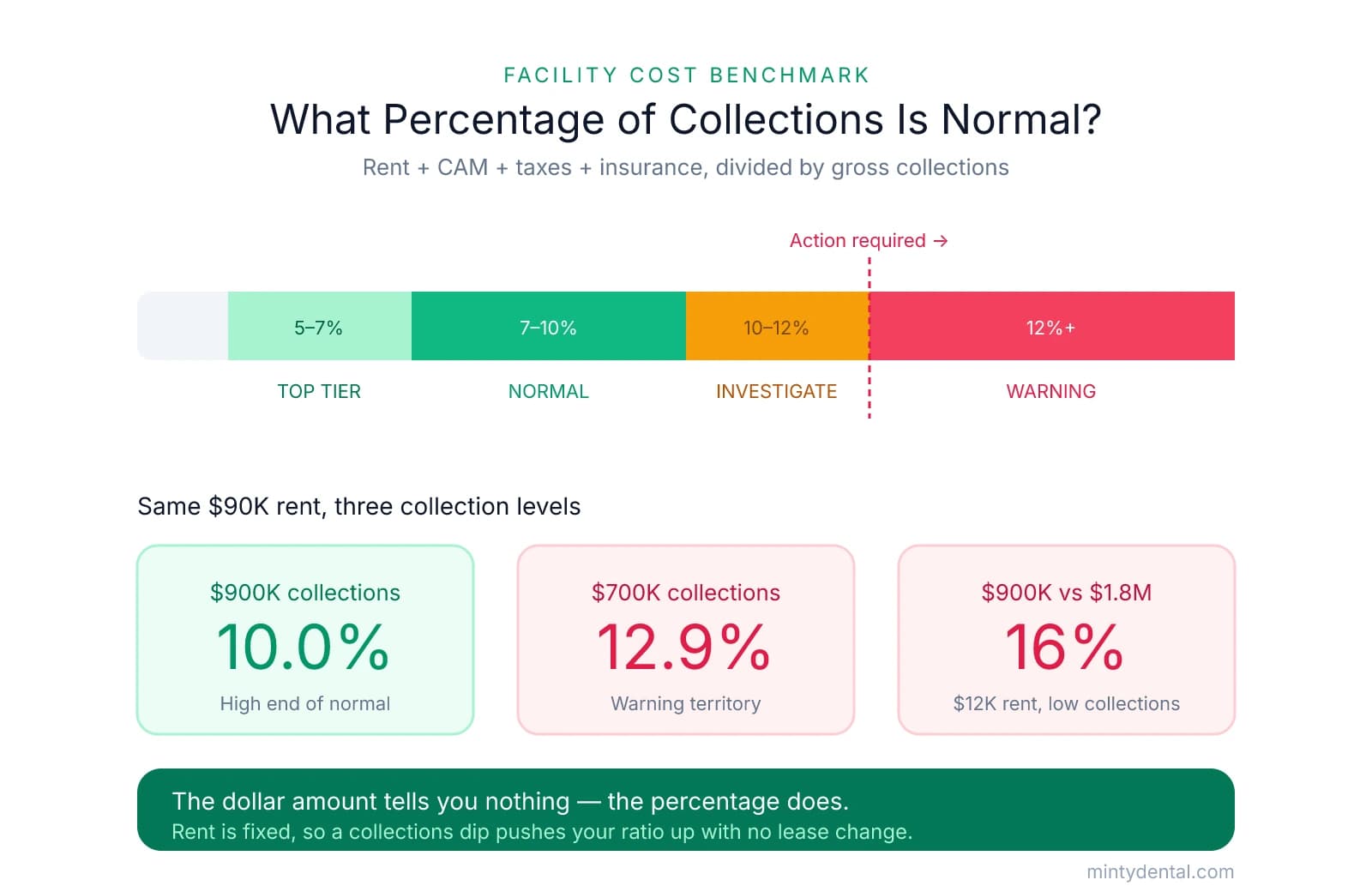
Landing in that 5–7% top-performer tier signals strong collections relative to your space or favorable lease terms, while 7–10% is an acceptable average to monitor over time. An elevated 10–12% ratio is worth investigating to see whether it's market-driven or a collections issue, and crossing 12% signals a structural problem requiring action.
The range exists because location and lease structure move the number legitimately. A practice in a dense urban market, particularly one leasing Class A medical office space, will run closer to 10–11% and still be operating normally for its market. The same ratio in a suburban strip center, where comparable space rents for half as much per square foot, signals something worth looking at. Location context matters before you conclude the number is a problem. This is one of the key practice metrics worth tracking month to month alongside collections so you catch a drift early rather than at renewal time.
When the percentage does land outside the normal range, there are only two root causes, and they call for completely different responses.
First, the rent dollar amount may be genuinely above market. This happens when a landlord builds in annual escalators that compound over a long lease term, when the practice signed under pressure in a competitive location, or when the surrounding market has softened since the lease was executed. In this situation, the rent itself is the problem, and the lever is renegotiation or relocation.
Second, collections may be underperforming relative to the space. The rent may be perfectly reasonable for the square footage and the market, but the practice isn't producing enough to dilute the fixed cost. Unfilled operatory time, heavy PPO write-off drag, and lost production volume from a departed provider can all push the percentage up without the lease changing at all. Here, renegotiating the rent doesn't fix anything; growing collections does.
When the Rent Is the Problem: How to Renegotiate Your Lease
If you've confirmed that your rent dollar amount is genuinely above market, not just a collections shortfall in disguise, the path forward is negotiation. Most practice owners wait until the landlord sends a renewal notice, which typically arrives 60 to 90 days before expiration. At that point, you have almost no leverage. Moving a practice is expensive and disruptive, your landlord knows it, and a 60-day window doesn't give you time to credibly threaten anything.
Start the process 12 to 18 months before your lease expires. That timeline gives you enough runway to pull market comps, tour competing spaces, and run parallel negotiations with multiple landlords before your current landlord even knows you're looking.
Comps first, then the conversation. Before you approach your landlord, you need to know what comparable dental and medical spaces in your market are actually trading for. Not what your landlord says the market is, but what new tenants in similar buildings nearby are signing. That data is your foundation. Without it, any number your landlord quotes sounds reasonable.
This is where a tenant-only healthcare real estate broker earns their value. The key word is tenant-only: a broker who represents both sides has a structural conflict. A broker working exclusively for tenants brings market data, knows what concessions landlords are offering new tenants in your building, and runs the competing-space strategy that actually moves a landlord to act. These brokers are typically free to the tenant, with fees paid by the landlord, so there's no financial reason to negotiate alone.
The competing-space strategy matters more than most owners expect. Tenants who negotiated with at least two alternative spaces simultaneously reduced rental rates by 13% more than those negotiating with a single landlord. A landlord who knows you're in active conversations with two other properties has to be competitive, while a landlord who knows you're probably staying because your buildout is here can offer whatever they like. Credible relocation posture, not a politely worded email asking for a reduction, is what creates movement.
What's actually on the table at renewal. Owners often assume renewal just means haggling over the base rent rate. There's more to negotiate than that:
- Base rent rate, which can often be held flat or reduced if market comps support it
- Annual escalation percentage, commonly set at 3% per year in existing leases but negotiable down
- Tenant improvement allowance, which landlords can offer at renewal, not only at initial signing, particularly if you're committing to another long term
- Free-rent months, a period at the start of the new term where no rent is due
- NNN pass-through caps, which limit how much CAM charges, property taxes, and building insurance can increase year over year
That last item is easy to overlook. If your NNN pass-throughs are uncapped, a landlord can pass along significant operating cost increases without touching the base rent line. Over a five or ten-year term, uncapped CAM escalation can quietly push your true facility cost well above what your lease rate implies. Negotiating an annual cap on pass-through increases, often in the 3 to 5% range, keeps that number predictable. The lease term you commit to also affects how much leverage you have on these terms: a longer commitment gives the landlord more certainty and typically makes them more willing to offer concessions.
When Collections Are the Problem: Growing Into Your Space
If you've confirmed your rent is at or below market rate, the lease isn't the problem. The percentage is high because the denominator is too small. And because rent is fixed, the math works in your favor once collections start moving: every additional dollar collected reduces your facility cost ratio without a single conversation with your landlord.
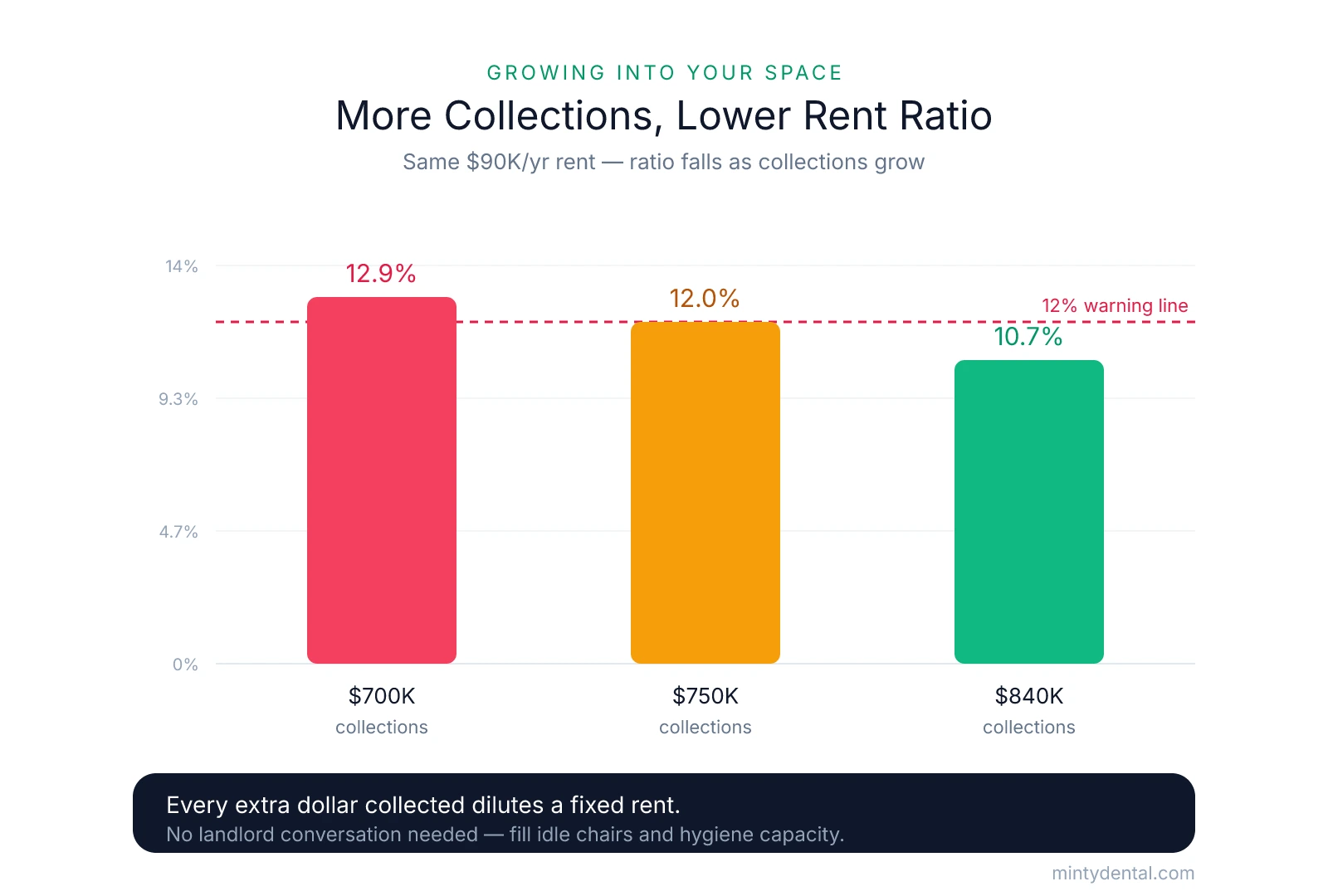
Take that hypothetical practice paying $90,000 per year in rent with $700,000 in collections, sitting at a 12.9% facility cost ratio. If that same practice grows collections to $750,000, the ratio drops to 12.0%, and at $840,000, it's down to 10.7%. Nothing in the lease changed and the rent check is identical; what shifted is how many revenue-generating appointments were happening inside that space.
That's the production-side opportunity in practices with idle capacity, and it starts with operatory utilization. Pull up your schedule and look honestly at how many chairs are running, and how many hours per day each one is actually occupied. A four-operatory practice where two chairs run full days and two open intermittently has meaningful capacity sitting unused. The square footage, and the rent for it, is being paid whether those chairs are producing or not.
Production per clinical hour is the most direct measure of whether you're using your space efficiently. A practice with consistent open time in the doctor's schedule has a utilization problem. One with a full schedule but low hourly production has a different problem, typically case mix or fee structure. Both suppress collections, but they point to different fixes.
Hygiene is the other major lever. A hygiene department running below capacity means your facility cost is being spread over fewer revenue-generating appointments every day. If you're not sure whether hygiene is actually the bottleneck, the question to ask is whether adding hygiene days would generate more appointments or just more available slots that go unfilled. The distinction matters: capacity you can't fill doesn't help your rent ratio.
One place the production picture can be misleading is PPO write-off drag. A practice writing off 40 to 45% in insurance adjustments may look busy by any scheduling measure, but net collections are significantly lower than gross production. Practices in heavy PPO markets often find that fee negotiation moves the needle more than additional volume because it lifts every procedure rather than requiring more chair time. If your write-off rate is that high, looking at your fee position and plan mix alongside the rent ratio is worth doing before you conclude that more appointments are the only path. Understanding your options for renegotiating PPO fees can have a meaningful effect on net collections without adding a single appointment.
Start by looking at your schedule from the last 90 days: what percentage of available chair hours were filled, what did each clinical hour produce, and where is the open time clustering? That record tells you whether an elevated rent ratio is a real estate problem or a capacity problem.
Sources & References
The data and claims in this article are drawn from the following sources. We prioritize government data, peer-reviewed research, and established industry publications to ensure accuracy.
- Dental Office Overhead Percentages: 2026 Report— dentimax.comIndustry
- What Should Dentists Consider When Negotiating and ...— helsell.comIndustry
- Ask the Expert: Practical strategies to reduce dental practice ...— adanews.ada.orgIndustry
- How to Save Money During a Lease Renewal Negotiation— carr.usIndustry
- Tips for negotiating the best dental office lease— www.dentistryiq.comNews
- How Much Rent Should a Dentist Pay? - Practice Biopsy— www.practicebiopsy.comIndustry
Cut Overhead by Fixing What Your P&L Reveals
If your facility costs are squeezing margins, the fix starts with the right systems behind your collections and overhead tracking. Minty Operations handles the business side so you can focus on the clinical decisions.