Dental Practice Add-Backs: What Lenders Actually Accept

Co-Founder, Minty Dental

In Summary
- Add-backs are expenses removed from a seller's reported costs to show normalized earning power — but sellers and lenders rarely agree on which ones count
- The seller's SDE or Adjusted EBITDA is a marketing number built to maximize price; the lender's verified cash flow is what actually drives loan approval
- Lenders reconstruct cash flow from tax returns — not P&L statements — because owners have a financial incentive to report honestly to the IRS
- Most dental-specific lenders require a debt service coverage ratio (DSCR) of 1.25x–1.35x on verified cash flow; a single disputed add-back can push a borderline deal below that threshold
- The add-back number drives cash flow, cash flow drives DSCR, and DSCR decides whether the loan gets approved — getting the add-backs wrong means everything downstream is wrong
The Seller's Earnings Number and the Lender's Earnings Number Are Rarely the Same
Add-backs defined: Add-backs are adjustments to a practice's reported expenses that remove costs considered non-recurring or specific to the current owner — producing a normalized cash flow figure meant to reflect what the business would earn under new ownership.
That definition sounds straightforward. The problem is what happens next. The seller's broker uses add-backs to build an SDE or Adjusted EBITDA figure that becomes the foundation of the listing price. You receive that number, run your own projections, and build an offer around it. Then the lender's underwriter reconstructs cash flow from scratch — and comes back with a materially lower figure.
This gap isn't unusual. It's the default. The seller is incentivized to add back as much as possible, because a higher earnings number supports a higher price. The lender is incentivized to verify every dollar, because they're the one getting repaid over the next decade. You're standing in the middle, relying on a number built by the party with the most to gain from inflating it.
A pattern worth understanding early: lenders don't underwrite from P&L statements. They reconstruct cash flow from tax returns — what the owner reported to the IRS. P&Ls are more descriptive and granular, but tax returns are treated as more reliable because owners have a direct financial incentive to report expenses honestly to the government. The add-back that looks clean on a broker's recast spreadsheet may not survive contact with three years of Schedule C or corporate returns.
This is where the two-number framework becomes useful. There's the add-back number you believe — built from conversations with the seller, site visits, and your operating assumptions. And there's the add-back number the bank will credit — independently verifiable from tax returns and supporting documentation. Both feel real. But your deal has to work under the bank's model, not yours.
The stakes are concrete. Most dental-specific lenders require a DSCR of 1.25x–1.35x on verified cash flow — meaning for every dollar of annual debt service, the lender needs to see $1.25 to $1.35 in confirmed earnings. A single disputed add-back — say, $40,000 in owner compensation adjustments the lender won't credit — can move a borderline deal from approved to declined. Because the add-back figure flows directly into cash flow, which flows directly into DSCR, getting it wrong at the start means every downstream number is built on a faulty foundation.
Learning to read the underlying financials before you accept a seller's recast is one of the most protective steps a buyer can take — not to second-guess the broker, but to understand which add-backs will hold up when the lender runs the same exercise.
A Three-Tier Framework for Reading Any Add-Back Schedule
The most useful mental shift when reviewing an add-back schedule is to stop asking "does this make sense?" and start asking "can a lender independently verify this from a tax return or receipt?" Those two questions produce very different answers — and the second is the only one that matters for loan approval.
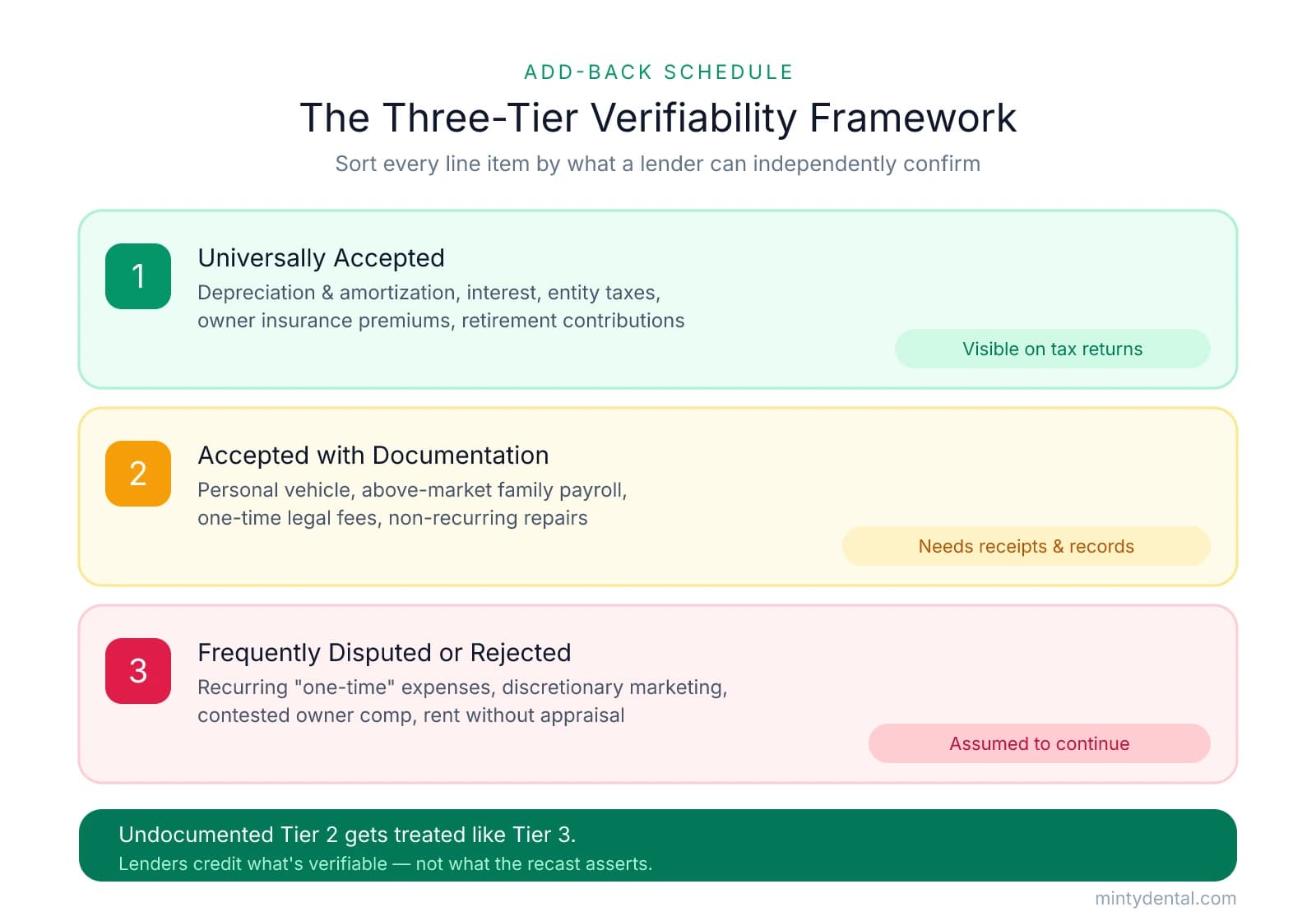
A practical way to apply this is to sort every line item on the seller's add-back schedule into one of three tiers before you build your offer.
| Tier | Category | Examples | What Lenders Need |
|---|---|---|---|
| 1 — Universally Accepted | Mechanical add-backs rarely disputed | Depreciation & amortization, interest expense, entity-level income taxes, owner health/life insurance premiums, retirement contributions | Visible on tax returns; no additional documentation typically required |
| 2 — Accepted with Documentation | Personal or non-recurring items requiring proof | Personal vehicle expenses, family member compensation above market rate, one-time legal or consulting fees, non-recurring repairs | Receipts, bank statements, payroll records, or written explanation tied to a specific event |
| 3 — Frequently Disputed or Rejected | Items lenders scrutinize or decline outright | "One-time" expenses that appear every year, marketing spend the seller claims is discretionary, above-market owner compensation where replacement cost is contested, rent adjustments without a formal appraisal | Often unverifiable or structurally ambiguous — lenders assume the expense continues |
One nuance that catches many buyers off guard: the owner salary add-back is not simply the seller's full compensation. Lenders add back what the seller paid themselves, then subtract what a replacement dentist — or you, if you're practicing — would need to earn. Only the net difference gets credited. If the seller paid themselves $350,000 and a market-rate associate would cost $220,000, the creditable add-back is $130,000, not $350,000. Overstating this line is one of the most common ways seller-prepared recasts diverge from lender underwriting.
The verifiability principle runs through all three tiers: lenders credit what can be independently confirmed from tax returns, receipts, and financial statements — not what the seller or broker asserts on a recast P&L. A Tier 2 add-back that arrives without documentation gets treated like a Tier 3 item. A Tier 3 item with unusually strong documentation might survive underwriting — but it's the exception, not the expectation.
Industry analyses have found financial discrepancies in more than 40% of small business acquisitions, in some cases making a business appear more than twice as profitable as it actually is. Dental practices aren't immune — and add-back inflation is one of the primary mechanisms.
A reputable Quality of Earnings report can sometimes substitute for tax-return-only underwriting, giving lenders a more granular verified picture of cash flow. But for a first acquisition, most dental-specific lenders will default to tax returns regardless. It's worth asking your lender early whether they'll accept a QoE — and factoring that answer into how much weight you give Tier 2 items on the seller's schedule.
The same scrutiny that applies to add-backs extends to revenue quality. Just as payer mix can affect your borrowing capacity, the composition of cash flow — not just the headline number — shapes what a lender will ultimately credit.
The Add-Back Categories Most Likely to Blow Up a Dental Deal
With the three-tier framework in place, it's worth going deeper on the specific line items that most reliably create friction between a seller's recast and a lender's verified number. These aren't edge cases — they're the categories that appear in a large share of dental acquisitions and tend to produce the biggest gaps.
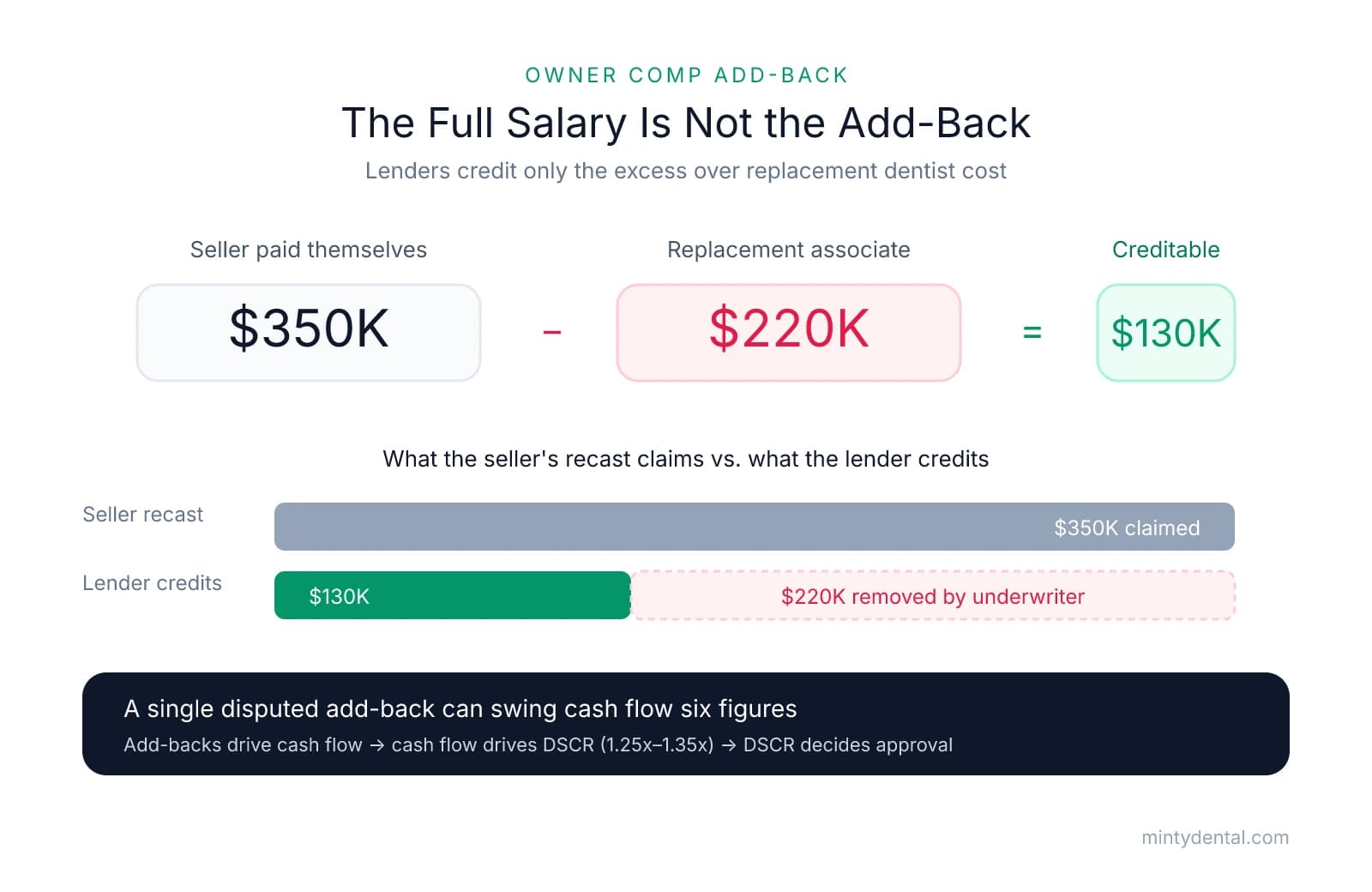
Owner compensation is the one that surprises buyers most often. The full seller salary is not the add-back. Lenders normalize to the cost of replacing the seller with a market-rate associate dentist, then credit only the excess. If the seller paid themselves $350,000 and a replacement dentist in that market commands $250,000, the creditable add-back is $100,000 — not $350,000. Many broker-prepared recasts present the full compensation figure without netting out replacement cost, which can overstate cash flow by six figures in a single line item.
Family member payroll follows similar logic. A spouse or child on payroll may be a legitimate add-back if the buyer genuinely won't need that function. But if the role is real — front desk coordination, billing management, office administration — the lender will ask what it costs to replace it. Buyers often get caught assuming the full payroll amount gets added back, when in practice the lender nets out a market-rate replacement cost for any function the practice actually requires.
Recurring "one-time" expenses are a pattern worth watching carefully. A legal fee appearing in year one is plausibly non-recurring. The same fee appearing in years one, two, and three is an operating cost — and lenders treat it that way. Pull three years of returns and flag any "one-time" item that appears more than once. That repetition is usually enough for an underwriter to reclassify it.
Personal expenses buried in operating categories — vehicle costs labeled "transportation," personal travel labeled "continuing education," meals labeled "staff appreciation" — are common and often partially credited. Lenders want receipts and bank statements, and even with documentation, they may credit 50–70% of the claimed amount. Full credit on personal expense add-backs is the exception, not the expectation.
Above-market rent paid to a related party can cut in either direction. If the seller owns the building and charges above-market rent, the lender normalizes to market rate — increasing the add-back. If rent is below market, the lender may reduce cash flow to reflect what a new lease would actually cost. Either way, lenders won't accept the stated rent figure without a market comparison.
The most protective step before making an offer is asking the seller's CPA for a written add-back memo with supporting documentation — receipts, payroll records, and a line-by-line explanation for each adjustment. This is the same document the lender will eventually request. Reviewing it early gives you a realistic picture of which add-backs will survive underwriting — normalizing EBITDA with legitimate add-backs can represent a 10–20% lift to verified cash flow, and it creates an opening to negotiate price adjustments if the verified number comes in materially lower than the broker's recast.
When the Lender's Number Comes Back Lower: Your Options
A lender's verified cash flow figure that's lower than the seller's adjusted number isn't a deal-killer — it's a negotiating data point with a specific dollar figure attached. The question is what you do with it.
There are four realistic paths forward, and the right one depends on how large the gap is and whether the disputed add-backs are genuinely verifiable.
Renegotiate the purchase price. The lender's verified cash flow is now the most defensible number in the room — and it gives you a concrete basis for a price reduction. Run the DSCR math openly with the seller: if verified cash flow supports $X in annual debt service at 1.25x coverage, and that debt service corresponds to a loan of $Y, then $Y is the price the deal actually supports. Presenting this as arithmetic rather than negotiation tends to land differently. The seller may disagree with the lender's methodology, but they can't argue with the coverage ratio their own lender will require.
Propose a seller note to bridge the gap. If the seller genuinely believes their add-backs are legitimate, a subordinated seller note is a natural test of that confidence. Rather than asking you to take the risk on unverified cash flow, they carry a portion of the purchase price themselves — and get repaid as the practice performs. When structured well, this aligns both sides: the seller gets closer to their number if they're right, and you're not overleveraged if they're not.
Bring in additional documentation. Tier 2 add-backs — personal vehicle expenses, family payroll, one-time professional fees — sometimes survive underwriting when the underlying documentation is genuinely strong. A dental-specific CPA or Quality of Earnings provider may be able to produce the receipts, payroll records, and written explanations the lender needs. This path is worth pursuing when the disputed amount is material and the expenses are legitimately verifiable — not when the add-backs are structurally ambiguous.
Walk away. If verified cash flow doesn't support debt service at any reasonable price adjustment, the lender's underwriting is telling you the deal doesn't work. As many dentists have discovered after multiple loan denials, it's common to agree on a purchase price only to find that the lender's valuation and terms don't align. Walking away from a deal that doesn't pencil is a legitimate outcome, not a failure.
The most valuable version of this analysis happens before you sign an LOI, not after. Engaging a dental-specific lender informally — sharing the seller's add-back schedule and asking them to stress-test it — turns a potential underwriting surprise into a pre-offer negotiating advantage. Because the practice's cash flow is the foundational piece lenders use when deciding their willingness to lend, knowing how a lender will read those numbers before you're under contract is the clearest edge you can build into your offer. Pair that with a purchase price allocation review to understand how the deal structure affects your post-close tax position, and you're building your offer around the number that will actually get financed.
Sources & References
The data and claims in this article are drawn from the following sources. We prioritize government data, peer-reviewed research, and established industry publications to ensure accuracy.
- SBA Add-Backs: Which Ones Lenders Accept (2026) | CLX— commerciallendingx.comIndustry
- Understanding Add-Backs: What SBA Lenders Will (and Won't) Accept— www.versquare.com
- The Dental Practice Sale - Podcast— podcasts.apple.com
- I Was Denied for My Dental Start-Up Loan 8 Times - Practice Biopsy— www.practicebiopsy.com
- What Banks Look for When You're Purchasing or Selling a Practice— ndptransitions.com
Ready to maximize your practice valuation?
Understanding add-backs is crucial when selling your dental practice, but navigating lender requirements can be complex. Minty's acquisition experts guide you through the entire process, ensuring your practice is positioned competitively and your financials are optimized for the best outcome.