When is it Worthwhile To Drop Dental Insurance Contracts?

Co-Founder, Minty Dental

In Summary
- When you buy a practice, you inherit every PPO contract the seller signed—and the patient base that depends on those networks, creating a structural constraint on your ability to change operations post-closing
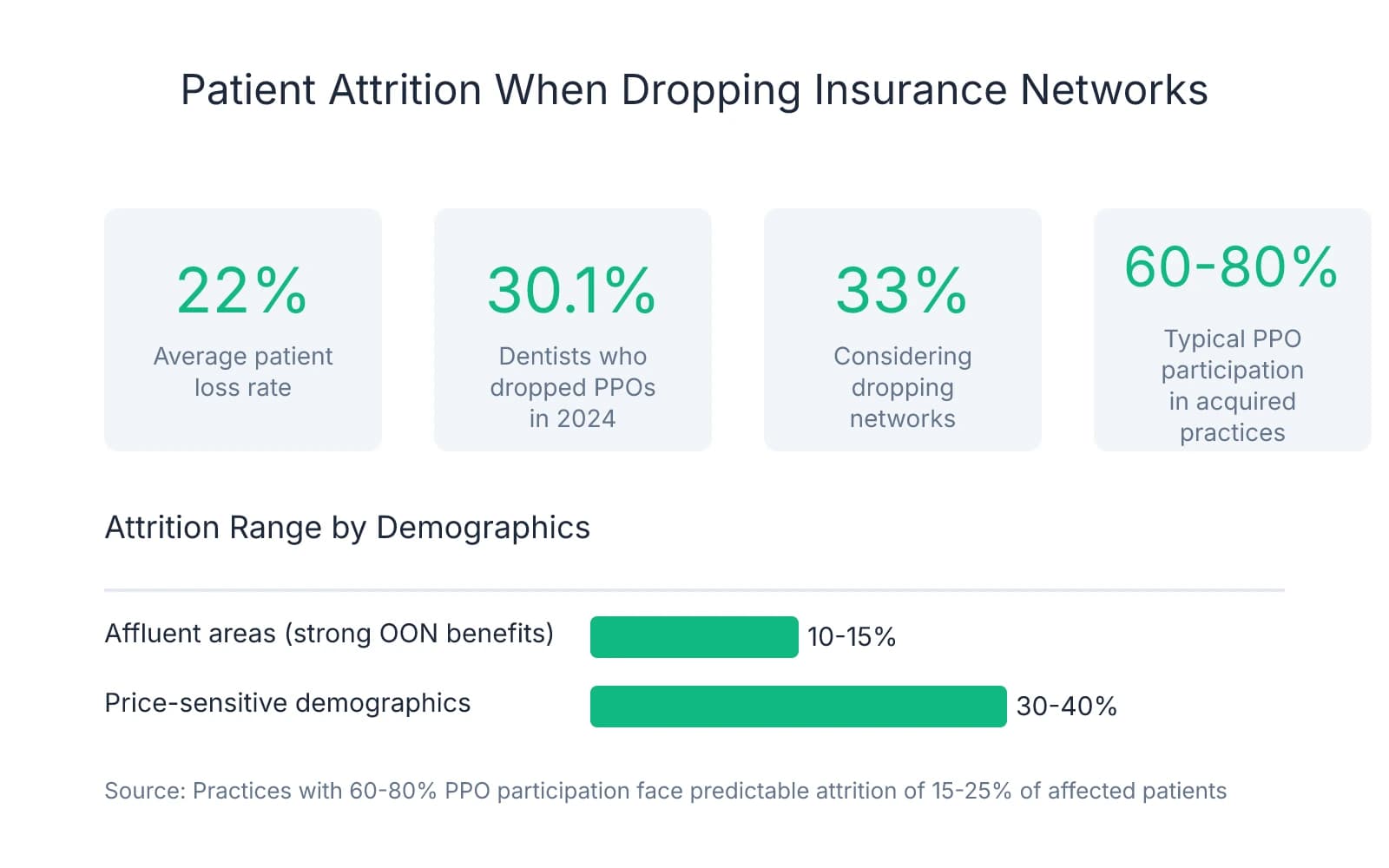
- Practices with 60-80% PPO participation face predictable patient attrition of 15-25% of affected patients when dropping networks, directly threatening your ability to service acquisition debt
- 30.1% of owner dentists dropped insurance networks in 2024, with another 33% considering it—making this a common post-acquisition decision point that buyers must plan for
- The average practice loses 22% of its patient base when dropping a major network, but attrition varies widely based on patient demographics, out-of-network benefits, and communication strategy
Insurance Dependency Is a Hidden Liability You Inherit at Closing
Insurance dependency in a dental practice acquisition refers to the percentage of revenue tied to PPO contracts and the portion of the patient base that relies on those specific networks for coverage. When you buy a practice, you're not just acquiring equipment and patient charts—you're inheriting every PPO contract the seller signed and the patient base that depends on those networks to afford care.
This becomes a structural constraint on your operations. If 70% of production comes from Delta Dental and MetLife contracts, you can't simply drop those networks without risking the revenue stream you just financed. The patients who chose this practice specifically because it accepted their insurance may not follow you if you leave the network.
The numbers make this risk concrete. 30.1% of owner dentists dropped insurance networks in 2024, with another 33% considering it. Many buyers purchase a practice intending to transition to fee-for-service or reduce PPO participation, only to discover the patient base won't support that shift without significant attrition.
When a practice drops a major network, the average patient loss sits at 22% of the affected patient base. But that figure varies widely. Practices in affluent areas with strong out-of-network benefits may lose 10-15%. Practices serving price-sensitive demographics may lose 30-40%. The attrition concentrates among patients who generate the most consistent hygiene recare and restorative treatment.
For buyers, this creates a specific risk: you're paying a multiple of EBITDA based on current production, but that production depends on contracts you may not want to honor long-term. If you drop a network representing 40% of your patient base and lose 22% of those patients, you've eliminated roughly 9% of your revenue—potentially tens of thousands of dollars per month.
One pattern worth paying attention to is how sellers frame PPO participation during the sale process. Many describe their insurance mix as "flexible" or "easy to transition," but the patient base tells a different story. Evaluating insurance dependency as a deal risk means looking beyond the seller's intentions and examining actual patient behavior—how many patients have out-of-network benefits, how many are price-sensitive, and how many chose this practice specifically because of its network participation.
The key insight: insurance dependency isn't something you can easily change post-closing without risking the revenue stream you just paid for. If the practice derives 60-80% of its production from PPO contracts, you're not buying clinical freedom—you're buying a business model that depends on those contracts to function.
How to Evaluate Insurance Risk During Due Diligence
The time to quantify insurance dependency is before you sign the purchase agreement. During due diligence, you need specific data points that most sellers won't volunteer—and many brokers won't think to request.
Start by requesting PPO participation data broken down by carrier. You need the percentage of active patients enrolled in each plan, the average reimbursement rate per carrier, and the total annual write-offs attributed to each network. If 40% of patients are on Delta Dental PPO but the practice writes off 35% on those claims, that's a different risk profile than a practice where 40% of patients are on a plan with 20% write-offs.
Next, calculate the worst-case attrition scenario using the data you've collected. If 70% of the patient base is on PPO plans and you're considering dropping those networks, expect 15-25% of those patients to leave. That translates to 10-18% of your total patient base at risk. If the practice produces $800,000 annually and you lose 15% of patients, you're looking at a $120,000 revenue gap in year one.
One protection many buyers overlook is evaluating out-of-network benefits for the major carriers represented in the patient base. Plans with strong OON coverage—typically 70-80% reimbursement after deductible—significantly reduce attrition risk. Request a sample of EOBs from the top three carriers and check the OON reimbursement language. If most patients are on plans with weak or nonexistent OON benefits, your flexibility post-closing is limited.
High PPO dependency should either lower the purchase price, trigger earnout protection, or prompt you to walk away entirely. A practice with 75% PPO participation and 30% average write-offs isn't worth the same multiple as a practice with 40% PPO participation and 18% write-offs—even if gross production looks similar.
Structuring an earnout agreement becomes particularly valuable in high-dependency scenarios. If the seller claims patients will stay regardless of network changes, tie a portion of the purchase price to actual patient retention over 12-18 months. This shifts the risk back to the seller and gives you downside protection if attrition exceeds expectations.
Practices with high PPO dependency often have other structural weaknesses that compound the risk—low hygiene reappointment rates, minimal new patient marketing, or aging patient demographics. These factors make post-acquisition attrition more likely because the practice lacks the infrastructure to replace lost patients quickly. Financial due diligence should examine revenue and expense trends over three to five years to identify sustainability issues that surface only through longitudinal analysis.
The checklist you're building should answer three questions: How much revenue is at risk if you drop networks? How much will it cost to replace that revenue through new patient acquisition? And can the practice's margins support both scenarios? Remember that patients belong to the practice, not to individual providers, which means continuity of care obligations fall to you as the new owner regardless of insurance network decisions.
Structuring the Transition to Minimize Patient Loss
If you've already closed on the practice or are committed to the deal despite high PPO participation, the transition timeline becomes your primary lever for controlling attrition. Rushing a network exit increases patient loss—phasing it over 6-12 months allows you to test messaging, adjust based on patient response, and maintain cash flow while you rebuild the schedule with fee-for-service patients.
Start by identifying the lowest-reimbursing plans first—typically those with 35-40%+ write-offs—and drop them in phases rather than all at once. If you're participating in five PPO networks, rank them by profitability and exit the bottom two in the first quarter, the middle two in months 4-6, and the highest-reimbursing plan last. This staged approach gives you time to observe patient behavior after each change and limits the revenue shock in any single month. Dr. Elias Almaz coordinated a Delta Dental exit while negotiating his practice acquisition, working with the seller to phase the transition before closing.
Patient communication should begin 90-120 days before each network change, not 30 days. The goal is to educate patients about what out-of-network benefits actually cover and what their true out-of-pocket cost will be. Your communication should include:
- A personalized letter explaining the specific network you're leaving and the effective date
- A breakdown of what their out-of-network benefits cover, ideally with a sample calculation showing their expected cost for a routine cleaning and exam
- A phone number or email where they can ask questions before the change takes effect
- An invitation to schedule their next appointment before the transition date to lock in in-network pricing one final time
The last point is strategic—it keeps patients in the schedule during the transition period and gives your front desk a natural conversation opener when patients call with concerns.
Training your front desk to navigate these conversations is as critical as the clinical transition itself. Role-play common objections: "I can't afford to come here anymore," "Why are you doing this?" "Will my insurance still cover anything?" Your team should be able to respond with specific numbers, not vague reassurances.
One retention tool that works particularly well during network exits is launching a membership plan for patients who lose in-network access. These plans typically cost $300-400 annually and cover preventive care—two cleanings, exams, X-rays, and a discount on restorative treatment. Practices that implement membership plans during transitions report 20-30% lower attrition among affected patients.
The timeline you're working with should look something like this:
- Months 1-2: Analyze PPO profitability, rank plans by write-off percentage, and identify the first network to drop
- Months 2-3: Draft patient communication materials, train front desk on objection handling, and finalize membership plan structure
- Month 3: Send first round of notification letters 90-120 days before the network exit date
- Months 4-6: Drop the first 1-2 networks, monitor patient response, and adjust messaging based on feedback
- Months 7-9: Repeat the process for the next tier of networks, incorporating lessons from the first phase
- Months 10-12: Exit the final network(s) and evaluate overall attrition against projections
This phased approach maintains your ability to service acquisition debt while you transition the business model. If you drop all networks at once and lose 20% of your patient base in 60 days, you're facing a cash flow crisis that could have been avoided with better sequencing.
Practices that communicate the transition as a move toward better care—rather than a financial decision—tend to retain more patients. Frame the change as allowing you to spend more time with each patient, offer more comprehensive treatment options, and eliminate insurance-driven constraints on care.
When to Walk Away Instead of Managing the Risk
Not every practice with high PPO participation is salvageable through careful transition planning. Some deals are structured around a business model that only works because of insurance-driven volume—and when you remove that volume, the remaining patient base can't generate enough revenue to service your acquisition debt.
Practices with >75% PPO participation and sub-40% margins sit in a particularly dangerous zone. If three-quarters of your production comes from contracts with 30-35% write-offs, your actual collections are already constrained before you factor in overhead. When you drop those networks and lose 20-25% of the affected patient base—which translates to 15-19% of your total patients—you're losing the volume that was barely profitable to begin with.
High-dependency practices often survive on PPO-driven volume rather than strong clinical systems. They're scheduling 40-50 patients per day at reduced reimbursement rates, which creates the appearance of a busy, successful practice. But when you drop networks and patient flow decreases, the practice's underlying weaknesses become visible—low treatment acceptance, minimal preventive recare, weak new patient marketing. Calculating your break-even timeline under worst-case attrition scenarios should happen before you sign the LOI.
The stress test you need to run: take the practice's current annual production, subtract 20-25% to account for insurance-related attrition, then subtract your projected operating expenses and debt service. If the remaining cash flow is negative or uncomfortably thin—less than $50,000 annually—the deal doesn't work at the current price.
If the seller won't adjust the purchase price to reflect insurance dependency, or refuses to structure an earnout that protects you from attrition, that's a signal the deal isn't aligned with reality. Earnout agreements work particularly well in high-dependency scenarios because they shift risk back to the seller—if patients stay and revenue holds, the seller gets paid in full; if attrition exceeds projections, you're protected.
The decision framework should answer three questions:
-
Can the practice generate enough revenue post-attrition to service debt and pay you? Run the numbers assuming 20-25% patient loss among PPO patients. If the remaining production doesn't cover your debt service plus a reasonable salary, the deal needs to be restructured or abandoned.
-
Does the practice have the infrastructure to replace lost patients quickly? Look at new patient acquisition rates, hygiene reappointment percentages, and treatment acceptance. If these metrics are weak, you're buying a practice that depends on insurance-driven volume to mask operational problems.
-
Is the seller willing to adjust terms to reflect the risk? If the answer is no—if they insist on full price with no earnout protection and no transition support—walking away is often the right call.
One protection many buyers overlook is negotiating beyond price to include transition support tied to patient retention. A seller who stays on for 90 days and helps communicate the network changes to patients reduces your attrition risk significantly—properly handled transitions typically see less than 10% patient attrition, but insurance network changes can push that number substantially higher.
Some practices are only profitable because of the volume PPO networks deliver. When you remove that volume, the business model collapses. Recognizing this before you close protects you from a deal that looks manageable on paper but becomes a financial burden within six months.
Sources & References
The data and claims in this article are drawn from the following sources. We prioritize government data, peer-reviewed research, and established industry publications to ensure accuracy.
- [PDF] Economic Outlook and Emerging Issues in Dentistry - ADA.org— ada.orgIndustry
- 29 Dental Patient Attrition Statistics Every Practice Should Know— clerri.comIndustry
- Dental Practice Transitions: A Due Diligence Guide— dentalcpaca.com
- Patients First: Guidance for Retreatment When an...— www.tdicinsurance.com
- California dentist rises to the challenge of being a new practice ...— cda.orgIndustry
- Strategies for Transitioning Your Dental Practice Away from Insurance— deodentalgroup.comIndustry
- Patient Retention Following a Dental Practice Sale— dentaltransitions.com
Frequently Asked Questions
Ready to acquire a stable patient base?
Buying a dental practice involves more than just the assets—patient retention is critical. Minty Plus provides hands-on guidance through acquisition and post-close management to help you navigate insurance decisions and keep patients engaged after takeover.