Open Insurance Claims When Closing on a Dental Practice

Co-Founder, Minty Dental

In Summary
- Open insurance claims and pending EOBs are tied to the seller's NPI and Tax ID — they cannot be transferred to the buyer, and collecting on them post-closing under the seller's credentials is insurance fraud.
- No grace period exists for billing under a seller's NPI after closing, regardless of what a purchase agreement says or how long credentialing takes.
- Legitimate options during the credentialing gap include treating patients out-of-network, retaining the seller as an employed treating provider, or timing the closing to align with credentialing milestones.
- The insurance aging report is the most revealing due diligence document — healthy practices keep 70–75% of insurance AR in the 0–30 day bucket, with under 10% past 60 days.
- Four purchase agreement provisions — collection-on-behalf arrangement, seller indemnification for pre-closing billing errors, timely filing responsibility, and audit tail coverage — are what convert due diligence findings into actual protection.
Open Claims and Pending EOBs Are a Different Problem Than Accounts Receivable
Most buyers who've done even basic research know that accounts receivable is something to negotiate at closing. What catches many off guard is discovering that a meaningful chunk of what looks like AR isn't actually AR at all — it's open claims and pending EOBs, and the rules around who can collect them are fundamentally different.
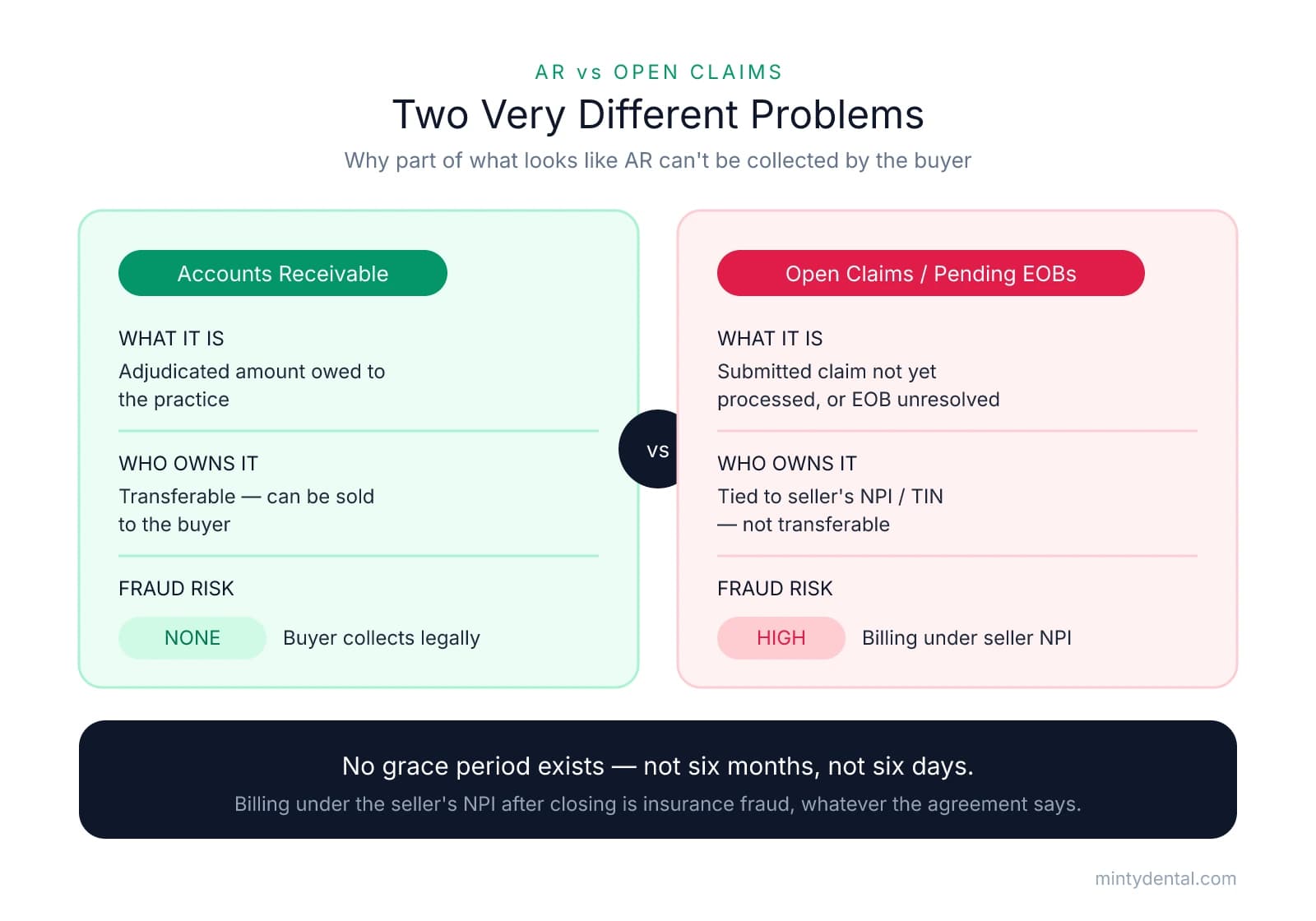
Accounts receivable (AR): Money that has been adjudicated — meaning the insurance company has processed the claim, determined the benefit, and issued an Explanation of Benefits (EOB) — and is now owed to the practice, either from the insurer or the patient. AR is a recognized asset that can be sold at a discount and collected by the buyer post-closing.
Open insurance claims: Services rendered before closing where the claim has been submitted to the insurer but not yet processed. No EOB has come back. The insurer hasn't adjudicated the benefit. The money isn't owed yet — it's pending a decision.
Pending EOBs: A narrower category where the EOB has returned, but either the payment hasn't been posted to the ledger, the claim was denied and needs correction, or a secondary insurer still needs to process. These sit in administrative limbo between submission and resolution.
The distinction matters enormously at closing because of what each category is tied to. AR is a financial asset — ownership can transfer, and the buyer can pursue collection. Open claims and pending EOBs are tied to the seller's NPI and Tax Identification Number. According to PPO Advisors, billing under a seller's NPI or TIN after closing — regardless of what a purchase agreement says — constitutes insurance fraud. There is no grace period, and no contractual language between buyer and seller changes that.
| Dimension | Accounts Receivable | Open Insurance Claims / Pending EOBs |
|---|---|---|
| What it is | Adjudicated amount owed to the practice | Submitted claim not yet processed, or EOB returned but unresolved |
| Who owns it | Transferable — can be sold to buyer | Tied to seller's NPI/TIN; not transferable |
| How it's handled at closing | Purchased at a discount or retained by seller | Must be resolved under seller's credentials before or after closing |
| Fraud risk | None — buyer collects legitimately | High — buyer billing under seller's NPI is insurance fraud |
One pattern worth paying attention to during due diligence is the seller's billing cadence. A practice that submits claims daily or weekly will have relatively few open claims at closing — most will have already been adjudicated and moved into true AR. A practice that batches claims monthly could have four or more weeks of unprocessed submissions sitting in limbo on closing day, representing a significant dollar amount the buyer has no legal path to collect.
This is why many buyers who dig into AR disputes after closing find the real problem wasn't the AR they negotiated — it was the open claims they didn't know to ask about.
The Fraud Trap Buyers Don't See Coming
That billing cadence problem is manageable when you know to look for it. What's harder to navigate is the legal exposure that follows when buyers try to bridge the gap between closing and credentialing — often without realizing they've crossed a line.
The most dangerous misconception in dental practice transitions is the idea that there's a "grace period" after closing during which the buyer can bill under the seller's NPI or Tax Identification Number while waiting for their own credentialing to come through. Thirty days. Sixty days. Sometimes ninety. The specific window varies depending on who's telling the story — but the underlying premise is the same, and it's wrong.
According to PPO Advisors, which has worked across 2,870+ dental practices and 12,000+ credentialing applications, no such grace period exists — not for six months, not for six weeks, not for six days. What makes this particularly dangerous is how credible the myth sounds: brokers write it into purchase agreements, attorneys sign off on it, and office managers are handed documents that appear to authorize something that is, in fact, insurance fraud.
The fraud isn't incidental. When a buyer submits a claim under the seller's NPI after closing, three things are being misrepresented simultaneously: the identity of the treating provider, the contracted entity receiving payment, and potentially the fee schedule under which reimbursement is calculated. Insurers contract with specific providers at specific rates — the seller's contracted rates belong to the seller. Collecting reimbursement under those credentials after ownership has transferred isn't a billing shortcut; it's a false claim.
The reason this trap is so easy to fall into is that the credentialing gap is a real and legitimate cash flow problem. Credentialing with insurance carriers typically takes 60 to 90 days after closing — sometimes longer if paperwork is incomplete or a carrier has a backlog. During that window, a buyer who can't bill in-network under their own NPI faces meaningful revenue disruption. The pressure to find a workaround is understandable. But the workaround most buyers reach for is the one that creates fraud exposure.
What buyers can do during the credentialing gap is worth understanding clearly, because there are legitimate paths through it:
- Treat patients as out-of-network during the gap period. Patients pay at the time of service and can receive a superbill to submit to their insurer directly. It's not ideal, but it's clean.
- Retain the seller as an employed treating provider — physically present and actually treating patients — during the transition. If the seller is the treating dentist of record, billing under their NPI is accurate, not fraudulent. This requires a properly structured seller employment agreement with defined responsibilities and a clear end date.
- Time the closing to align with credentialing milestones. Starting the credentialing process before closing — ideally 90 days out — can compress the gap significantly. Some buyers negotiate a delayed closing date specifically to get credentialing further along before the transition occurs.
One question worth adding to your due diligence checklist: what is the seller's current credentialing status with each carrier, and how long does each carrier typically take to credential a new provider? The answer shapes your closing timeline more than most buyers expect. A deeper look at how to navigate the credentialing gap can help you build a realistic plan before you're in the middle of it.
Buyers who understand these constraints early are in a much stronger position — not because the problem disappears, but because they can structure the closing, the seller's post-closing role, and the purchase agreement around how credentialing actually works.
What to Look for During Due Diligence
With the legal constraints around post-closing collection clearly in view, the goal during due diligence shifts to understanding exactly what you're walking into before you sign anything. The central document to request is the insurance aging report: a breakdown of all outstanding insurance claims organized by age bucket (0–30, 31–60, 61–90, and 90+ days). This report tells you more about a practice's billing health than almost any other single document.
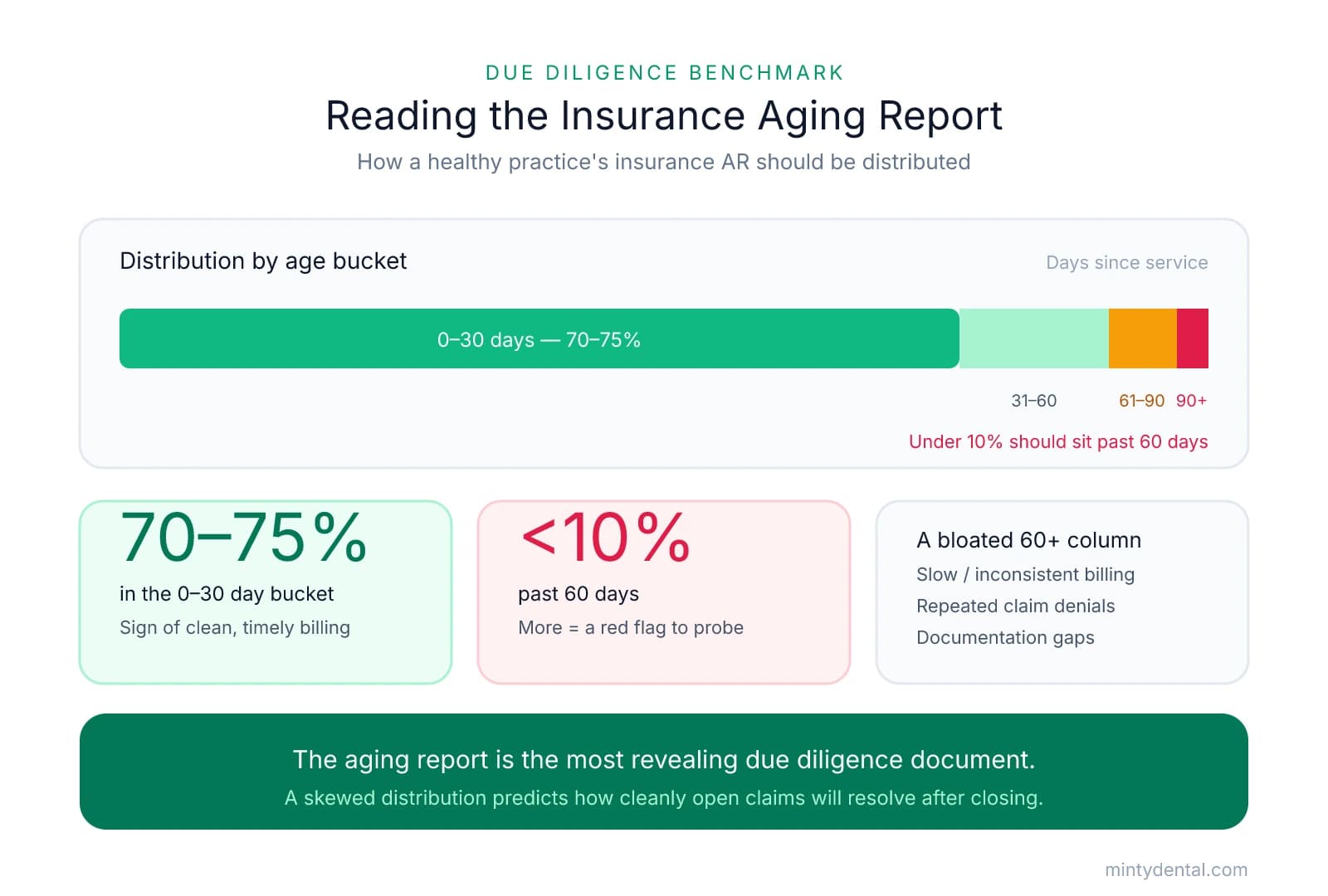
What a healthy aging report looks like: Well-run practices typically keep 70–75% of insurance AR in the 0–30 day bucket, with no more than 10% sitting past 60 days. A bloated 60+ day column usually points to one of three things: slow or inconsistent billing practices, a pattern of claim denials requiring resubmission, or documentation gaps causing carriers to pend or reject claims. Any of these creates real uncertainty about how cleanly those open claims will resolve after closing.
The second thing to probe is timely filing deadlines. As Veritas Dental Resources explains, most PPO plans allow 90 days to one year from the date of service to submit a claim — but Medicaid programs in some states allow as little as 90 days, and the window varies by carrier. If the seller has old, unsubmitted claims sitting in the system, some may already be approaching their filing deadline. If you've purchased the AR and those claims expire before anyone files them, that's a loss you absorb.
A subtler risk is the pattern of retroactive payer audits and recoupment demands. As the Michigan Dental Association notes, insurers can use statistical extrapolation to apply overpayment findings across an entire audit period — meaning a modest documentation problem on a handful of claims can escalate into a five- or six-figure recoupment demand. If the seller's billing shows repeated denials, frequent resubmissions, or downcoding patterns, that's worth raising with your attorney before closing. Depending on how the purchase agreement is structured, those demands can become your problem — a risk that parallels the retreatment liability exposure buyers often overlook on the clinical side.
Use this checklist as a starting point for your open claims review:
- Request the insurance aging report — broken down by 0–30, 31–60, 61–90, and 90+ day buckets
- Identify all claims over 60 days — ask the seller to explain each bucket and what's driving the aging
- Ask about denial rates by carrier — a high denial rate with a specific payer signals a documentation or coding problem worth understanding
- Confirm timely filing windows for the top five payers — verify how much runway remains on any claims approaching their deadline
- Ask whether any payer audits are pending or recently resolved — a recently closed audit doesn't mean the risk has passed; recoupment demands can surface months later
The goal of this review isn't to find a reason to walk away — it's to understand the true state of the billing operation so you can negotiate appropriate protections into the purchase agreement, which is where the real leverage sits.
How to Structure the Purchase Agreement to Protect Yourself
Everything uncovered in due diligence — the aging report, the timely filing windows, the audit risk — only translates into protection if the purchase agreement reflects it. Vague or seller-favorable language around open claims is one of the more common ways buyers absorb losses they never anticipated. Four specific provisions are worth negotiating before you sign.
1. Collection-on-behalf arrangement
If you're not purchasing the AR outright, the agreement should define exactly how open claims get collected after closing. A well-drafted clause specifies that the buyer will collect pre-closing insurance claims on the seller's behalf — using the seller's NPI and TIN, with the seller's active involvement — and remit proceeds to the seller on a defined schedule (typically monthly, for 90 to 180 days post-closing). It should also clarify who handles resubmissions: if a claim comes back denied and needs correction, that work falls to someone. Leaving it undefined is how claims expire during the transition and the loss lands on whoever is holding the bag.
2. Seller indemnification for pre-closing billing errors
The seller should warrant that all claims submitted before closing were accurately coded, properly documented, and compliant with each payer's requirements. This matters because, as Mahan Dental Law notes, purchase agreements with vague representations around insurance billing leave buyers exposed to recoupment demands they have no contractual path to recover. If a payer audit surfaces a coding problem from two years before closing, the indemnification clause determines whether that liability stays with the seller or migrates to you.
3. Timely filing responsibility clause
This provision answers a specific question: if a claim was submitted before closing but comes back denied — or was never submitted at all — who is responsible for correcting and resubmitting it, and what happens if the filing window expires before anyone acts? Without this language, both parties tend to assume the other is handling it, and claims quietly expire. The clause should name a responsible party, define a response timeline, and address what happens if a claim becomes uncollectable due to inaction during the transition.
4. Audit tail coverage with defined caps and baskets
Post-closing audits triggered by pre-closing billing patterns are a real risk, and the indemnification provisions need to address them explicitly. As DDS Lawyers explains, caps establish the seller's maximum indemnification exposure, while baskets set the minimum threshold before indemnification obligations are triggered. For insurance-related claims specifically, push for a survival period extending at least two to three years post-closing — long enough to capture audit cycles that may not surface immediately.
Buyers who negotiate these four provisions walk into closing with something most don't have: a clear process for handling open claims, a seller who's contractually responsible for pre-closing billing problems, and no ambiguity about who collects or resubmits what. A purchase agreement that's silent on these points doesn't make the risk disappear — it transfers the risk to you by default.
The open claims issue is ultimately a contract negotiation problem dressed up as a billing detail. Treat it that way early, and the AR disputes that tend to surface after closing become far less likely to catch you off guard.
Sources & References
The data and claims in this article are drawn from the following sources. We prioritize government data, peer-reviewed research, and established industry publications to ensure accuracy.
- Selling Accounts Receivable in a Dental Practice Transition— www.adstransitions.comIndustry
- Billing During Practice Transition: 5 Critical Rules to Avoid ...— ppoadvisors.comIndustry
- The Hidden Challenge in Dental Practice Transitions— ameriprac.comIndustry
- 🕒 Understanding Timely Filing Laws in Dental Insurance— veritasdentalresources.comIndustry
- Insurance Audits: What to Do— www.michigandental.orgIndustry
- Red Flags in Dental Practice Purchase Agreements— mahandentallaw.comIndustry
- What Practice Owners Need to Understand About Post ...— ddslawyers.comIndustry
Navigate Practice Transitions With Expert Guidance
Closing on a dental practice involves complex insurance and claims considerations. Minty's acquisition specialists guide you through every step of the purchase process, ensuring you understand critical details like open claims and pending EOBs before you take ownership.