Retreatment Liability After Buying a Dental Practice

Co-Founder, Minty Dental

In Summary
- Retreatment liability is the financial and legal obligation a new practice owner faces when patients return with failed work performed by the seller — and it's one of the most consistently overlooked risks in a dental acquisition
- Two distinct exposures require different solutions: the patient-relations cost of redoing prior work, and the malpractice risk tied to harm caused by prior treatment
- Retreatment issues typically surface 6–18 months post-closing, making pre-closing contract clarity essential
- Vague "as mutually agreed" language is the most common failure mode — it sounds reasonable but provides no enforceable mechanism when a costly failure occurs
- Buyers are practically exposed even when not legally liable — patients rarely distinguish between the previous dentist's work and the new owner's
Retreatment Liability Is the Clinical Risk Most Buyers Never Price In
Retreatment liability in a dental acquisition: the obligation — financial, clinical, or legal — a new owner inherits when patients return with failed or defective work performed by the seller before closing. It's not hypothetical. It's one of the most consistently overlooked risks in a dental practice purchase, and it tends to arrive at the worst possible time.
Six months after closing, a patient walks in with a failing implant placed by the previous dentist. They expect you to fix it. They don't know — and frankly don't care — who placed it. You're the dentist. You're the practice. And if your purchase agreement says retreatment disputes will be resolved "as mutually agreed," you're holding a $4,000 problem with no enforceable path to recover it from the seller.
This tension splits into two separate exposures that are easy to conflate but require very different solutions:
-
The patient-relations cost — the financial burden of redoing prior work at reduced or no charge to preserve goodwill and retain the patient. This is a practice management problem, and it's more common than most buyers expect.
-
The malpractice exposure — the legal risk that a patient claims prior treatment caused harm. This is an insurance and indemnification problem, and the stakes are categorically higher.
As Hatch Legal Group notes, "as mutually agreed" clauses fail to acknowledge that retreatment problems can be extremely costly — including failures that result in malpractice actions. The language sounds collaborative in negotiation and becomes meaningless in a dispute.
What makes this particularly difficult is the timing. Retreatment issues rarely surface at closing. Crown failures, root canal complications, and implant problems tend to emerge 6–18 months post-closing — well after the seller has moved on and goodwill is no longer a negotiating lever. By then, the only protection you have is whatever was written into the purchase agreement before you signed.
Buyers who've done thorough financial due diligence — reviewing three years of P&L, stress-testing collections, benchmarking overhead — sometimes still miss this because it doesn't show up in a spreadsheet. Reviewing the malpractice and complaint history of a practice before closing is one way to gauge clinical risk exposure, but contract language is what actually protects you when something goes wrong.
How to Assess Retreatment Exposure Before You Make an Offer
Most due diligence checklists focus on revenue, overhead, and patient retention — and those matter. But retreatment exposure is a clinical risk that lives in the procedure mix, the records, and the seller's insurance history. Here's a practical framework for sizing it up before you're committed to a deal.
Start with the Procedure Mix
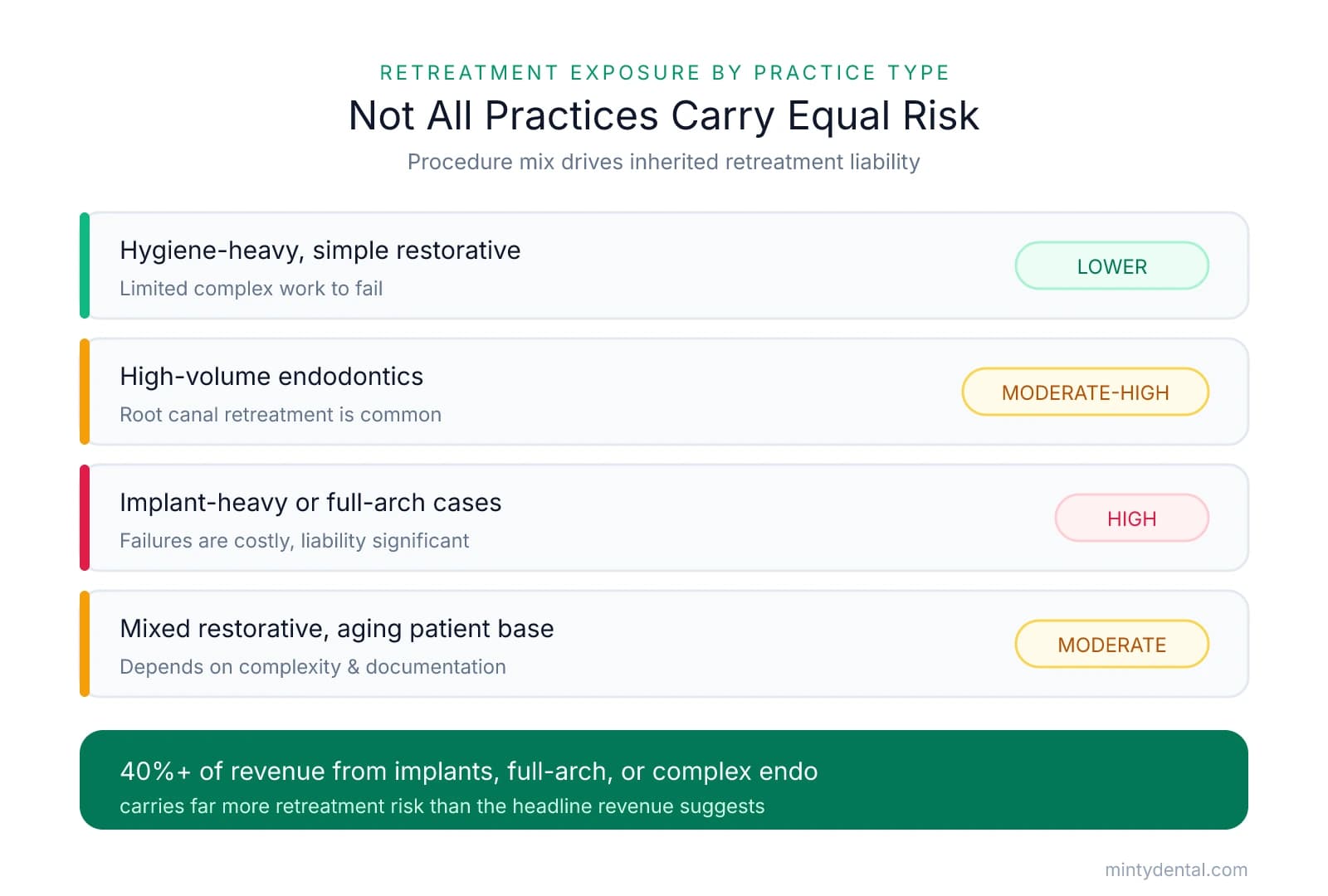
Not all practices carry equal retreatment risk. A hygiene-dominant practice with straightforward restorative work looks very different from one built around implants, full-arch reconstructions, and endodontics.
| Practice Profile | Retreatment Exposure |
|---|---|
| Hygiene-heavy, simple restorative | Lower — limited complex work to fail |
| High-volume endodontics | Moderate-high — root canal retreatment is common |
| Implant-heavy or full-arch cases | High — failures are costly and liability is significant |
| Mixed restorative with aging patient base | Moderate — depends on case complexity and documentation |
When reviewing production reports, ask for a procedure code breakdown. A practice generating 40%+ of revenue from implants, full-arch, or complex endo carries meaningfully more retreatment exposure than the headline revenue number suggests.
Ask for Treatment Plan Completion Data
A large backlog of incomplete treatment plans is a specific signal worth investigating. Patients diagnosed and treatment-planned under the seller may return expecting the new owner to honor prior commitments — sometimes at the seller's quoted price. Ask for a report showing open treatment plans by dollar value and age. Plans sitting open for 12+ months are the ones most likely to create friction post-closing.
Look for Informal 'Redo' Patterns
Ask the seller directly: Have you redone or discounted any work in the past two to three years? Are there any patients with ongoing clinical concerns? Most sellers will answer honestly when asked plainly. A review of patient ledgers and clinical notes can surface additional patterns — repeated appointments on the same tooth, write-offs tied to specific procedures, or notes referencing patient dissatisfaction. These informal signals often predict where post-closing complaints will originate.
Review the Seller's Malpractice Claims History
A seller's claims history is a reasonable proxy for clinical quality and documentation habits — and it informs retreatment risk directly. A history of complaints or paid claims in complex restorative categories should prompt deeper scrutiny of those case records.
Understand the Seller's Policy Type
This is where retreatment risk intersects directly with insurance coverage. As Wipfli Law explains, claims-made policies only cover claims filed while the policy is active — meaning if the seller cancels coverage at closing without purchasing tail coverage, prior work may be uninsured if a claim surfaces later. Occurrence-based policies cover incidents when they happened, regardless of when the claim is filed, so tail coverage isn't required.
Ask the seller which type of policy they carry. If it's claims-made, understanding who is responsible for tail coverage — and getting that obligation written into the purchase agreement — is essential before closing.
What a Well-Structured Retreatment Clause Actually Looks Like
Once you've assessed a practice's retreatment exposure during due diligence, the next step is translating that risk into enforceable contract language. A well-drafted retreatment clause doesn't just acknowledge that prior work might fail — it specifies exactly what happens when it does.
The Five Elements of a Functional Retreatment Clause
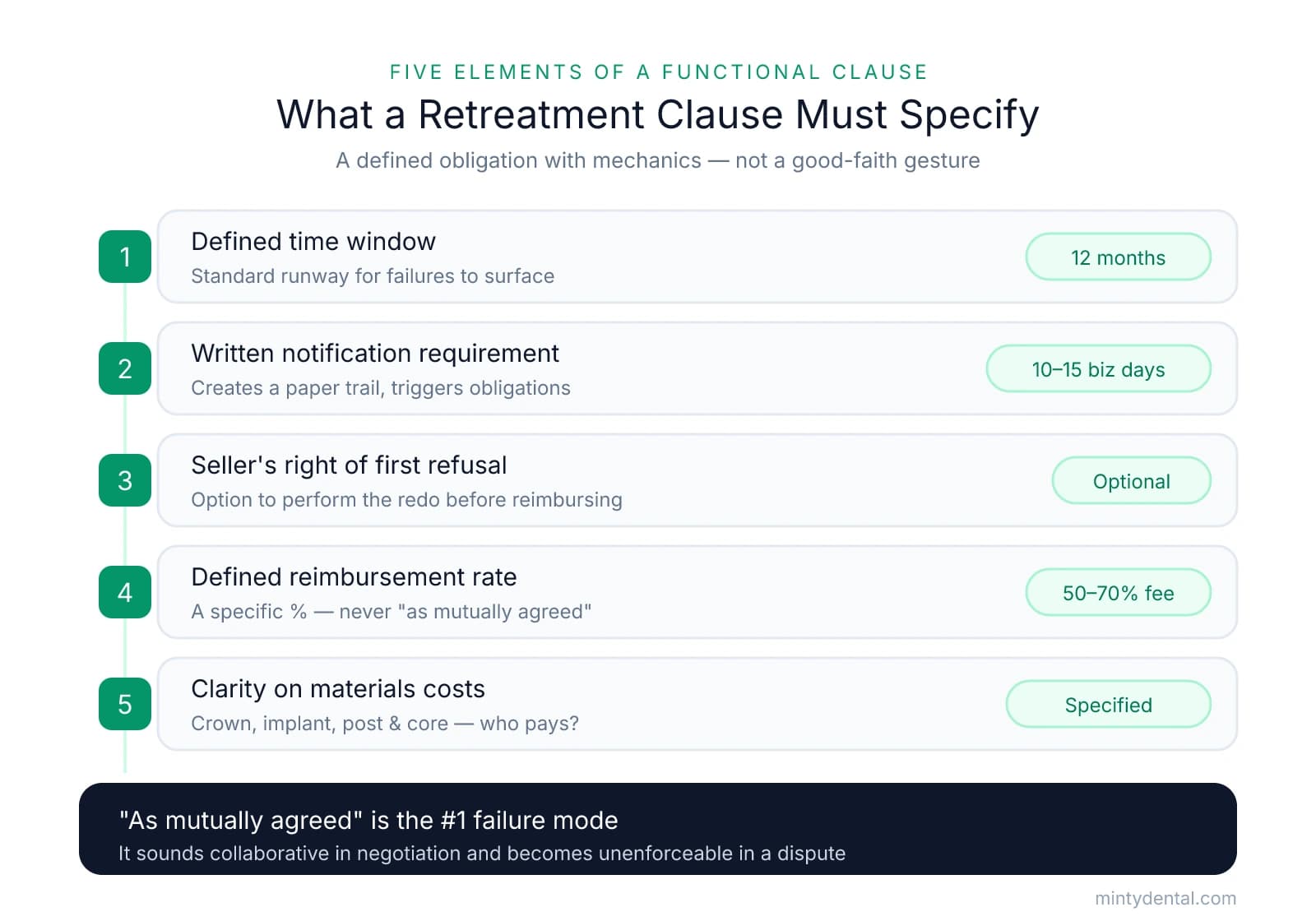
Industry-standard practice purchase agreements treat retreatment as a defined obligation with specific mechanics, not a good-faith gesture. A clause worth signing should include all five of the following:
-
A defined time window. Twelve months post-closing is the standard — enough runway to capture the failures most likely to surface without leaving the seller exposed indefinitely.
-
A written notification requirement. When retreatment is needed, the buyer notifies the seller in writing within a specified timeframe (typically 10–15 business days of identifying the issue), creating a paper trail and triggering the seller's obligations clearly.
-
Seller's right of first refusal. The seller gets the option to perform the retreatment themselves before any reimbursement obligation kicks in. Most sellers won't exercise it, but the right should be there.
-
A defined reimbursement rate. If the seller declines or is unavailable, the standard reimbursement runs 50–70% of the buyer's usual fee. This should be a specific percentage — "as mutually agreed" or "reasonable compensation" are phrases that become unenforceable in a dispute.
-
Clarity on materials costs. Who pays for the crown, the implant component, the post and core? The clause should specify whether materials are covered by the reimbursement rate or billed separately to the seller.
How Indemnification Caps and Baskets Interact with Retreatment
Beyond the retreatment clause itself, buyers need to understand how it fits into the broader indemnification structure. As dental practice attorneys at DDS Lawyers explain, purchase agreements typically include two limiting mechanisms:
- Caps establish the seller's maximum indemnification exposure — commonly 25–50% of the purchase price for mid-market dental deals.
- Baskets function like deductibles: the buyer must accumulate losses above a threshold before the seller's indemnification obligation is triggered at all.
The practical problem is that individual retreatment cases — a $2,500 crown, a $1,800 root canal redo — often fall below the basket threshold. Each one is real money, but none individually triggers the seller's obligation. Over 12 months, those cases can add up to meaningful out-of-pocket losses that the general indemnification structure never captures.
One protection worth pushing for: ask your attorney to carve retreatment obligations out of the general indemnification basket entirely, or establish a separate, lower threshold specific to retreatment claims.
Tail Coverage Should Be Written In, Not Assumed
A retreatment clause handles the patient-relations side of prior work. The malpractice side requires explicit language in the purchase agreement confirming the seller will maintain tail coverage on their claims-made policy post-closing. The cost typically runs 150–200% of the seller's annual premium and is normally the seller's responsibility — but "normally" isn't enforceable. If the obligation isn't written in, it's an assumption, not a protection.
A post-closing employment agreement can also reinforce these obligations when the seller is staying on during transition — tying their continued presence to retreatment responsibilities creates accountability that a standalone clause sometimes lacks.
After Closing: Handling Retreatment Requests Without Losing the Patient
The contract work is done. Now a patient is sitting in your chair with a failing crown placed eight months ago by the previous dentist. What you do in the next ten minutes — and the next ten days — determines both whether you recover the cost and whether that patient stays in your practice.
Document First, Then Act
When a retreatment request comes in, create a written record immediately: the date, the procedure in question, the patient's complaint, and your clinical assessment of what's needed and what it will cost. This documentation activates your notification clause — most agreements require written notice to the seller within 10–15 business days of identifying the issue. A clinical note alone isn't enough. You need a dated communication to the seller that establishes the claim clearly and starts the clock on their response window.
Talking to the Patient Without Creating New Exposure
The patient doesn't need a legal explanation — they need to feel heard and confident you'll take care of them. Acknowledge the issue directly, commit to resolving it, and avoid characterizing the prior work as negligent or substandard. There's a meaningful difference between "this crown has failed and we're going to fix it" and "this was done wrong." The first builds trust; the second creates statements that can complicate things if the situation escalates.
For more on navigating these conversations, the patient complaint communication framework covers the specific language patterns that tend to work — and the ones that tend to backfire.
Most Disputes Resolve Without Lawyers
In practice, the majority of retreatment disputes are resolved with a phone call or email to the seller. The contract language isn't a litigation roadmap — it's leverage that makes the seller take the conversation seriously. Sellers who might dismiss a verbal request tend to respond differently when there's a written notification clause, a defined reimbursement rate, and a signed agreement behind it.
That said, looping in your attorney makes sense if the seller disputes the claim outright, if the cost approaches your indemnification threshold, or if the patient is signaling something beyond a simple redo. Language about "what the last dentist did to me" or requests for records can be early indicators of a malpractice trajectory. When a patient asks for a refund alongside a redo, the stakes shift further; preparing a proper release before issuing any refund is a step most dentists skip until they've learned why they shouldn't.
The Bigger Picture
Buyers who handle retreatment requests confidently and fairly in the first 12 months tend to retain more patients and build goodwill faster than those who hesitate or absorb the cost resentfully. The contract protections you negotiated aren't just about recovering $2,500 on a crown — they're about having the financial confidence to do right by patients without carrying unlimited exposure for someone else's clinical decisions.
Sources & References
The data and claims in this article are drawn from the following sources. We prioritize government data, peer-reviewed research, and established industry publications to ensure accuracy.
- Unique Legal Issues in the Sale or Purchase of a Dental Practice— hatchlegalgroup.comIndustry
- Selling Your Medical Practice? Make Sure You Have Tail Coverage.— www.wilaw.comIndustry
- 20 Essential Negotiation Terms to Include in your Dental Practice ...— practiceorbit.comIndustry
- Credit Where Credit Is Due: Accounting for Unused Patient Credits ...— ddslawyers.comIndustry
- How to Properly Handle Patient Refunds and Avoid Disputes— medprodental.com
Protect Your Practice From Previous Owner Liabilities
Navigating retreatment liability and seller indemnification is crucial when acquiring a dental practice. Minty's acquisition experts guide you through due diligence and contract protections to ensure you're not inheriting costly liabilities from the previous owner.