Buying an Orthodontic Practice as a General Dentist

Co-Founder, Minty Dental
In Summary
- Orthodontic practices generate revenue from multi-year treatment plans (typically 18–24 months), creating more predictable cash flow than general dentistry — but also a more complex financial picture at acquisition
- The buyer pool for ortho practices is traditionally narrower than for general practices, meaning less competition for GP buyers but also less precedent to learn from
- Orthodontic practices are largely private-pay (>70% in many cases), insulating revenue from insurance reimbursement pressure
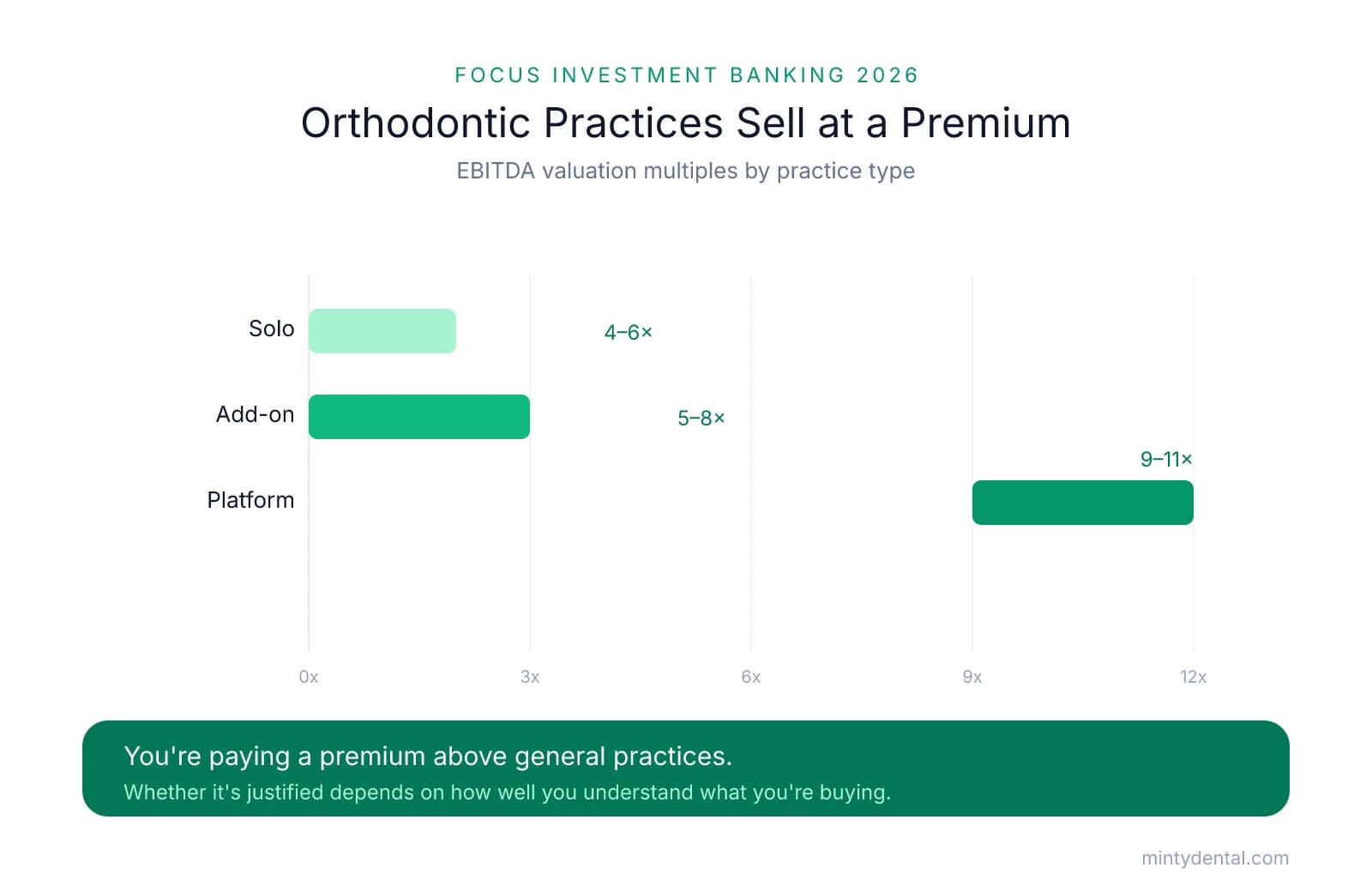
- According to FOCUS Investment Banking's 2026 report, solo orthodontic practices sell for 4–6× EBITDA, add-on practices for 5–8×, and platform groups for 9–11× — meaningfully above comparable general practice multiples
- Three questions shape every ortho acquisition for a GP buyer: Who performs the clinical work? How do the financials actually work? And how do you manage a transition when patients are mid-treatment?
Orthodontic Practices Reward Buyers Who Understand What Makes Them Different
An orthodontic practice is structurally different from a general dental practice in ways that matter enormously at acquisition — not just operationally, but financially and clinically. Where a general practice generates revenue through discrete, episodic visits, an orthodontic practice runs on multi-year treatment contracts, typically spanning 18–24 months. That model creates something most healthcare businesses struggle to achieve: genuinely recurring, predictable revenue. It also creates a balance sheet that looks unlike anything most GP buyers have encountered before.
That predictability is exactly what draws general dentists to ortho acquisitions. Orthodontic practices carry a private-pay revenue mix exceeding 70% in many cases, which means far less exposure to insurance reimbursement pressure than a PPO-heavy general practice. The business tends to be cleaner, the margins stronger, and the patient relationships longer.
But the same qualities that make ortho attractive create risk for buyers who don't know what they're evaluating. According to FOCUS Investment Banking's 2026 Orthodontic Practice Valuation report, add-on orthodontic practices typically sell for 5–8× EBITDA, while platform groups reach 9–11× — meaningfully above the range for comparable general practices. You're paying a premium. Whether it's justified depends entirely on how well you understand what you're buying.
The buyer pool adds another layer of complexity. Orthodontic practices have historically traded within a narrow market — mostly other orthodontists acquiring nearby competitors or expanding their footprint. A general dentist entering this space faces less competition, but also less precedent. The structural differences between specialty and general practice acquisitions are real, and ortho sits at the more complex end of that spectrum.
Three questions cut to the heart of every ortho acquisition for a GP buyer:
-
Who will perform the clinical work? Will you treat patients yourself, hire an associate orthodontist, or build a hybrid model? This decision shapes everything from staffing costs to licensure requirements to how patients experience the transition.
-
How do the financials actually work? Contracts receivable, deferred revenue, and private-pay collections behave differently than anything in a general practice — and misreading them is one of the most common ways buyers overpay.
-
How do you manage a transition when patients are mid-treatment? Unlike a general practice where most patient relationships reset naturally, an ortho acquisition means inheriting hundreds of active cases at various stages of completion. The transition isn't a handoff — it's a handoff in motion.
Your Clinical Model Decision Shapes Everything Else
Before you open a single financial statement, there's a decision that will reframe every number you see: who is going to perform the clinical work?
This isn't a detail to sort out after closing. The clinical model you choose determines what the practice's normalized EBITDA actually looks like once the seller's production is replaced — and that changes the valuation math entirely.
The Licensing Reality (and Where It Actually Gets Complicated)
In most U.S. states, your DDS or DMD license already permits you to perform orthodontic procedures. There is no separate "orthodontic license" required. The IAO (International Association for Orthodontics) has actively defended this right when state regulators have pushed back — including a notable Michigan case where a board investigator's overreach was successfully challenged on First Amendment grounds.
The practical constraint isn't licensure — it's advertising rules and clinical competence. Texas, for example, requires under 22 Tex. Admin. Code § 108.55 that general dentists advertising orthodontic services include a clear "General Dentist" disclosure in equivalent font size. Most states have similar consumer transparency expectations. Check your state dental board before assuming your marketing can mirror what the selling orthodontist was doing.
The Three Models, Side by Side
| Model | Who Performs Clinical Work | Key Risk | Best Fit For | Financial Impact |
|---|---|---|---|---|
| GP performs ortho | You | Clinical competence gaps on complex cases | GPs with significant CE training or prior ortho experience | Highest margin — no associate cost |
| Associate orthodontist | Hired specialist | Key-person risk if associate leaves | GPs who want the business, not the clinical work | Associate compensation of $200K–$450K+ reduces post-acquisition cash flow materially |
| Hybrid | You (aligners/limited) + associate (comprehensive) | Scheduling complexity; two-provider coordination | GPs with aligner experience looking to expand case scope | Middle ground — associate cost offset by your production |
What Each Model Actually Requires
Model 1 — GP performs ortho works best when you've completed substantial continuing education and have honest clarity on the case complexity the practice handles. A practice running 80% clear aligner cases is a very different clinical ask than one built on comprehensive bracket treatment. Reviewing your clinical readiness for ownership through this lens is worth doing before you fall in love with a listing.
Model 2 — hiring an associate orthodontist is the most common path for GP buyers, and it's operationally straightforward — until the orthodontist leaves. The central question: is the practice's goodwill tied to the seller as a clinician, or to the brand, location, and patient base? If patients follow the doctor, that risk doesn't disappear when you hire a replacement. Buyers navigating practices that already have an associate will recognize this dynamic.
Model 3 — the hybrid can maximize revenue, but it adds real management complexity. Two providers, two schedules, and a clear division of case types all need to work smoothly from day one.
Make This Decision First
A pattern worth paying attention to: buyers who defer the clinical model decision until after reviewing financials tend to anchor on the seller's production numbers — which reflect a board-certified orthodontist working full-time. Once you factor in associate compensation or the ramp time to build your own ortho volume, the practice's actual cash flow to you can look quite different. Settle on your model first, then build the financial picture around it.
The Financial Due Diligence That's Unique to Orthodontics
With your clinical model settled, the financial picture comes into focus — and orthodontic practices have a few line items that don't exist anywhere in general dentistry. Getting these right is the difference between a well-priced acquisition and one that creates a cash flow crisis in year one.
Contracts Receivable: The Number Most Buyers Misread
Contracts receivable (CR) is the orthodontic-specific equivalent of accounts receivable — but instead of representing money owed for completed treatment, it represents future payments patients will make as treatment continues over the next 12–18 months. A patient who started a $6,000 case, paid $1,500 down, and owes $250/month for 18 months contributes $4,500 to the practice's CR balance. Multiply that across hundreds of active cases and you're looking at a significant asset — or a significant liability, depending on how the seller structured their collections.
The two scenarios play out very differently:
- High CR is a buyer advantage. Patients are still paying into their treatment contracts, so you inherit predictable incoming cash flow while you complete those cases.
- Low CR is a cash flow trap. The seller collected most fees upfront — often through pay-in-full incentives — and you're now completing months of treatment on cases that have already been paid out. As CFS Dental Division explains, this can create a first-year revenue gap that catches buyers completely off guard.
How to audit CR before closing:
- Request a full contracts receivable aging report broken down by patient, balance remaining, and months of treatment left
- Cross-reference against a list of all active cases with treatment start dates — this lets you verify the aging report reflects real, ongoing cases
- Calculate the average remaining balance per active case and multiply by total active patients to confirm the CR figure matches what's on the books
- Ask for 12–24 months of new patient starts to understand whether the CR balance is being replenished or slowly running off
- Have your accountant assess whether the CR will be assigned to you at closing or retained by the seller — this is a negotiable deal term with real cash flow implications
Normalizing EBITDA for the Seller's Clinical Role
Before applying any valuation multiple, one adjustment is non-negotiable: subtracting the clinical replacement cost from EBITDA. When the seller is the primary clinical producer — typical in solo ortho practices — their production is baked into the revenue figure. Once they leave, you're either doing that work yourself or paying someone else to do it.
The clinical replacement cost for an associate orthodontist typically runs 30–35% of production. On a practice generating $1.2M in collections, that's $360,000–$420,000 that needs to come off EBITDA before you apply a multiple. Skipping this step is one of the most common ways buyers overpay.
Private-Pay Mix and New Patient Flow
According to FOCUS Investment Banking's 2026 valuation report, private-pay revenue exceeding 70% continues to attract premium valuations and stronger lender interest. A practice insulated from insurance reimbursement pressure carries more predictable margins — exactly what dental lenders want to see. The relationship between fee-for-service revenue and practice value applies here too: verify the actual private-pay percentage from billing records, not just the seller's representation.
That efficiency only holds, however, if new case starts are healthy. New patient flow — specifically, case starts per month — is the most important forward-looking number in an ortho practice. A practice with strong collections today but declining new starts is living off its existing caseload; when those cases finish, revenue drops. Request 24 months of new patient data and look for the trend, not just the current number.
Managing the Transition When Patients Are Mid-Treatment
Everything covered so far — the clinical model, the financial due diligence, the valuation math — comes together in the first 90 days after closing. And in orthodontics, those 90 days are more consequential than in almost any other practice acquisition.
The patients you're inheriting aren't episodic visitors. They're mid-treatment, often 6–18 months into a relationship with a specific provider and clinical team. When the seller disappears at closing, that relationship doesn't automatically transfer to you. The ADA's guidance on patient retention during transitions is clear that staff continuity and shared philosophy of care are among the strongest predictors of retention — and in orthodontics, both matter more than in general dentistry.
Negotiate a Longer Seller Transition — and Define It Clearly
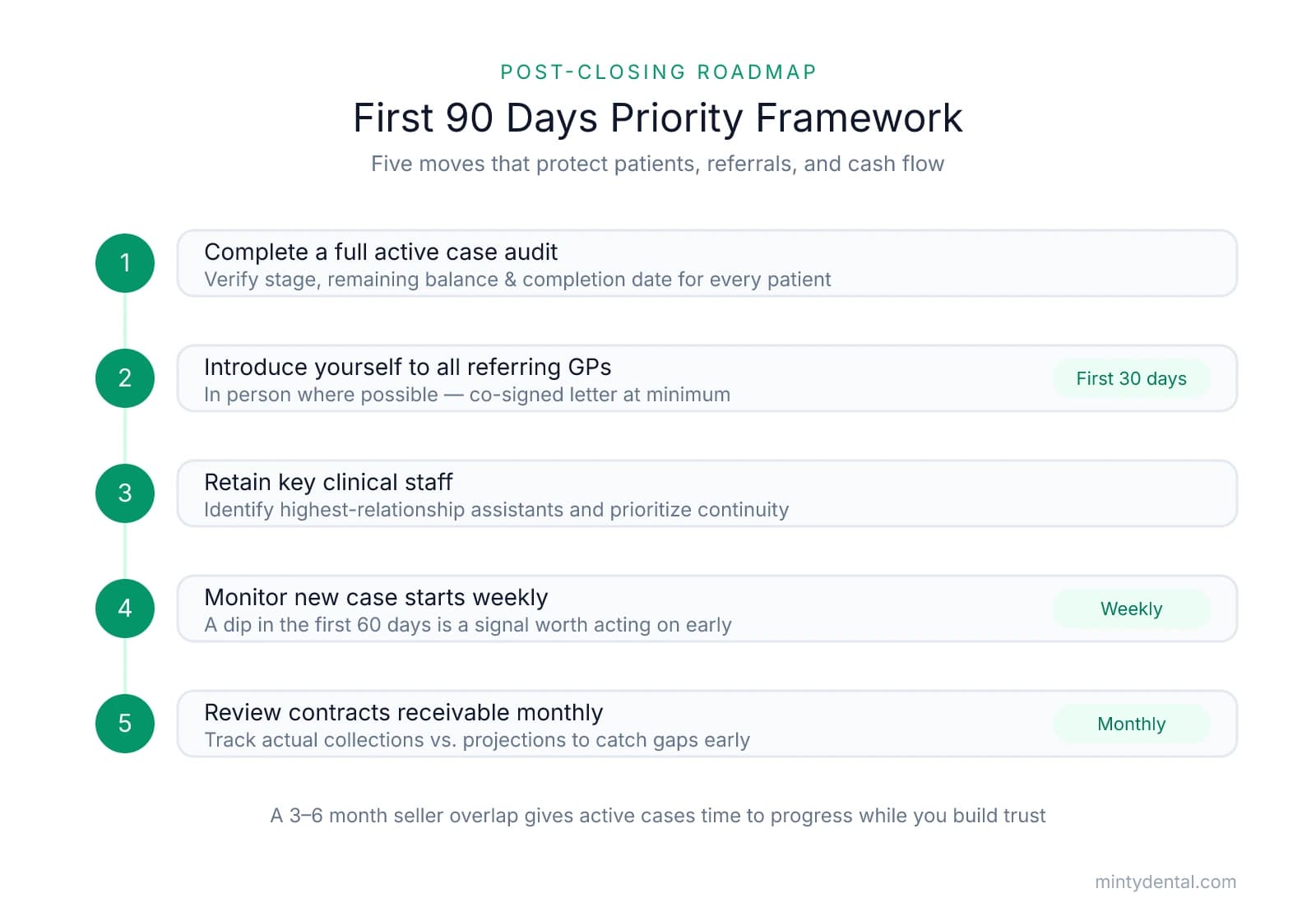
The standard 60–90 day seller transition common in general practice acquisitions is often insufficient for orthodontics. A 3–6 month overlap, with defined clinical responsibilities, gives active cases time to progress under the seller's care while you build patient trust in parallel.
The post-closing employment agreement should specify:
- Which active cases the seller will continue to manage through completion
- How handoffs are structured for cases that cross the transition boundary
- What happens to new case starts after closing — these should be yours from day one
Getting this language right before closing is worth the negotiation. A well-structured seller employment agreement protects both parties and keeps patient care from falling into an undefined gap.
The Referral Network and Staff Retention
Many orthodontic practices depend heavily on GP referrals — and those relationships often belong to the seller personally. Before closing, map the referral sources: How many GPs refer regularly? How long have those relationships existed? Plan a formal introduction to every referring GP within the first 30 days after closing. A co-signed letter from the seller, followed by an in-person visit, is the most effective approach.
Staff continuity matters just as much. Orthodontic patients often have stronger relationships with the clinical assistants managing their appointments than with the orthodontist. Losing a key assistant in the first 90 days can accelerate patient attrition in ways that compound over time. Evaluating staff stability before closing is one of the highest-leverage steps in ortho due diligence.
The Patient Announcement
The communication to active patients should be warm, personal, and co-signed by the seller. Patients in the middle of treatment need one clear message: their care plan is unchanged, their clinical team is intact, and the new owner is committed to seeing their treatment through.
First 90 Days Priority Framework
- Complete a full active case audit — verify treatment stage, remaining balance, and expected completion date for every patient
- Introduce yourself to all referring GPs — in person where possible, co-signed letter at minimum
- Retain key clinical staff — identify your highest-relationship assistants and prioritize their continuity
- Monitor new case starts weekly — a dip in the first 60 days is a signal worth acting on early
- Review contracts receivable monthly — track actual collections against your pre-closing projections to catch cash flow gaps before they compound
Orthodontic acquisitions reward buyers who prepare for the transition with the same rigor they bring to the financial analysis. The practices that retain patients, preserve referral relationships, and maintain clinical continuity through the handoff are the ones that grow — and that outcome is entirely within reach when the transition is treated as part of the acquisition, not an afterthought to it.
Sources & References
The data and claims in this article are drawn from the following sources. We prioritize government data, peer-reviewed research, and established industry publications to ensure accuracy.
- Orthodontic Practice Valuation 2026 - FOCUS Investment Banking— focusbankers.comIndustry
- General Dentists Perform Orthodontics— iaortho.orgIndustry
- 22 Tex. Admin. Code § 108.55 - Advertising for General Dentists— www.law.cornell.eduAcademic
- Why Some Orthodontic Practices Look Profitable But Aren't— cfsdentaldivision.comIndustry
- How to Retain Patients When Buying or Joining a Practice— www.ada.orgIndustry
Ready to acquire your orthodontic practice?
Transitioning from general dentistry to practice ownership requires expert guidance through valuation, due diligence, and closing. Minty's acquisition specialists help you navigate specialty practice purchases from search to keys in hand.