Buying a Dental Practice That Lost Patients After COVID

Co-Founder, Minty Dental
In Summary
- Practices that lost patients after COVID are appearing on the market at discounted prices — the key question is whether that patient loss is recoverable or permanent
- Two types of attrition matter: temporary (patients who paused care but haven't switched providers) and permanent (patients who moved, switched practices, or stopped going to the dentist entirely)
- Preventive dental care broadly returned to near pre-pandemic levels by 2023, but solo practices recovered significantly more slowly than DSOs and group practices
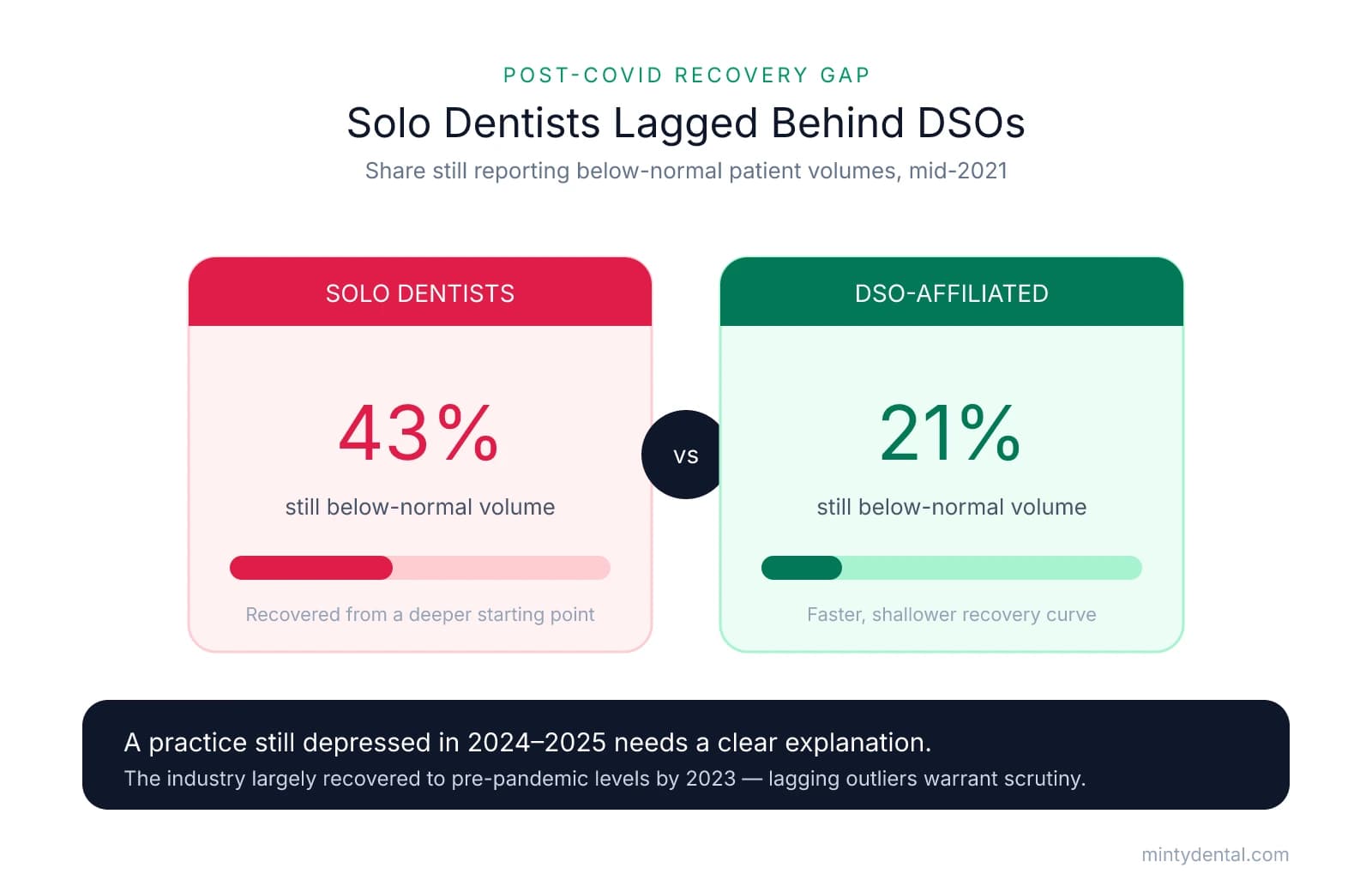
- The ADA Health Policy Institute found that nearly 43% of solo dentists were still reporting below-normal patient volumes as late as mid-2021 — meaning a practice still showing depressed numbers in 2024 or 2025 warrants a different explanation
- The buyer's job isn't to decide whether COVID hurt the practice — it's to determine whether the patient base is recoverable and whether the asking price reflects the real risk
COVID Patient Loss Is Either a Discount Opportunity or a Value Trap — Here's How to Tell
Practices that lost patients after COVID are still showing up on the market — and many of them are priced to reflect it. For a buyer who can read the data clearly, that's either a genuine opportunity to acquire a recovering practice below its stabilized value, or a warning sign dressed up as a discount. The difference comes down to one question: where did those patients actually go?
What tends to happen is that buyers treat COVID-era patient loss as a single category of risk. It isn't. There are two meaningfully different buckets. The first is temporary attrition — patients who paused care during the pandemic, haven't formally left the practice, and are reclaimable with outreach and consistent scheduling. The second is permanent attrition — patients who moved, switched to another provider, or disengaged from dental care entirely. These two groups look identical on a collections report. They don't behave the same way after you close.
The industry-wide recovery picture makes this harder to read, not easier. According to the Delta Dental Institute's 2025 extended analysis, preventive and diagnostic procedures largely returned to pre-pandemic levels by 2023 — encouraging at the macro level, but that aggregate recovery masks real variation at the practice level. The ADA Health Policy Institute's mid-2021 survey data showed that nearly 43% of solo dentists were still reporting below-normal patient volumes at that point, compared to roughly 21% of DSO-affiliated practices. Solo practices recovered more slowly and from a deeper starting point.
That context matters when evaluating a specific practice. A solo practice that dipped in 2020, recovered through 2022, and is now performing at or above pre-pandemic collections tells a very different story than one still showing depressed numbers heading into 2025. The timing of the loss matters as much as the size of it — and a practice that hasn't recovered in line with broader industry trends needs a clear explanation for why.
The sections that follow walk through how to build that explanation from the data: what to pull, what to ask, and how to structure a deal that reflects whichever reality the numbers reveal. A useful starting point is understanding the practice's new patient flow rate, since that metric often separates temporary softness from a deeper structural problem with patient retention.
How to Read the Patient Data Before You Make an Offer
Once you've established that a practice has COVID-era patient loss, the next step isn't forming an opinion — it's requesting the right data. A single current patient count tells you almost nothing. What you're building is a timeline, and that requires pulling numbers across multiple dimensions from 2019 to present.
Here's a practical framework for what to request and what each metric actually tells you.
The Five Data Points That Separate Recoverable from Permanent Loss
1. Active patient count by year (2019–present) Ask for this as a year-by-year trend, not a current snapshot. A practice that dropped from 1,800 active patients in 2019 to 1,200 in 2020 and has since recovered to 1,600 is a fundamentally different asset than one that dropped to 1,200 and stayed there. The trajectory matters more than the current number.
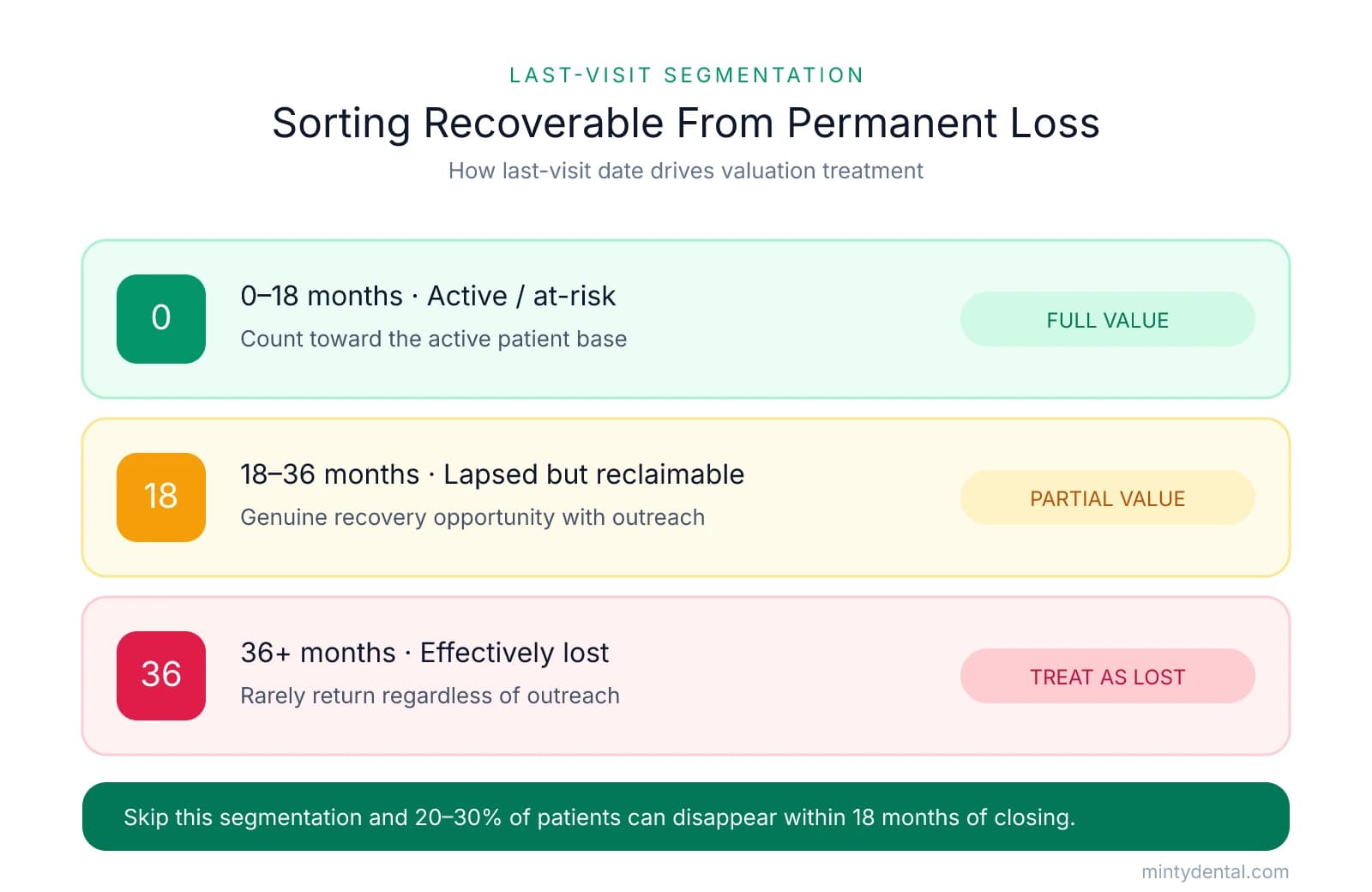
2. Last-visit date distribution This is where the real segmentation happens. Pull the inactive patient list and sort it by how long each patient has been away:
| Last Visit | Status | Valuation Treatment |
|---|---|---|
| 0–18 months | Active / at-risk | Count toward active base |
| 18–36 months | Lapsed but reclaimable | Partial value — recovery possible with outreach |
| 36+ months | Effectively lost | Treat as lost for valuation purposes |
The mybcat.com due diligence framework flags 18 months as the standard threshold for classifying a patient as inactive — and notes that acquirers who skip this segmentation often watch 20–30% of patients disappear within 18 months of closing. Patients in the 18–36 month window represent a genuine recovery opportunity; those past 36 months rarely return regardless of outreach.
3. New patient flow rate, year-over-year This is the leading indicator most buyers underweight. A practice that lost existing patients during COVID but maintained consistent new patient volume has a self-correcting mechanism already in place. One where both existing retention and new patient flow declined simultaneously signals a deeper problem — likely one that predates the pandemic. Ask for monthly new patient counts going back to 2019 and look for whether the trend recovered or flattened.
4. Hygiene recall compliance rate A healthy benchmark sits at 75% or above. According to Dental Economics, practices lose roughly 17% of their active patient base annually under normal conditions — meaning recall compliance is the primary lever keeping that number from compounding. A rate below 60% suggests a systemic retention problem that won't self-correct after you take over.
5. Patient zip code distribution Cross-referencing where lapsed patients lived against local population movement data can reveal whether attrition was geographic — patients who relocated — or behavioral — patients who switched providers. Geographic attrition is largely permanent. Behavioral attrition is often recoverable with the right reactivation approach, which is worth understanding when thinking about how much that patient base is actually worth.
One Qualitative Question That Changes the Picture
Ask the seller directly: did they run any reactivation campaigns for lapsed patients? A large untouched inactive list is a genuine growth asset — reactivating an existing patient costs a fraction of acquiring a new one. But if the seller already worked that list and got minimal response, the recoverable pool is smaller than it appears. The answer shapes how you structure retention protections, which is worth exploring further when negotiating a patient retention guarantee as part of the deal.
How COVID Patient Loss Should Affect the Price and Deal Structure
With a clear picture of the patient data, the next step is translating what you found into an offer. This is where many buyers lose ground — not because they misread the data, but because they don't know how to connect it to price.
Goodwill and the assumption it rests on: In most dental practice sales, goodwill represents 70–85% of the total purchase price. That number is built on one core assumption: that the patients who generated past revenue will keep coming back. COVID-era patient loss directly challenges that assumption. If a meaningful portion of the active base is gone — or uncertain — the goodwill figure needs to reflect it, not the practice's pre-pandemic peak.
The seller-favorable framing to watch for is valuation based on pre-COVID collections. It's a reasonable starting point for a practice that has fully recovered, but for one still running below 2019 levels in 2024 or 2025, it overstates what you're actually buying. The more defensible baseline is trailing 12-month actual performance — with adjustments for any one-time factors that distorted collections in either direction. The standard rule of thumb (70–80% of trailing collections) works, but only when the trailing period reflects a stable, representative run rate.
A pattern worth noting: the dental transitions market post-COVID showed that fully recovered practices received full pre-COVID valuations, while those still lagging required creative deal structures to bridge the gap. That's the framework to bring into your negotiation.
Where Earnouts Fit
When seller and buyer genuinely disagree on how much of the patient base will return, an earnout is often the right tool — not a compromise, but a structure that aligns incentives without requiring either side to bet everything on an uncertain outcome. As Oral Health Group's analysis of dental earnouts describes it: an earnout lets buyer and seller disagree on valuation and still agree on a transaction.
In this context, a workable structure looks like:
- Base price set on current, verified performance — what the practice is actually producing today
- Milestone payments tied to active patient count or collections thresholds, measured at 12 and 24 months post-closing
- Clear definitions of what counts toward the milestone — gross collections, net of adjustments, with a specific patient activity threshold
This protects you if the recovery doesn't materialize, while giving the seller a path to full value if their confidence in the patient base turns out to be warranted.
Seller Transition Length as a Risk Variable
One protection that's easy to undervalue is structured transition support. In a standard acquisition, a 30–60 day seller presence is common. In a practice with meaningful COVID-era attrition, that's often not enough. A seller who stays 90 days or more — and actively participates in reactivation outreach, patient introductions, and recall campaigns — is a genuine risk mitigant. A seller who hands over the keys at closing leaves the reactivation burden entirely on you.
When negotiating the seller's post-closing employment agreement, consider building in specific responsibilities around patient reactivation, not just clinical coverage. Defined expectations on both sides tend to produce better outcomes than a general "transition support" clause.
A practice still significantly below pre-COVID collections in 2024–2025 — in an environment where the broader industry largely recovered by 2023 — has a harder story to tell. The discount should reflect not just the current gap, but how much of that gap remains unexplained by the data you've reviewed.
Making the Decision: When to Walk Away and When to Move Forward
Everything in this analysis comes down to a single question: does the data support a recovery thesis, and does the deal structure protect you if that thesis takes longer than expected?
Here's how the two scenarios tend to look in practice.
The 'move forward' signal set is fairly consistent across deals worth pursuing: collections trending upward over the last 12–18 months, a large inactive patient list that hasn't been worked through reactivation campaigns, new patient flow that held steady or recovered, a seller willing to stay 90 days or more with defined transition responsibilities, and a price anchored to current performance rather than 2019 peak collections. When those conditions align, you're buying a practice with a credible recovery story — and paying a discount that a fully-recovered practice would never offer.
The 'walk away or renegotiate' signal set is equally recognizable: collections still flat or declining in 2024–2025 with no clear explanation, new patient flow also declining (which points to a competitive or demographic problem that predates COVID, not a pandemic hangover), an aging patient base with high natural attrition, and a seller asking for pre-COVID valuation with no earnout flexibility. When a seller won't accept a price adjustment or milestone-based structure on a practice that hasn't recovered in line with the broader market, that's meaningful information about how they read the risk.
The inactive patient list is often the variable that separates these two scenarios. A large, unworked list of patients who haven't formally left the practice is a genuine asset — one that can be reactivated at a fraction of the cost of new patient acquisition. A list that's been worked and didn't respond is evidence of permanent loss, and it should be treated that way in your valuation. It's worth noting that 76% of dental offices closed to all but emergency patients during the early pandemic period, which means inactive lists at practices that never ran reactivation campaigns may represent years of accumulated dormant patients — not permanent attrition.
One factor that often surfaces late in the process is the financing picture. Lenders will scrutinize multi-year revenue trends closely, and a practice with a sustained post-COVID decline may face tighter loan terms or require a larger down payment — which affects your cash flow math from day one. Understanding what banks actually look for when financing a dental practice acquisition is worth reviewing before you finalize your offer structure.
On the tax side, how you allocate the purchase price across goodwill, equipment, and other assets has real implications for post-closing cash flow — particularly in deals where goodwill is discounted from a typical multiple. The dental practice purchase price allocation calculator is a useful tool for modeling different allocation scenarios before you finalize terms.
Buyers who do this analysis rigorously are positioned to acquire a recovering practice at a discount that a stabilized, fully-recovered practice would never offer. The work is in confirming the recovery thesis before closing — not hoping for it after.
Sources & References
The data and claims in this article are drawn from the following sources. We prioritize government data, peer-reviewed research, and established industry publications to ensure accuracy.
- Research shows preventive dental care nears pre- ...— www.deltadentalinstitute.comIndustry
- Pandemic recovery: Solo dentists lag behind— coronavirus.dental-tribune.comNews
- Dental Acquisition Due Diligence: Patient Retention Red— mybcat.comIndustry
- Patient attrition: 3 steps to finding a hidden gold mine— www.dentaleconomics.comIndustry
- Update: Dental Practice Sales in a Post-COVID Environment— dentaltransitions.comIndustry
- Update: Dental Practice Sales in a Post-COVID Environment— dentaltransitions.comIndustry
- Earnouts in dental practice acquisitions: What you need to ...— www.oralhealthgroup.comIndustry
- COVID-19 and Dentistry Timeline— pages.ada.orgIndustry
Ready to acquire a resilient dental practice?
Buying a practice with patient loss requires careful due diligence and the right support. Minty guides you through acquisition strategy, valuation assessment, and recovery planning to ensure your investment succeeds.