Buying a Practice with an In-House Membership Plan

Co-Founder, Minty Dental

In Summary
- A dental membership plan can be a genuine recurring revenue asset — but in an asset purchase, member contracts don't transfer automatically without explicit assignment language in the purchase agreement.
- Membership patients generate 17–51% higher net production than commercial insurance patients and tend to accept more treatment, visit more consistently, and churn at lower rates.
- Churn rate is the most revealing due diligence metric: a plan with 40% annual churn is a treadmill, not a durable asset.
- In-house plans are regulated as Discount Medical Plans in most states; 25 states require formal DMPO licensure, and inheriting a non-compliant plan puts that revenue at immediate risk.
- Buyers who document compliance, verify transfer mechanics, and negotiate seller indemnification aren't just protecting downside — they're confirming the asset they're paying for is real.
A Membership Plan Is an Asset — But Only If It Transfers
An in-house dental membership plan is a direct subscription agreement between a dental practice and its patients. Patients pay a flat monthly or annual fee in exchange for bundled preventive care — typically two cleanings, exams, and X-rays — plus a defined discount on restorative and other treatment. There's no insurance company involved, no claims process, no reimbursement lag. The ADA describes these arrangements as a direct financial relationship between doctor and patient, distinct from both commercial insurance and third-party discount networks.
That distinction matters more than it might seem at first.
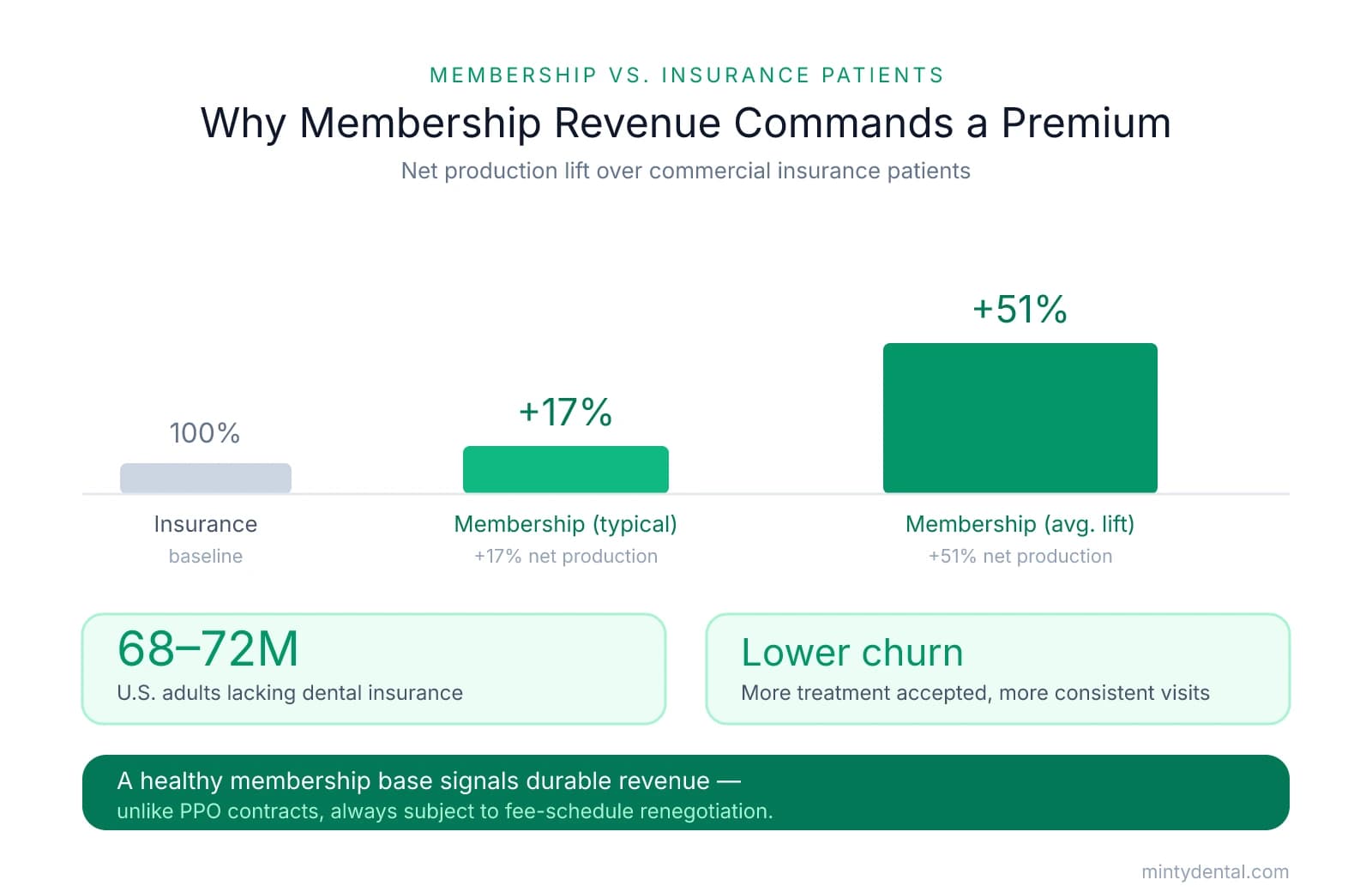
For a practice buyer, a well-run membership plan can look like exactly what it is: a recurring revenue stream attached to a loyal, treatment-accepting patient base. The numbers behind that picture are hard to ignore. According to Clerri, net production for membership patients runs 17% higher than patients on commercial insurance — and across the broader population of practices using their platform, that lift averages closer to 51%. Membership patients also tend to accept more treatment, visit more consistently, and churn at lower rates than uninsured fee-for-service patients.
The market context reinforces why this matters. Roughly 68–72 million American adults lack dental insurance, and practices that convert even a fraction of that population into membership subscribers gain a meaningful edge over PPO-dependent competitors. For buyers evaluating a practice's revenue mix, a healthy membership plan can signal something more durable than insurance contracts — which are always subject to fee schedule renegotiation. That dynamic is worth understanding alongside the broader fee-for-service vs. PPO value question that shapes most acquisition conversations.
But here's where the opportunity gets conditional.
A membership plan is not a license, a certification, or a transferable asset in the traditional sense. It's a collection of individual contracts — one between the practice and each enrolled patient. In an asset purchase (the structure used in the vast majority of dental acquisitions), those contracts don't follow the practice automatically. Without explicit assignment language in the purchase agreement, a buyer can close on a practice and find themselves operating a plan they have no legal standing to honor — or collect revenue from.
That contractual reality is the thread running through everything that follows. The goal isn't to treat membership plans as a red flag — they're genuinely worth pursuing. It's to give you a framework for evaluating whether the plan you're inheriting is a real asset or a liability in disguise.
How to Read the Membership Revenue — and Stress-Test What You're Actually Buying
Even when transfer is handled correctly, the revenue itself deserves its own scrutiny. A plan with 400 members generating $180,000 in annual fees can look like a strong recurring income stream. Whether it actually is depends on four things most buyers don't examine until after the LOI.
Start with the Member Roster — Before You Model Anything
Request a full member roster early in due diligence, ideally before you've committed to a price. What you're looking for:
- Total active members (not historical enrollments — active and current)
- Monthly vs. annual payers — annual payers generate upfront cash but create service obligations; monthly payers are easier to model but churn more visibly
- Average membership tenure — a plan where most members have been enrolled for 3+ years signals genuine loyalty; one where the average tenure is under 12 months suggests the plan is newer or churning heavily
- Upcoming renewal dates — a cluster of annual renewals in the 60–90 days after closing means you'll face an early retention test before you've had time to establish relationships
This roster is the raw material for everything that follows. Without it, you're valuing a subscription business without knowing who the subscribers are.
Calculate Churn — Then Recalculate the Revenue
Churn rate is the single most revealing metric in membership plan due diligence. A plan with 300 members and 40% annual churn is replacing 120 patients per year just to stay flat — that's not recurring revenue, it's a treadmill. A plan with 300 members and 10% churn is a genuinely durable asset.
Ask for two to three years of enrollment data: members at the start of each year, new enrollments, and cancellations. The math is straightforward — cancellations divided by beginning membership equals annual churn. FOCUS Investment Banking notes that EBITDA quality, not just the raw number, drives valuation multiples in dental acquisitions — and recurring revenue with high churn is exactly the kind of composition issue that erodes a multiple.
Understand the Prepaid Revenue Problem
Annual memberships create a liability that doesn't always appear on a seller's books. If a patient paid $400 in January and you close in July, you inherit six months of service obligations — cleanings, exams, X-rays — without receiving the corresponding cash. Across a plan with several hundred annual payers, that deferred obligation can be material.
Ask how the seller accounts for prepaid memberships. If they're booking the full annual fee as revenue at enrollment rather than recognizing it ratably, the P&L will overstate cash available to you around closing. This is worth flagging with your dental CPA and potentially structuring as a closing adjustment.
The Seller Dependency Question
One pattern worth watching: membership retention driven by patients' personal relationship with the selling dentist. Long-tenured patients who enrolled because they trust Dr. Smith specifically may not renew under new ownership — regardless of how well the plan is structured. Churn data alone won't capture this risk.
The seller's post-closing role matters here. A structured transition where the seller remains present for 60–90 days — with defined patient communication responsibilities — can meaningfully reduce attrition. A well-drafted seller employment agreement is one place to formalize that arrangement.
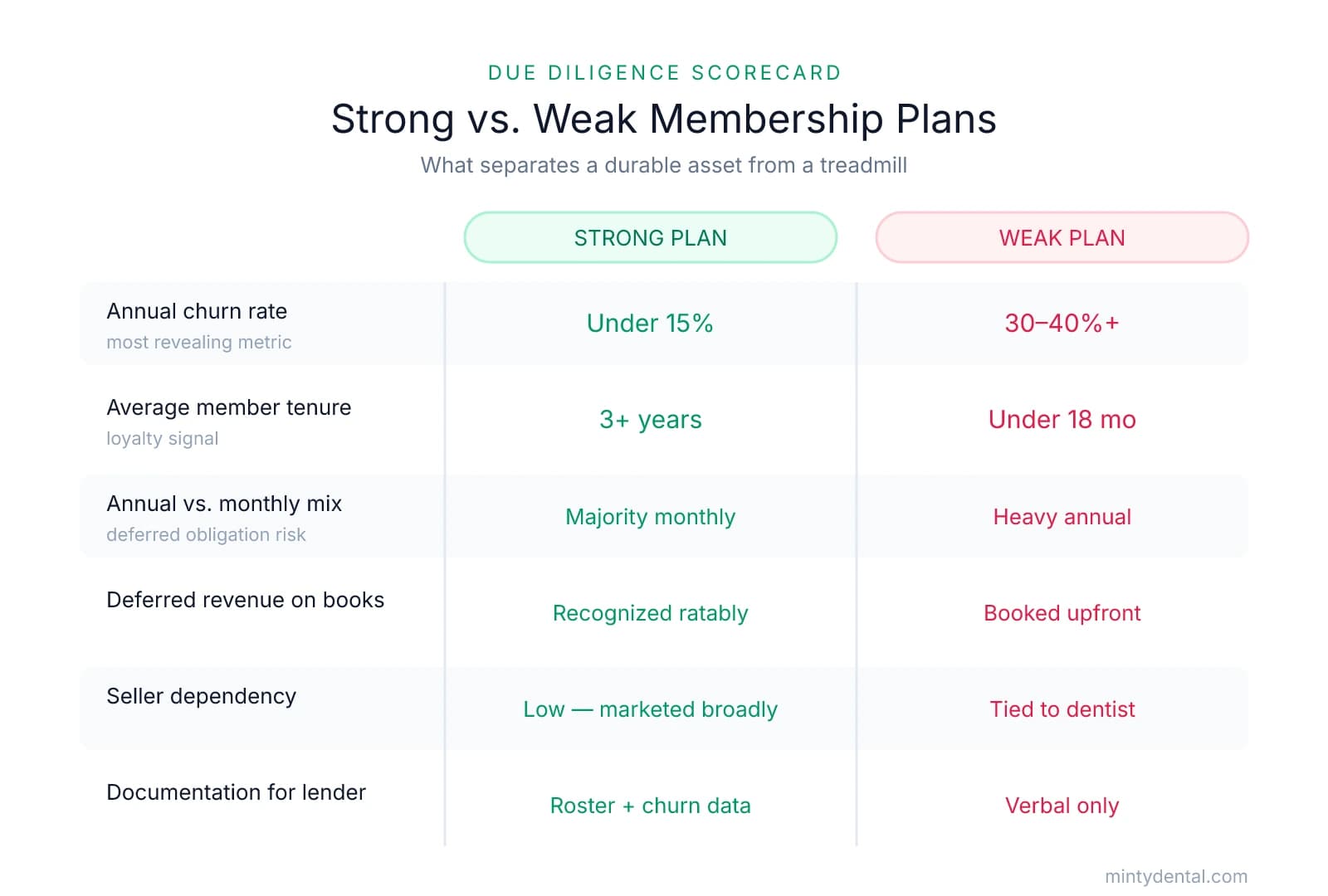
What Strong vs. Weak Membership Metrics Look Like
| Metric | Strong Plan | Weak Plan |
|---|---|---|
| Annual churn rate | Under 15% | 30–40%+ |
| Average member tenure | 3+ years | Under 18 months |
| Annual vs. monthly mix | Balanced or majority monthly | Heavy annual (deferred obligation risk) |
| Deferred revenue on books | Properly recognized ratably | Booked upfront, liability understated |
| Seller dependency | Low — plan marketed broadly | High — retention tied to outgoing dentist |
| Documentation for lender | Roster, renewal history, churn data available | Verbal representations only |
Lenders and appraisers can support a higher valuation multiple for practices with documented, low-churn recurring revenue — but "documented" is the operative word. If the seller can't produce a roster, renewal history, and churn data, the plan shouldn't be treated as a premium asset in your offer.
The Compliance and Contract Transfer Checklist Every Buyer Needs
Revenue quality is only half the picture. Before you can rely on membership income as a durable asset, you need to confirm the plan can legally continue operating under your ownership — and that's not a given.
In-house dental membership plans are classified as Discount Medical Plans (DMPs) in most states. According to Group Dentistry Now, DMPs are currently regulated in 35 states — and per Subscribili, 25 of those states require formal DMPO licensure before a plan can legally enroll a single patient. Application and renewal fees run $500–$2,000 per state, plus annual surety bond requirements — and the licensing process itself can take 6 to 18 months.
The consequence of a non-compliant plan isn't just a fine. Regulators can suspend or terminate the plan outright. A buyer who closes on a practice and inherits a plan operating without proper licensure could lose that membership revenue almost immediately — revenue that was likely factored into the purchase price.
Bring the following checklist to your attorney before closing.
Pre-Closing Compliance and Transfer Checklist
1. Is the plan registered or licensed in this state? Request documentation — not a verbal confirmation. If the practice operates in a state requiring DMPO licensure, ask for the license number and verify it's current with the state insurance department.
2. Who holds the license or registration? If the license is held by the seller personally, or by a practice entity being dissolved in the transaction, it doesn't transfer automatically. You may need to re-register or apply for a new license before continuing to operate the plan — which takes time and creates a gap in legal authority.
3. Does the purchase agreement explicitly assign the member contracts? In a standard asset purchase, membership contracts don't transfer automatically. Your attorney needs to include explicit assignment language covering the individual subscriber agreements. Without it, you have no legal standing to collect membership fees or honor the plan's terms post-closing.
4. Are the member agreements compliant with state disclosure requirements? States that regulate DMPs often require specific language in member-facing contracts — cancellation rights, fee disclosures, service descriptions. If the seller's agreements don't meet current requirements, you inherit the compliance gap.
5. Does the practice also participate in PPO networks? If so, review those insurance contracts for most-favored-nation (MFN) clauses. Offering membership discounts that undercut your contracted PPO rates can trigger violations — creating audit exposure with insurers. This risk compounds if you're also navigating an insurance credentialing gap in the transition period.
6. If the plan runs on a third-party platform, is that contract assignable? Platforms like Smile Advantage, Clerri, or Plan Forward hold their own agreements with the practice. Confirm whether the platform contract transfers to the buyer, what the transition process looks like, and whether there are fees or re-enrollment requirements. This sits alongside other vendor contract transfer questions that surface in any acquisition.
None of these questions should be a reason to walk away from an otherwise strong practice. A compliant, well-documented plan that transfers cleanly is a genuine asset. The goal is to confirm that's what you're actually buying — before the wire clears.
Negotiating Around the Plan and Setting Up for Day One
By the time you've worked through the compliance checklist and stress-tested the membership revenue, you have something most buyers don't: specific, documented information about the plan's actual condition. That information is negotiating leverage — and it's worth using.
A plan with regulatory gaps or high churn isn't automatically a dealbreaker, but it's a legitimate basis for adjusting terms. If the plan is operating without required DMPO licensure, or if churn data reveals the membership base is eroding, those are quantifiable risks that belong in the price conversation. A seller who priced the practice assuming healthy recurring revenue should be willing to either adjust the purchase price or agree to a seller indemnification clause covering pre-closing regulatory violations — and your attorney can draft language tying the indemnification specifically to the plan's compliance status before closing.
What the Purchase Agreement Should Cover
Beyond price, the purchase agreement itself needs to address the membership plan explicitly. Four provisions are worth confirming with your attorney:
- Explicit assignment of member contracts — in an asset purchase, these don't transfer automatically. The agreement should name the membership plan and assign the individual subscriber agreements to you as buyer.
- Seller representations about compliance status — the seller should represent, in writing, that the plan is currently operating in compliance with applicable state law. If that representation turns out to be false, the indemnification clause gives you recourse.
- Indemnification for pre-closing violations — any regulatory action or member dispute arising from conduct before the closing date should remain the seller's liability, not yours.
- A defined transition support period — the seller's post-closing role in communicating the ownership change to members should be spelled out. This connects naturally to the seller employment agreement negotiation and is worth formalizing rather than leaving to goodwill.
Communicating the Transition to Members
A proactive, co-signed letter from both the outgoing and incoming dentist — sent before or immediately at closing — is one of the highest-return steps a buyer can take. Members who feel informed tend to renew; members who discover the change at their next appointment tend to cancel. The content matters less than the timing and the co-signature: patients need to hear from the dentist they trusted that the transition is intentional and endorsed.
If the Plan Needs to Be Rebuilt
If you inherit a DIY plan with compliance gaps, the path forward is migration — not continuation. Operating a non-compliant plan as the new owner creates fresh liability that belongs entirely to you. Moving members to a licensed third-party platform before re-enrolling them is the cleaner approach, even if it means a temporary enrollment pause.
A practice with a compliant, low-churn membership plan offers something genuinely difficult to replicate: predictable revenue attached to patients who've already opted into a relationship with the practice. Most PPO-heavy practices can't say the same — membership plans reduce dependence on insurance carriers whose fee schedules and claim delays control practice profitability. Buyers who do this work carefully aren't just protecting themselves from downside — they're confirming that the asset they're paying for is real.
Sources & References
The data and claims in this article are drawn from the following sources. We prioritize government data, peer-reviewed research, and established industry publications to ensure accuracy.
- Is an in-office dental plan right for your practice?— ada.orgIndustry
- Dental Membership Plans Prove Better Than Insurance— decisionsindentistry.comIndustry
- Dental Practice EBITDA - FOCUS Investment Banking— focusbankers.comIndustry
- Membership Plan Regulations: Everything You Need to Know to ...— groupdentistrynow.com
- DMPO Licensing: Why DIY Dental Membership Plans Fail ...— subscribili.comIndustry
- Why Dentists Should Consider an In-House Membership Plan— engageadvisors.com
Ready to acquire your membership-based practice?
Buying a practice with an established membership plan requires careful evaluation of patient contracts and revenue stability. Minty's acquisition experts guide you through every step of the process, from initial search to closing, ensuring you understand the membership model's financial health and transferability.