When the Associate Outproduces the Owner: Is It Safe to Buy?

Co-Founder, Minty Dental

In Summary
- When an associate outproduces the owner, the practice has two distinct revenue streams — one that transfers automatically and one that depends entirely on a provider with no legal obligation to stay
- The seller's asking price is almost always anchored to total collections; buyers who negotiate from that number without isolating transferable revenue are paying a premium for production they may not retain
- The "floor test" — calculating collections if the associate leaves on day one — reveals what you're actually financing, not what the listing presents
- Provider concentration is the single biggest risk factor in dental practice M&A: when one associate generates 60% or more of collections, enterprise value can drop 15–25%
- Associate production is a real asset, but only if the revenue actually transfers — verifying that before closing is the work
When the Associate Outproduces the Owner, You're Buying Two Different Assets
Most listings that feature a high-producing associate frame it as a selling point. More chairs running, more capacity already built, a second revenue engine already humming. Brokers present it as upside. And in some cases, it genuinely is. But when the associate outproduces the owner, something more specific is happening: the practice's largest revenue stream belongs to a provider who has no legal obligation to stay after closing. That's not a reason to walk away — it's a reason to look much more carefully at what you're actually buying.
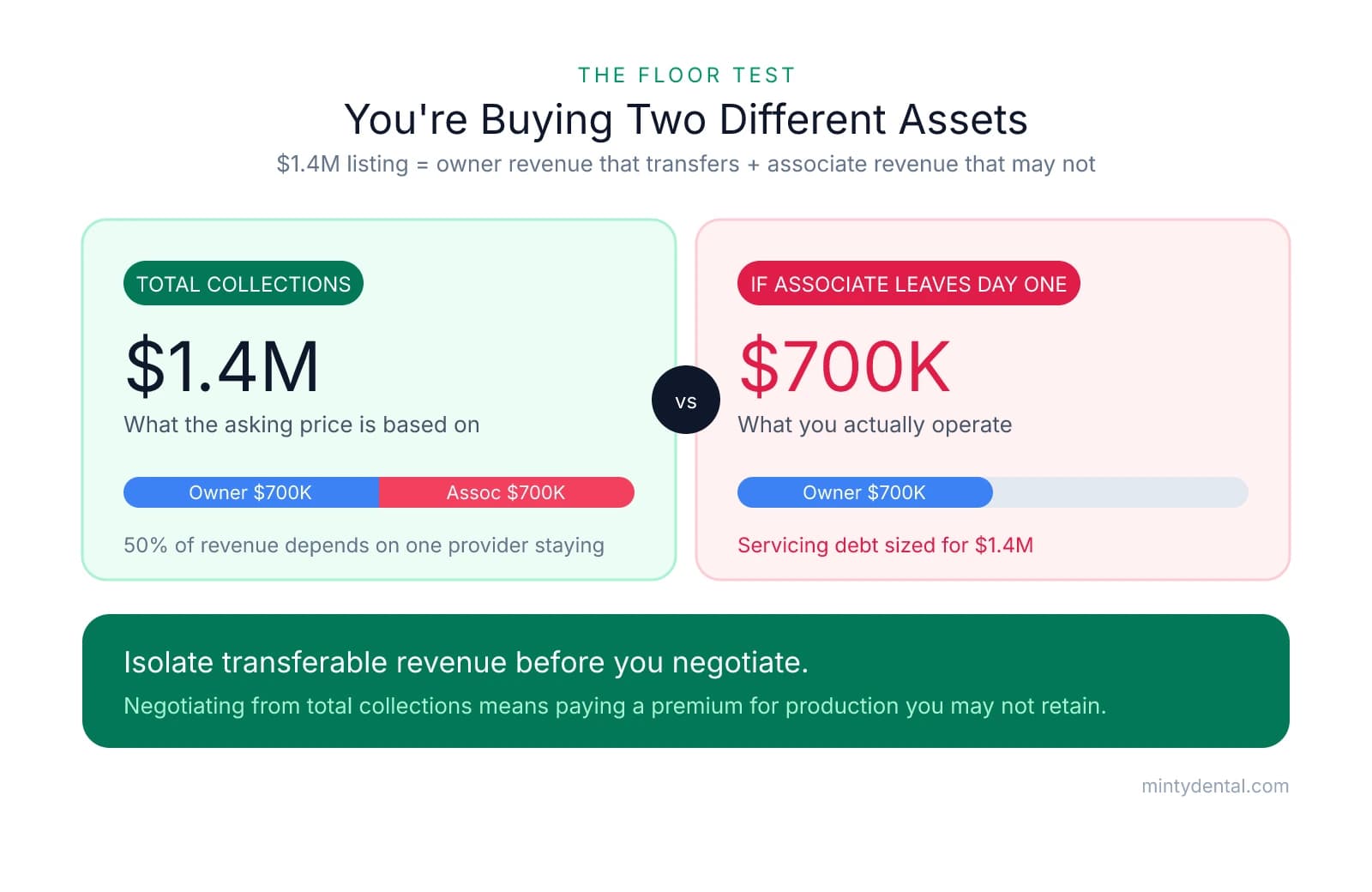
The clearest way to see this is through a production-by-provider report — a practice management report that breaks out each clinician's individual production rather than presenting a single blended collections figure. Request this before anything else. It separates the practice into its two actual components: owner production, which transfers with the keys, and associate production, which transfers only if the associate does.
Take a concrete example. A practice lists at $1.4M in total collections. The associate accounts for $700K of that. The seller's asking price — almost certainly calculated as a multiple of total collections — reflects both streams equally. But if the associate leaves on day one, you're operating a $700K practice while servicing debt sized for a $1.4M one. That gap is what the floor test is designed to surface: strip out associate production entirely, and ask whether the remaining revenue justifies the price and the loan.
The seller's asking price is almost always based on total collections. Buyers who negotiate from that number without isolating transferable revenue are paying a premium for production they may not retain.
The risk scales with concentration. According to Glacier Lake Partners, provider concentration is the single biggest risk factor in dental practice M&A — a practice where one associate produces 60% or more of collections faces a key-man discount that can reduce enterprise value by 15–25%. That's not a marginal adjustment; it's a fundamental reframe of what the practice is worth under realistic assumptions.
None of this makes the scenario a deal-killer. Practices with strong associate production can be excellent acquisitions — the associate's revenue is real, the patients are real, and the chair capacity is already there. The question isn't whether to buy; it's whether the associate's production is priced correctly and protected contractually. Buyers who've navigated associate dynamics before closing know that the due diligence work happens before the ink dries, not after. The sections that follow walk through exactly how to do that.
How to Underwrite the Real Risk: Reading the Numbers That Actually Matter
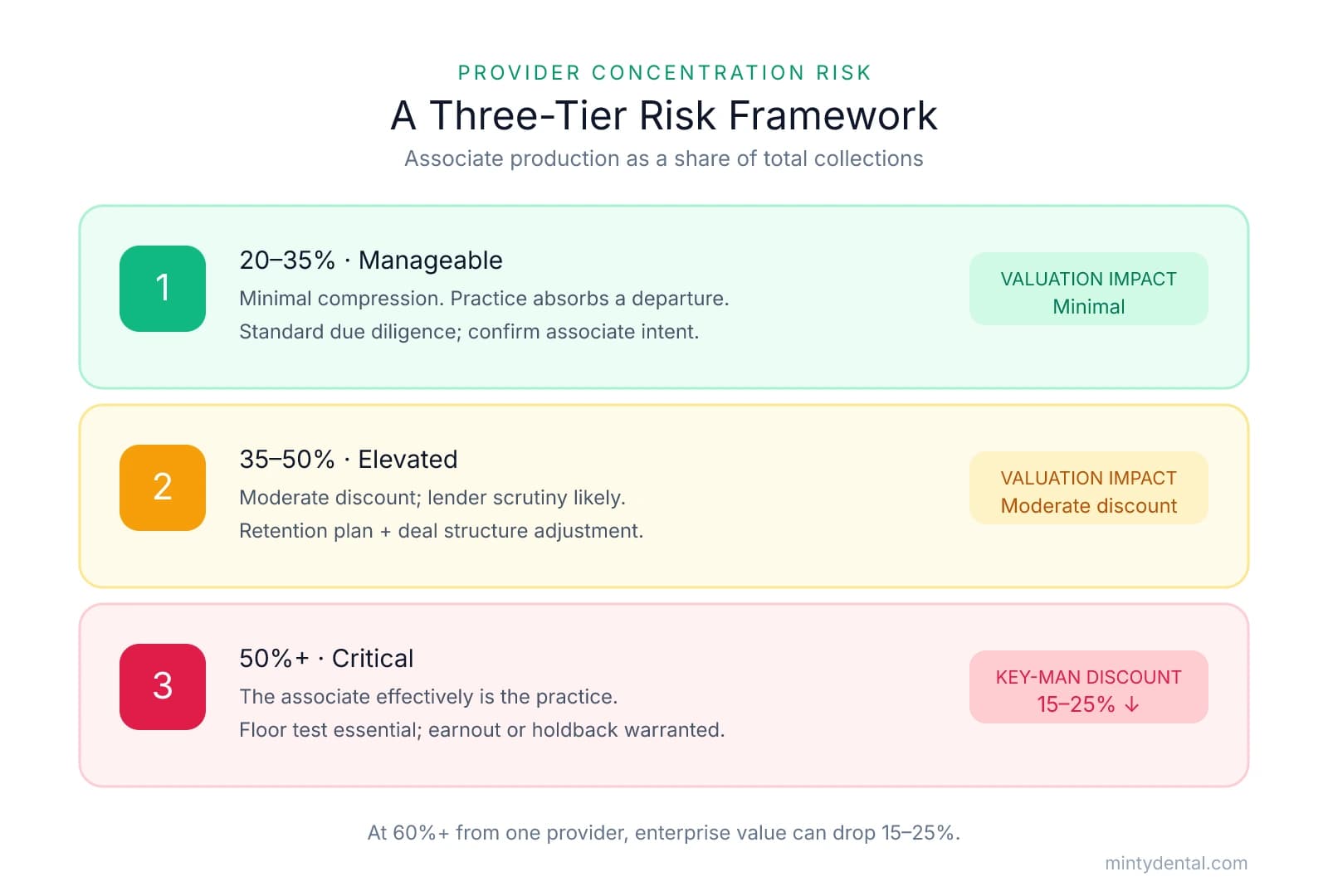
Once you've isolated associate production from owner production, the next question is how much concentration risk you're actually carrying — and what it means for price, structure, and financing. A useful starting framework is a three-tier model based on associate production as a percentage of total collections.
| Associate Production (% of Collections) | Risk Level | Valuation Impact | Buyer Action |
|---|---|---|---|
| 20–35% | Manageable | Minimal compression | Standard due diligence; confirm associate intent |
| 35–50% | Elevated | Moderate discount; lender scrutiny likely | Retention plan required; consider deal structure adjustment |
| 50%+ | Critical | Significant compression; key-man discount applies | Floor test essential; earnout or holdback warranted |
Tier 1 (20–35%) represents meaningful but not practice-defining exposure. The associate contributes real revenue, but the practice can absorb their departure without collapsing debt service. Standard due diligence applies — confirm the associate's intent, review their contract, and move forward with normal underwriting.
Tier 2 (35–50%) is where many buyers underestimate the structural problem. The associate is now a material revenue driver, and lenders will notice. Just as payer mix can compress borrowing capacity, provider concentration affects how conservatively a lender underwrites the deal. At this tier, a documented retention plan and some form of deal structure adjustment — a seller holdback, a reduced upfront price, or a retention-linked earnout — starts to make sense.
Tier 3 (50%+) is where the framing shifts entirely: the associate effectively is the practice. According to Glacier Lake Partners, when one provider generates 60% or more of collections, enterprise value can face a key-man discount of 15–25%. Sophisticated buyers — particularly DSOs — rarely absorb that risk through a lower headline price alone. Instead, they move it into deal structure: holdbacks, earnouts tied to associate retention, or staged payments contingent on production continuity.
There's a goodwill dimension here that's easy to miss. The ADA's valuation guidance puts goodwill at 75–85% of a dental practice's sale price — the dominant asset in almost every transaction. But goodwill has two forms: enterprise goodwill, which belongs to the practice's systems and transfers with ownership, and personal goodwill, which is tied to individual provider relationships. When the associate is the primary producer, a meaningful share of that goodwill is theirs — built on patient trust and clinical reputation that doesn't automatically transfer to a new owner.
Before making an offer on any Tier 2 or Tier 3 practice, run the floor test across three scenarios: collections if the associate stays at 100% production, at 80%, and at 60%. Model debt service against each. The scenario where the associate reduces production by 40% — not an unlikely outcome after a change of ownership — should still leave you with a serviceable practice. If it doesn't, the price needs to move, the structure needs to change, or both.
What the Associate's Contract Actually Means — and What to Negotiate Before Closing
Here's a dynamic that catches many buyers off guard: in an asset purchase — the most common structure in dental practice transactions — the seller's employment agreement with the associate does not automatically transfer to the buyer. You're acquiring the business assets, not the seller's legal entity. That means the associate's existing contract is essentially between them and the seller. You start with a clean slate.
That's both an opportunity and a risk. The opportunity: you're not locked into compensation terms that may not work under your ownership model. The risk: the associate isn't locked into anything either. Close without a new agreement in place, and your largest revenue producer walks in on day one with no contractual obligation to stay.
Four questions worth answering before you close:
-
Does the associate have a non-compete with the seller — and does it survive the sale? Some associate agreements include non-competes that bind the associate to the selling entity, not the practice location. Whether that clause transfers or expires at closing is a legal question worth running through your attorney. As Dental CPAs notes, associates motivated to go independent after their employer exits can leverage established patient and staff relationships — which are now yours — to do exactly that.
-
Is the associate's compensation structure sustainable under your model? Review the existing comp arrangement during due diligence. A percentage-of-production structure that made sense under the seller's overhead profile may look different once you're servicing acquisition debt.
-
Has anyone had a direct conversation with the associate about their intent to stay? This is the step many buyers skip because it feels awkward to arrange. Their answer — or their reluctance to give one — is material information. An associate who's enthusiastic about the transition is a very different risk profile than one who's noncommittal or actively exploring other options.
-
What protections can you negotiate with the associate before closing? Before closing, you have something the associate wants: continuity, stability, and a clear path forward. After closing, that leverage largely disappears.
Asking the associate to sign a new employment agreement — including a non-compete and non-solicitation clause — is standard practice in acquisitions where associate production is material. The ADA's practice transition guidance treats restrictive covenants as a routine component of these arrangements, not an adversarial one. The framing matters enormously, though. Leading with a legal demand rarely sets the right tone. The more effective approach is to pair the non-compete with genuinely competitive compensation — presenting it as a mutual commitment rather than a constraint. You're asking them to stay; the agreement formalizes that.
If the associate refuses any retention agreement, that's important information. It doesn't automatically kill the deal, but it materially changes the risk profile and should factor directly into your offer price. Some buyers in this position have found that structuring patient retention protections into the deal itself provides a partial hedge, though it's not a substitute for associate continuity. Where the relationship looks genuinely untenable, it's worth reading through the dynamics of buying when you may need to replace the associate — a related but distinct set of considerations.
The broader point: the window before closing is when leverage over the associate situation is highest. Use it.
How to Structure the Deal When the Associate Is the Practice's Engine
If you've done the work — run the floor test, reviewed the contract, had the direct conversation — you're now in a position most buyers never reach: you understand what you're actually buying. The question shifts from should I buy this? to how do I structure it correctly?
Three deal tools address associate concentration risk directly.
1. Negotiate from the transferable revenue floor, not total collections.
The seller's asking price is almost always anchored to combined collections. When the associate generates a material share of production, the gap between total collections and owner-only collections is the starting point for any price adjustment conversation — not a footnote. If the associate leaves on day one, what does the practice actually produce? That floor is what you're financing, and the distance between it and the asking price is where your due diligence findings become negotiating leverage.
2. Propose a partial earnout tied to associate retention or post-close collections.
When a seller prices in the associate's production, they're asking you to pay today for revenue that depends on a provider decision made tomorrow. A partial earnout rebalances that. Rather than absorbing the full risk at closing, a portion of the purchase price becomes contingent on the associate remaining — or on post-close collections hitting a defined threshold. As Oral Health Group explains, earnouts are increasingly common in dental acquisitions precisely because they let buyers and sellers bridge a valuation disagreement without walking away from a deal. The seller gets upside if the associate stays; you get protection if they don't.
3. Structure a retention escrow or holdback.
A portion of the purchase price — typically 10–15% — held in escrow and released only after the associate remains for a defined period, usually 12–24 months. This isn't punitive; it's a standard mechanism that aligns the seller's incentive with your risk. If the associate stays, the seller receives the full amount. If they leave in month three, the holdback compensates you for the revenue disruption.
Taken together, these tools reframe the scenario. A practice that already supports two producers has demonstrated something valuable: the patient base, chair capacity, and systems can sustain more than one clinical revenue stream. That's infrastructure, not liability. Your job as the buyer is to verify the second producer comes with the deal, price the risk correctly where there's uncertainty, and build the contractual protections that convert that uncertainty into a manageable outcome.
The place to start is straightforward: request the production-by-provider report before making an offer. Then, before you submit anything, have a direct conversation with the associate. Their intent — and their openness to a new employment agreement — tells you more than any financial document. If you're modeling what a competitive retention package might look like, the associate compensation calculator is a practical tool for stress-testing different comp structures against your post-acquisition overhead.
The associate outproducing the owner isn't a red flag. It's a complexity — one that rewards buyers who do the work.
Sources & References
The data and claims in this article are drawn from the following sources. We prioritize government data, peer-reviewed research, and established industry publications to ensure accuracy.
- Glacier Lake Partners— glacierlakepartners.com
- Personal Goodwill: Why a Dental Buyer Can Withhold Your ...— precisiondentalanalytics.comIndustry
- Staff Contracts When a Dental Practice Is Sold in LA— polishedlegal.comIndustry
- The Role of Restrictive Covenants in Dental Acquisitions— dentalcpas.comIndustry
- Joining and Leaving the Dental Practice— ada.orgIndustry
- Earnouts in dental practice acquisitions: What you need to know— www.oralhealthgroup.comIndustry
Ready to acquire a thriving dental practice?
Evaluating a practice with a high-producing associate requires expert guidance to assess sustainability and risk. Minty's acquisition specialists help you navigate provider concentration concerns and structure deals that protect your investment.