Found a Better Dental Practice After Signing the LOI: Your Options

Co-Founder, Minty Dental

In Summary
- Most LOI provisions remain negotiable until you sign the definitive purchase agreement, but three clauses bind you immediately: exclusivity (typically 30–90 days), confidentiality, and earnest money deposit conditions (1–3% of purchase price).
- Earnest money is refundable if you exit for reasons covered by due diligence contingencies—financing denial, lease assignment failure, material record discrepancies—but walking away to pursue another deal typically triggers forfeiture.
- The practice under LOI has been stress-tested; the new listing hasn't. Apply the same diligence framework before assuming the second opportunity is materially better—recency bias makes untested practices look shinier than they are.
- Push forward when issues are operational (fixable with capital and process changes); pivot only when they're structural (declining patient base, lease termination, undisclosed liabilities) and you're still within contingency protection.
Most LOI Provisions Are Non-Binding—But Three Clauses Lock You In
Signing a letter of intent does not mean you own the practice. What it does mean: you've entered a binding commitment on three specific fronts that determine whether you can walk away cleanly or whether pivoting to a second opportunity will cost you money, legal exposure, or both.
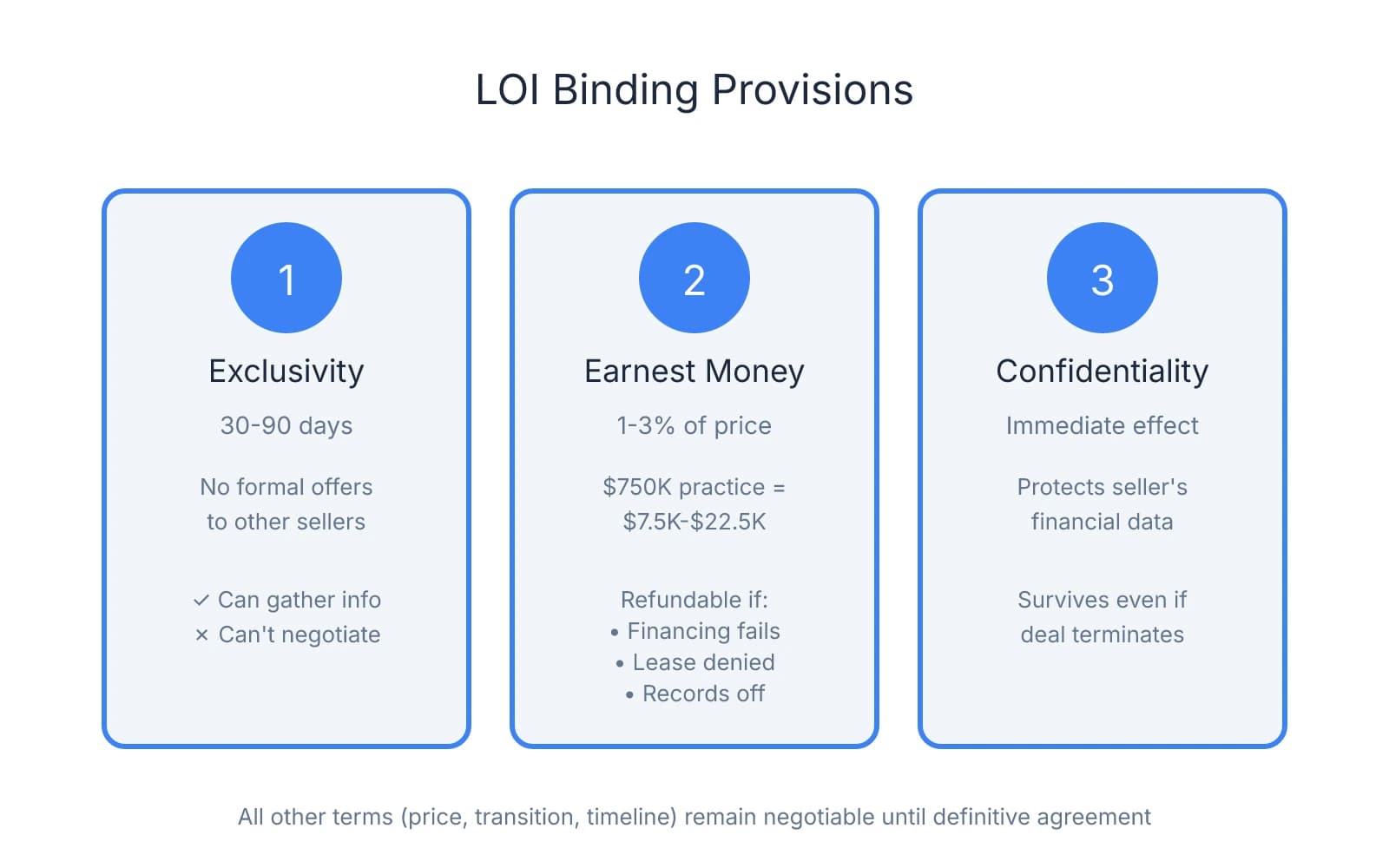
Exclusivity, confidentiality, and earnest money deposit conditions are binding from signature. Everything else—purchase price, payment structure, transition support, closing timeline—remains negotiable until the definitive purchase agreement is executed. Courts may treat a letter of intent as enforceable if the parties intended to be bound and it contains material terms, but in most dental transactions, the LOI explicitly states that only these three provisions carry immediate legal weight.
The exclusivity period typically runs 30–90 days and prohibits formal solicitation or negotiation with other sellers. The clause protects the seller's time investment—once they take the practice off the market and open their books, they need assurance you won't use that access to shop around. Where buyers misread the provision: assuming it prevents all contact with other opportunities. You cannot submit a formal offer or enter negotiations with a second seller, but you can gather preliminary information, attend open houses, or have exploratory conversations. The line between "gathering information" and "negotiating" is where most disputes originate, so if a second practice surfaces, document your actions carefully and consult your attorney before substantive discussion.
Earnest money deposits sit in the 1–3% range—on a $750,000 acquisition, expect to wire $7,500–$22,500 into escrow at LOI signing. This deposit is refundable if you exit for reasons covered by due diligence contingencies: financing falls through, the lease cannot be assigned, or records reveal material discrepancies. What triggers forfeiture: walking away for reasons outside those protections—most commonly, deciding you prefer another practice. The deposit clause should enumerate exactly which contingencies protect your funds. Vague or missing language means you're operating without a safety net.
Due diligence contingencies function as your legal exit ramps. Standard provisions include financing approval (the bank must fund the deal at acceptable terms), lease assignment (the landlord must approve you as tenant), and satisfactory record inspection (actual performance must align with seller representations). These give you the right to walk away and recover your deposit if the practice fails baseline criteria. Where buyers get trapped: treating contingencies as catch-all escape clauses. If you exit because you found a practice you like better—not because this one failed a specific diligence test—the seller will argue you forfeited the deposit by breaching exclusivity.
The exclusivity window is when most buyers encounter competing opportunities. You're deep in due diligence on Practice A when a broker emails about Practice B—better location, newer equipment, stronger hygiene revenue. The timing is not coincidental. Once you sign an LOI, you become a known buyer with financing in motion, and brokers will continue surfacing opportunities. The question is not whether you'll see other practices during exclusivity—you almost certainly will—but whether the second practice is genuinely better or just shinier because you haven't spent 60 days scrutinizing its weaknesses.
If you're evaluating a pivot, first determine whether your current LOI's contingencies give you a legitimate exit. Financing fell through, lease terms changed, or patient count dropped 15%—those are defensible reasons to walk away and recover your deposit. You simply like the other practice's layout better—that's not. The distinction matters because forfeiting a $15,000 deposit is one cost; burning a professional relationship in a small regional market where reputation travels fast is another.
For a detailed breakdown of which LOI terms protect you and which expose you to risk, see what to negotiate in your dental practice letter of intent. If the seller has threatened to enforce exclusivity or withhold your deposit, your options when a deal is cancelled after signing the LOI walks through the legal and financial consequences.
How to Objectively Compare Two Practices When One Is Already Under LOI
The practice you're in due diligence on has been stress-tested. You've seen three years of P&L statements, identified overhead bloat, mapped patient retention gaps, and priced equipment that needs replacing in 18 months. The second practice—the one that just hit the market—hasn't been scrutinized yet. It looks better because you haven't spent eight weeks cataloging its problems.
One pattern that surfaces repeatedly: recency bias dressed up as opportunity. The first practice feels stale because you know its weaknesses. The second feels exciting because you only know its strengths. Before assuming the new listing is materially better, apply the same diligence framework—and recognize that the second practice will reveal similar or different problems once you dig past marketing photos and optimistic projections.
Start with three-year collections trends, not single-year snapshots. A practice that collected $850,000 last year sounds stronger than one that collected $780,000—until you see the first dropped from $920,000 two years ago, while the second grew steadily from $710,000. Capitalized excess earnings models rely on average annual net receipts, which means declining revenue compresses value faster than a lower absolute number with stable or improving performance. If the second practice's collections trend is flat or falling, you're not upgrading—you're trading one set of revenue risks for another.
Patient retention rates and active patient counts tell you whether the practice can sustain current production. The practice under LOI may have 1,200 active patients with 70% retention—meaning 840 return annually and 360 churn out. If the second practice has 1,400 active patients but only 60% retention, it's losing 560 patients per year and relying on higher new patient flow to offset the bleed. That's not a stronger patient base—it's a practice with a conversion or experience problem that hasn't surfaced yet because you haven't reviewed recall reports. For what patient metrics reveal about growth potential, see how to tell if a dental practice can grow before you buy.
Overhead structure and PPO participation rates determine how much production you actually keep. A practice grossing $900,000 with 40% overhead and strong fee-for-service mix may deliver $540,000 in owner compensation. A practice grossing $1,000,000 with 65% overhead and heavy PPO write-offs may only net $350,000. The second practice looks bigger on paper, but you'll take home $190,000 less annually. When comparing two practices, calculate adjusted EBITDA after normalizing for owner salary, PPO reimbursement rates, and non-clinical expenses the seller has been covering personally. The practice with lower gross production but tighter cost control often outperforms the higher-grossing practice once you account for what you'll actually earn. For how insurance mix affects valuation, see fee-for-service vs PPO dental practice: which is worth more.
Lease terms, equipment condition, and staff stability are capital costs that erode any apparent purchase price advantage. The second practice may be listed at $50,000 less, but if it requires $80,000 in immediate equipment upgrades, a $30,000 build-out to meet ADA compliance, and has a lease expiring in 18 months with no renewal option, you're not saving money—you're deferring a larger cash outlay to month two of ownership. The practice under LOI has been inventoried. You know the compressor is failing, the digital sensor needs replacing, and the front desk software is two versions behind. You've priced those repairs and built them into your financing request. The second practice hasn't been inventoried yet, which means you're comparing a known cost structure to an unknown one.
Apply the 'materially better' test before considering walking away. The second practice should offer at least 20% improvement in key metrics—EBITDA, patient quality, growth runway, or operational efficiency—to justify the financial and reputational cost of forfeiting your deposit and restarting due diligence. If the second practice is 10% better on paper, that margin disappears once you account for the $15,000 deposit you'll lose, the 60 days of due diligence time you'll repeat, and the risk that the second deal falls apart for reasons you haven't uncovered yet. Marginal improvements don't justify the pivot. Material improvements do.
Where buyers often misjudge the comparison: treating the second practice as a blank slate. It has the same categories of risk you've been mapping in the first practice—patient attrition, overhead creep, deferred maintenance, staff turnover—but you haven't identified them yet because you haven't done the work. The practice under LOI isn't perfect, but you know exactly what you're buying. The second practice may be better, or it may just be untested.
The Real Cost of Walking Away: Deposit, Reputation, and Opportunity Loss
Walking away from the first deal to pursue the second carries three distinct cost categories that compound quickly. The financial cost is immediate and quantifiable. The reputational cost is delayed but persistent. The opportunity cost is speculative but real. Most buyers focus exclusively on the first and underestimate the second and third, which is where the decision often goes sideways.
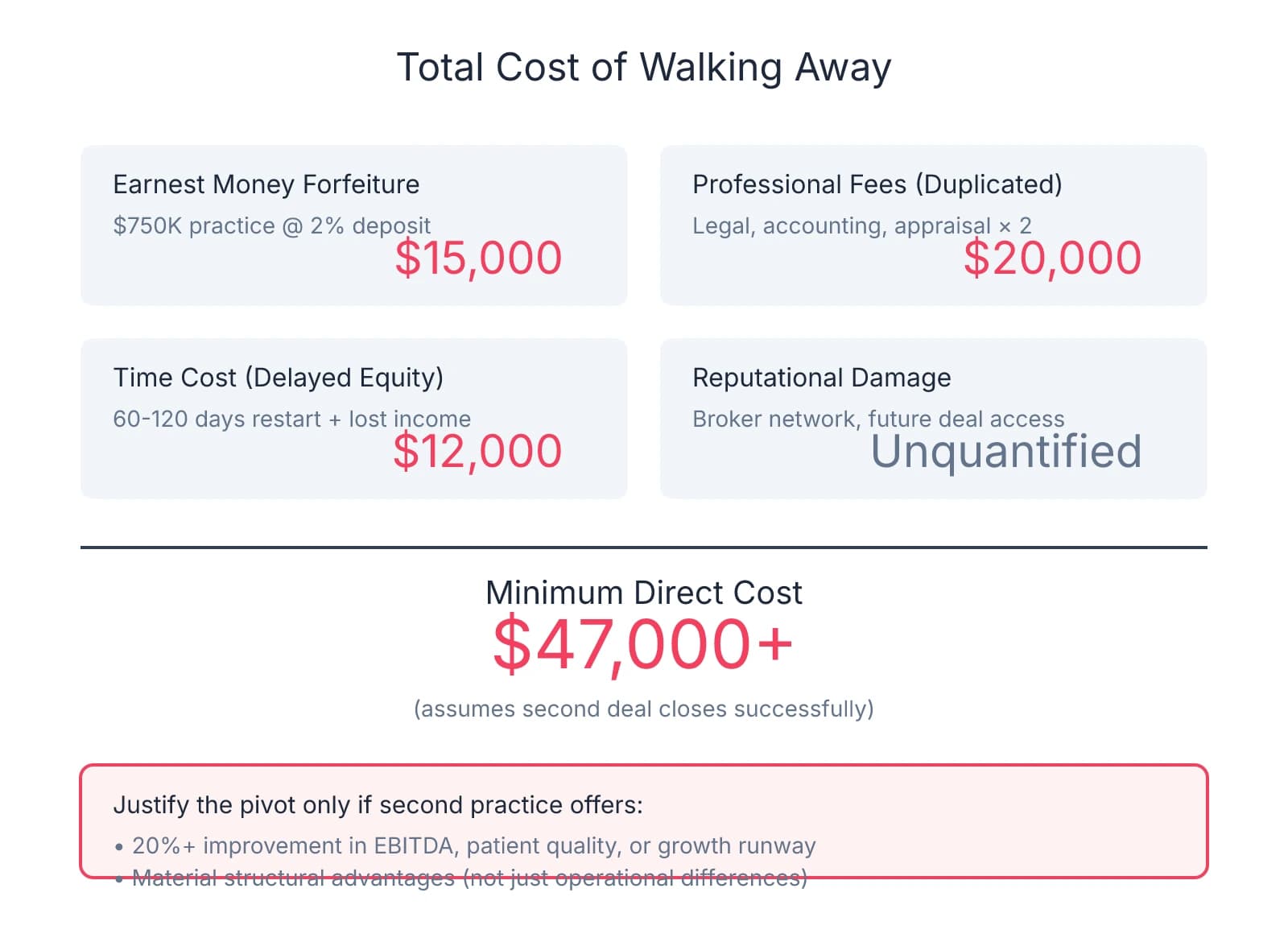
Earnest money deposits are refundable if you exit for reasons covered by due diligence contingencies—financing denial, lease assignment failure, material discrepancies in financial records. Where deposits become non-refundable: when you walk away for reasons outside those protections. If you exit because you found a practice you prefer, not because this one failed a specific diligence test, the seller will enforce the forfeiture clause. On a $750,000 acquisition with a 2% deposit, you lose $15,000. On a $1,000,000 practice with 3%, you lose $30,000. That money doesn't roll forward to the second deal—it's gone, and you start the next transaction from a weaker cash position.
Professional fees already incurred are sunk costs you'll duplicate on the second practice. Legal review of the LOI and purchase agreement typically runs $2,000–$5,000. Accounting analysis of three years of tax returns, P&L statements, and adjusted EBITDA calculations adds $1,500–$3,000. If you commissioned an independent appraisal, that's $3,000–$7,000 you won't recover. These aren't contingent fees—they're billed whether the deal closes or not. If you pivot to the second practice, you'll pay the same fees again, meaning a $10,000 professional services bill becomes a $20,000 total outlay across both transactions before you own anything.
Reputational cost within the local dental community is harder to quantify but easier to trigger than most buyers expect. The first seller and their broker will share your decision with other sellers, brokers, and transition advisors in the region. Dental markets are small, and professional networks overlap. If you walk away from a signed LOI to pursue another deal, the narrative that circulates isn't "the buyer found a better fit"—it's "the buyer is unreliable and will waste your time." That perception affects your ability to negotiate future deals, limits which brokers will prioritize your offers, and reduces the likelihood sellers will accept your terms when competing buyers are in play. One buyer who forfeited a deposit and pivoted found that three brokers in the same metro area stopped returning calls within a month. The cost wasn't just the $12,000 deposit—it was being shut out of half the available inventory in the market.
The opportunity cost of restarting due diligence is the risk that both deals fall through, leaving you with neither practice. While you're extricating yourself from the first LOI, negotiating deposit forfeiture, and initiating diligence on the second practice, another buyer may submit a stronger offer on the second listing. Practices that appear materially better often attract multiple competing offers, which means the second deal isn't guaranteed just because you walked away from the first. If the second practice goes to another buyer while you're unwinding the first transaction, you've forfeited your deposit, burned a professional relationship, and delayed ownership by another 60–120 days while you restart the search. That delay has a direct financial cost: every month you remain an associate instead of an owner, you're not building equity, not capturing tax advantages of ownership, and not controlling your income trajectory.
Time cost is the least visible but most persistent consequence of switching deals mid-process. Restarting adds 60–120 days to your ownership timeline. You'll repeat the same diligence steps—financial analysis, lease review, staff interviews, equipment inspection—that you already completed on the first practice. If the second practice reveals similar issues once scrutinized, or if financing terms are less favorable than expected, you may find yourself back at square one six months later with no practice, no deposit, and a reputation for indecision.
Where buyers misjudge the cost structure: treating the deposit as the only real expense. The deposit is the most visible cost, but rarely the largest. When you add professional fees, duplicated diligence costs, delayed equity building, and reputational friction that limits future deal flow, the total cost of walking away often exceeds $40,000–$60,000 in direct and indirect losses. That's the baseline cost of switching horses mid-transaction—and it assumes the second deal actually closes. If it doesn't, the cost is higher and the outcome is worse.
The decision to walk away isn't inherently wrong, but it should be made with full visibility into what you're trading. If the second practice is materially better—20%+ improvement in EBITDA, patient quality, or growth runway—the cost may be justified. If the difference is marginal, or if the second practice just looks shinier because you haven't stress-tested it yet, the cost of pivoting will likely exceed the benefit.
When to Push Forward, When to Pivot, and How to Have the Conversation
The decision framework is simpler than the emotional weight suggests: push forward when the first practice's issues are operational, pivot when they're structural. Operational problems—outdated equipment, inefficient scheduling, underutilized hygiene capacity—are fixable with capital and process changes. Structural problems—declining patient base, lease termination in 12 months, undisclosed tax liabilities—are not. The distinction determines whether you're buying a practice that needs improvement or inheriting someone else's unsolvable problem.
Where many buyers get this wrong: treating every issue uncovered during due diligence as equally disqualifying. A practice with $40,000 in deferred equipment maintenance isn't a bad deal if the fundamentals are solid—it's a negotiation opportunity. Most successful owners bought a solid foundation and improved it over time rather than waiting for a turnkey opportunity that required no work. If due diligence reveals the practice needs a new compressor, updated software, and operatory chair refresh, those are capital expenses you can price, finance, and recover through improved efficiency. If due diligence reveals that 30% of the patient base is over 70 with no replacement cohort, the seller has been subsidizing payroll from personal funds, or the building owner is planning a redevelopment that will terminate your lease, those are structural risks that compound over time and cannot be fixed with better management.
Pivot to the second practice only if it offers materially better fundamentals and you're still within the due diligence contingency period that protects your deposit. The threshold is 20%+ improvement in EBITDA, patient demographics, or growth potential—not 10% better curb appeal or a slightly newer patient management system. A practice generating $520,000 in adjusted EBITDA with stable patient retention and a transferable lease is materially better than one generating $400,000 with declining collections and a lease expiring in 18 months. A practice with 15% annual patient growth in a high-income ZIP code is materially better than one with flat growth in a saturated market. The second practice should solve a problem the first practice creates, not just offer a different set of tradeoffs.
Timing determines whether you can pivot cleanly or forfeit the deposit and damage your reputation. If you're still within the due diligence window and can document a legitimate contingency failure—financing denial, lease assignment refusal, material misrepresentation in records—you can exit with your deposit intact and pursue the second opportunity. If you're past the contingency deadlines or cannot tie your exit to a specific diligence failure, walking away will cost you the deposit and the professional relationship. One buyer who pivoted after the contingency period closed lost a $22,000 deposit and found that the broker representing the second practice withdrew their listing rather than risk another forfeiture. The cost wasn't just financial—it was being locked out of the broker's entire portfolio for the next 12 months.
If the data supports walking away, reference specific due diligence findings in your conversation with the seller—not the fact that you found a better opportunity. The distinction protects both your deposit and your reputation. "Our lender denied financing based on the practice's debt service coverage ratio" is a defensible exit. "We reviewed the lease and the landlord will not approve assignment without a personal guarantee we cannot provide" is a defensible exit. "We found another practice we prefer" is not. The first two tie your decision to contingencies the LOI explicitly protects. The third signals that you used the exclusivity period to shop around, which is exactly what the no-shop clause prohibits.
Frame the conversation around diligence findings, not the comparison. "After reviewing three years of patient records, we identified a 22% annual attrition rate that our financial model cannot absorb" is specific and tied to data. "The practice's overhead structure is 68%, which exceeds our lender's underwriting threshold" is objective and verifiable. "We're concerned about declining hygiene revenue and the lack of a recall system" points to operational risks you discovered, not opportunities you're chasing elsewhere. If you must forfeit the deposit, acknowledge it directly and offer to execute the forfeiture without dispute. That gesture preserves the relationship and signals you're exiting professionally, not opportunistically.
If the data supports staying with the first deal, implement strategies to manage FOMO and stay focused on the opportunity in front of you. Limit exposure to new listings during your exclusivity period—unsubscribe from broker emails, stop browsing practice marketplaces, and avoid conversations with other sellers until you've either closed or formally exited the current transaction. The second practice will face the same scrutiny once you're in due diligence, and the issues you haven't identified yet will surface just as they did with the first practice. What feels like a better opportunity today may feel like a lateral move once you spend 60 days reviewing its financials, interviewing its staff, and pricing its deferred maintenance.
Focus on the upside you've already identified in the practice under LOI. If you saw 15% growth potential through improved hygiene scheduling, that's real value you can capture. If you identified $80,000 in annual savings by renegotiating supply contracts and eliminating redundant software subscriptions, that's margin you can recover in year one. The practice doesn't need to be perfect—it needs to be profitable and improvable. For perspective on how other buyers navigated similar decisions, see whether to make a backup offer on a second-choice practice.
Recognize that perfect practices rarely exist, and when they do, they command premium pricing and attract multiple competing offers. The practice you're in due diligence on may not be flawless, but if the fundamentals are sound and the issues are fixable, you're holding a solid asset you can improve over time. The second practice may look better today, but it will reveal its own weaknesses once tested—and by then, you may have forfeited your deposit, burned a professional relationship, and delayed ownership by another six months. The question isn't whether the second practice is shinier. The question is whether it's materially better in ways that justify the cost of walking away. If the answer is no, push forward and build the practice you already have under contract.
Sources & References
The data and claims in this article are drawn from the following sources. We prioritize government data, peer-reviewed research, and established industry publications to ensure accuracy.
- What Dental Practice Owners Need to Know About Letters of Intent ...— ddslawyers.com
- A dentist's guide to dental practice valuation methods | Baker Tilly— www.bakertilly.com
- Due Diligence 101: What Every Dental Practice Buyer Needs to ...— ameriprac.comIndustry
- Most successful owners bought a solid foundation and improved it over time— dentaleconomics.com
Frequently Asked Questions
Ready to explore your best practice options?
Whether you're navigating LOI complexities or comparing multiple opportunities, having expert guidance makes all the difference. Minty Plus connects you with acquisition specialists who help you evaluate practices and negotiate the best terms for your situation.