When Your Spouse Earns More: How to Size Your Practice Risk

Co-Founder, Minty Dental

In Summary
- Dental practice loans are underwritten on the practice's cash flow, not household income — a spouse's salary has little to no effect on loan approval in most cases
- The key metric lenders use is debt service coverage ratio (DSCR): most dental lenders require the practice to generate at least $1.25 for every $1.00 of annual debt service
- Dental practice loans have a default rate under 1% — ownership risk is real but often overstated, and the goal is calibrating that risk intelligently, not avoiding it
- A spouse's higher income genuinely changes three things: how much salary you need to draw from day one, how large a working capital reserve you need, and which deals by size and complexity are realistically within reach
- Buyers who conflate loan qualification with risk calibration often either over-constrain their search or take on more complexity than their household can absorb
Your Spouse's Income Doesn't Change the Loan — But It Changes Everything Else
If you've spent any time researching practice financing, you've probably wondered whether your spouse's income could strengthen your loan application. It's a reasonable instinct — that's exactly how mortgage lending works. But dental practice loans operate on a different logic entirely.
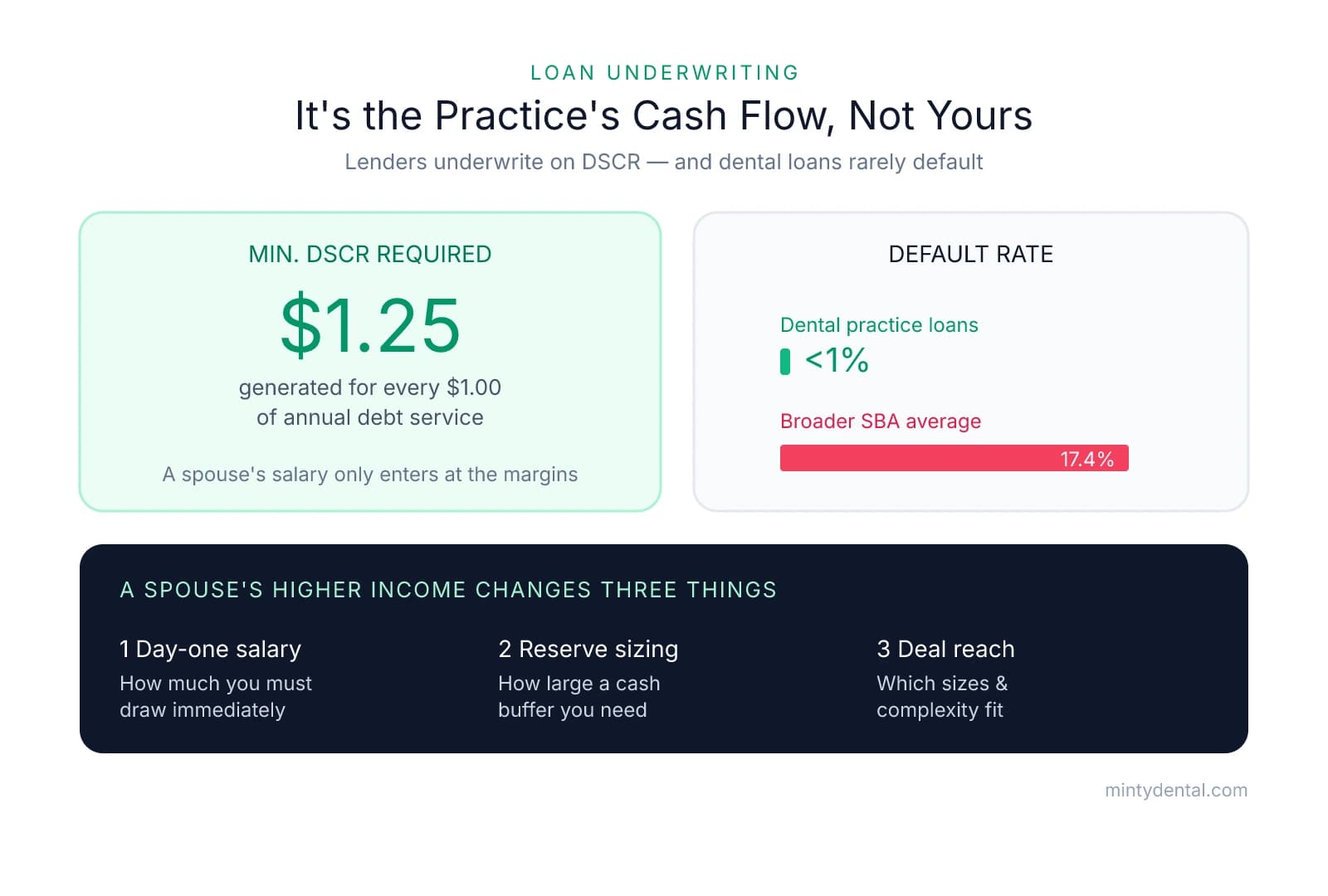
Whether you're pursuing an SBA 7(a) or a conventional dental-specialty product, lenders aren't primarily asking what do you earn? They're asking what does the practice earn? The underwriting centers on debt service coverage ratio (DSCR) — specifically, whether the practice generates at least $1.25 for every $1.00 of annual debt service. A practice with strong, documented cash flow can qualify a buyer for full financing regardless of personal income. A spouse's salary enters the picture only at the margins. If you want a deeper look at exactly where it does and doesn't move the needle, this breakdown of spouse income in dental practice lending covers the mechanics in detail.
That framing matters because it shifts the real question. The question isn't whether your spouse's income helps you borrow more — it's whether it lets you borrow smarter.
Here's the context that makes that worth sitting with: dental practice loans default at a rate below 1%, compared to 17.4% for the broader SBA loan average. Practice ownership carries real risk, but it's not the financial cliff many first-time buyers imagine. The more common mistake isn't taking on too much risk — it's miscalibrating it, either by over-constraining a search out of unnecessary caution or by absorbing more complexity than the household can actually support.
That's where a higher-earning spouse genuinely changes the picture — not through the loan, but through three practical levers that shape which deals make sense for your specific household:
- Day-one salary requirements — how much the practice needs to pay you immediately, before it's had time to stabilize under your ownership
- Working capital reserve sizing — how large a cash buffer you actually need to hold against slow months, unexpected equipment costs, or a slower-than-expected ramp
- Deal complexity and size — whether a larger, higher-revenue practice or one with more operational moving parts is now realistically within reach
The rest of this article works through each of those levers in practical terms.
The First-Year Salary Problem — and How a Household Cushion Solves It
The compensation tension new practice owners face in year one is genuinely difficult to navigate. Draw too much from the practice and you starve it of the working capital it needs to build reserves, cover unexpected costs, and service debt comfortably. Draw too little and personal financial stress starts bleeding into clinical decision-making — which is its own kind of risk.
The long-run numbers are compelling. According to the ADA Health Policy Institute, practice owners average around $228K in annual net income compared to roughly $177K for associates. But that gap takes time to materialize. In year one, while the practice is stabilizing under new ownership, patient retention is being established, and systems are being refined, owner compensation is often well below the long-run average. Buyers who plan around the destination income rather than the year-one reality tend to create cash flow pressure that didn't need to exist.
The deeper risk isn't just lower income — it's variable income. According to the CFPB's Making Ends Meet survey, small business owners are nearly twice as likely to report that their income varies month to month compared to non-owners. That variability is what a household cushion actually absorbs — not the average income shortfall, but the unpredictable swings around it.
The household floor is the key variable. A spouse's higher income lowers the minimum the practice must generate for personal finances to stay stable. That single shift changes how conservatively you need to draw in year one — and how quickly the practice can build reserves.
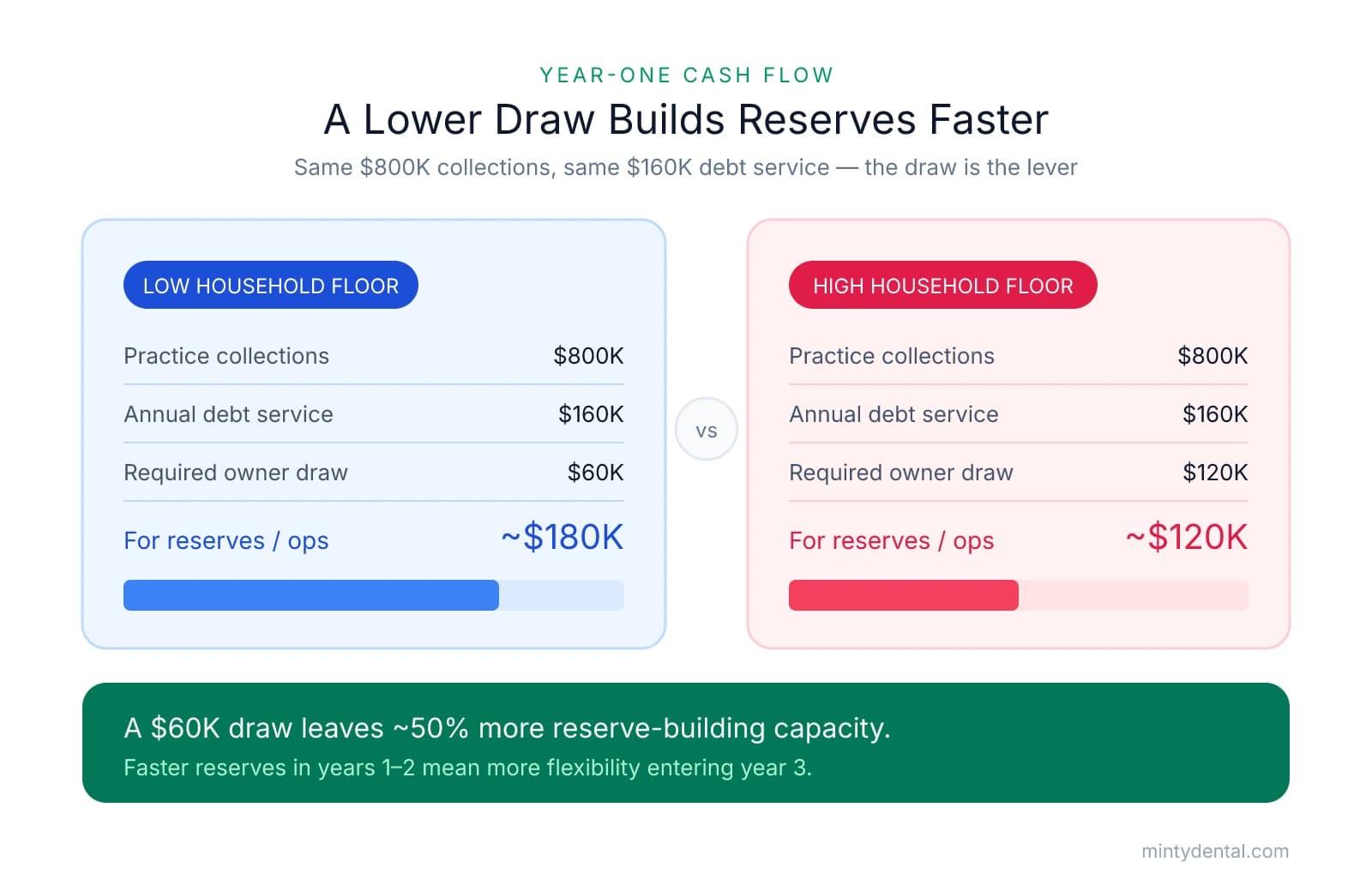
The difference becomes concrete when you run the numbers side by side:
| Scenario | Practice Collections | Annual Debt Service | Required Owner Draw | Available for Reserves/Ops |
|---|---|---|---|---|
| Low household floor | $800K | $160K | $60K | ~$180K (est.) |
| High household floor | $800K | $160K | $120K | ~$120K (est.) |
Estimates assume ~50% overhead on $800K collections, leaving ~$240K before owner draw and debt service.
A buyer who needs $120K from the practice to cover personal expenses is working with roughly half the reserve-building capacity of one who can live on $60K while a spouse covers the rest. That gap compounds: practices that build reserves faster in years one and two tend to enter year three with more financial flexibility — whether that means equipment upgrades, hiring, or simply weathering a slow quarter without stress.
If your household can run on your spouse's income alone — or close to it — a conservative owner draw in year one isn't a sacrifice. It's a deliberate strategy that lets the practice accumulate the financial health that makes ownership rewarding over time. Understanding how to read the practice's P&L before closing helps you set a realistic draw target based on actual cash flow patterns rather than projected averages — and being aware of seasonal cash flow dips helps you plan around the months where that draw will feel most constrained.
Which Deals Open Up — and Which Risks Stay Off the Table
Salary flexibility is really just the entry point. Once you've established that your household can absorb a conservative draw in year one, a more interesting question opens up: does that cushion change which practices you should be targeting in the first place?
In most cases, it does — but with meaningful limits worth understanding before you expand your search.
Three deal types where a household cushion genuinely expands your range:
1. Larger practices with higher debt service. A $1.5M–$2M collection practice carries more debt service than an $800K one, but it also tends to generate stronger long-run owner income. The challenge is that year-one draws can feel constrained while systems stabilize under new ownership. A buyer who doesn't need the practice to cover all personal expenses can absorb that transition period without financial stress — and let the practice build the operational momentum that makes the higher revenue sustainable.
2. Turnaround and underperforming practices. This is arguably where a spouse's income matters most. A practice that needs 12–18 months to stabilize — whether due to a retiring seller's reduced schedule, a thin new patient pipeline, or operational inefficiencies — may generate below-average owner income during that window. For a buyer who needs the practice to cover everything from day one, that timeline creates real pressure. For a buyer with a household cushion, it's a manageable transition period, not a crisis. The key is distinguishing between a practice that's underperforming for fixable reasons versus one with structural problems — a pattern worth examining carefully before assuming a turnaround is within reach.
3. Higher-cost markets with stronger demographics. Purchase prices in urban and suburban growth markets often run higher than rural benchmarks. But if the demographic profile — patient density, income levels, insurance penetration — supports stronger long-run collections, the elevated price may be justified. A household cushion gives you the flexibility to absorb a tighter year-one margin while the practice grows into its potential.
What a household cushion does NOT fix:
A spouse's income changes your personal risk tolerance. It doesn't change the quality of the deal in front of you. A few risks stay fully on the table regardless of household income:
- Broken fundamentals. A declining patient base, a payer mix weighted toward low-reimbursement plans, or aging equipment that needs immediate capital — these are practice-level problems that no household cushion resolves. The practice still has to work on its own terms.
- Clinical mismatch. If the case mix requires procedures you're not yet comfortable performing at volume, that's a clinical readiness issue, not a financial one. A situation where an associate is outproducing the owner can signal exactly this kind of mismatch — worth examining before assuming you can grow into the production.
- Variable spouse income. A spouse who earns on commission, runs their own business, or works in a cyclically sensitive industry provides less of a floor than the headline income suggests. Use a conservative estimate of your spouse's income in this calculation — not the best recent year. This matters especially when weighing whether to open a second location down the road — stacking two high-risk financial decisions on variable household income compounds the exposure significantly.
A simple framework for deal selection:
Map your household floor against the practice's projected year-one owner income. The gap between those two numbers — positive or negative — tells you how much deal complexity you can realistically absorb. A positive gap means you can consider practices that require patience before they perform. A negative gap means the practice needs to generate meaningful income quickly, which argues for a cleaner, more established operation with less execution risk.
The household cushion expands your range on the upside. It doesn't make a bad practice worth buying.
Building Your Household Risk Framework Before You Make an Offer
The previous sections established the logic. This one gives you the tool. Before you evaluate a specific practice — before you request financials, engage a broker, or submit an LOI — work through these four calculations as a household.
Step 1: Calculate your household floor. Add up every fixed monthly obligation: mortgage or rent, student loan payments, childcare, car payments, insurance premiums, minimum debt payments. This number is your floor — the minimum monthly income your household needs from all sources to stay solvent. Many buyers undercount this figure by excluding irregular but predictable expenses like annual insurance renewals or quarterly tax payments.
Step 2: Model the practice's projected year-one owner income. Start with the practice's documented collections and apply a realistic overhead percentage — typically 55–65% for a general practice. Subtract annual debt service. Then subtract a working capital reserve of 2–3 months of operating expenses, held back rather than distributed. What remains is a reasonable estimate of what the practice can actually pay you in year one. If you want a benchmark for what you'd earn staying as an associate instead, the associate pay calculator makes that comparison concrete.
Step 3: Calculate the gap — and assign it a timeline. Subtract your projected year-one owner income from your household floor. If the number is negative, your spouse's income needs to cover that gap. The more useful question isn't just how much — it's for how long. A six-month gap is a manageable transition. An 18-month gap requires a different conversation about whether the deal is sized correctly for your household.
Step 4: Stress-test your spouse's income. W-2 income from a salaried position is a genuine cushion. Commission-based income, self-employment income, or income tied to a cyclically sensitive industry carries its own variability — which reduces the effective floor it provides. Use a conservative estimate of your spouse's income in this calculation, not the best recent year.
The conversation most buyers avoid. These four numbers only function as a framework if both partners have agreed on them before the offer goes in. That means aligning on what the household floor actually is, how long you're both willing to absorb a gap, and what "underperformance" looks like — not as an abstract possibility, but as a specific scenario with a specific response plan. Practices that skip this alignment step are also more likely to stumble on the broader succession planning pitfalls that derail transitions after the deal closes.
Buyers in dual-income households have a real structural advantage over solo-income buyers. The goal isn't to feel vaguely reassured by that — it's to use it deliberately, by targeting deals where the cushion creates genuine optionality rather than just emotional comfort.
Sources & References
The data and claims in this article are drawn from the following sources. We prioritize government data, peer-reviewed research, and established industry publications to ensure accuracy.
- Dentists Default at 0.3% - Arvind Murthy— arvindmurthy.comIndustry
- Trends in Dentists' Income, Revenue and Hours Worked— www.ada.orgIndustry
- The Financial Security of Small Business Owners: Evidence from ...— www.consumerfinance.govGovernment
- Should I Open A Second Dental Practice? - Guide - Panacea Financial— panaceafinancial.com
- Dental Practice Succession Planning: A Free Guide— dentaltransitions.com
Ready to buy with confidence?
Understanding your household's risk tolerance is crucial when acquiring a dental practice. Minty's acquisition experts guide you through realistic financial projections and help you find a practice that fits your family's income stability and goals.