Buying a Dental Practice from an Estate After the Owner Dies

Co-Founder, Minty Dental

In Summary
- A dental practice estate sale occurs when the practice is sold by a deceased owner's estate through an executor or personal representative — not by the dentist themselves
- Goodwill typically represents 60–80% of a dental practice's total purchase price, and unlike most business assets, it begins eroding immediately when patients can no longer reach their provider
- A dental practice can lose significant value within weeks of an owner's death if no licensed dentist steps in — the dentist is the business in a way that has no parallel in most industries
- Estate executors are often motivated to close quickly and may lack the negotiating leverage of a living seller, which can create genuine pricing advantages for prepared buyers
- Buyers who understand the compressed timeline, goodwill dynamics, and executor-driven process can move with both speed and confidence — this guide gives them the framework to do exactly that
Estate-Sale Practices Offer Real Opportunity — But the Clock Starts the Day the Owner Dies
A dental practice estate sale happens when a dentist dies while still owning their practice, and the practice becomes an asset of their estate — sold not by the dentist, but by an executor or personal representative acting on behalf of the estate. That distinction matters more than it might seem.
These situations are uncommon in the broader market and can feel uncomfortable to approach. But they represent a legitimate and often underserved segment of dental practice acquisitions — one where prepared buyers can move decisively while others hesitate.
The core tension in any estate sale comes down to one dynamic: In a dental practice, the dentist is the business — which means goodwill begins to erode the moment patients can't reach their provider.
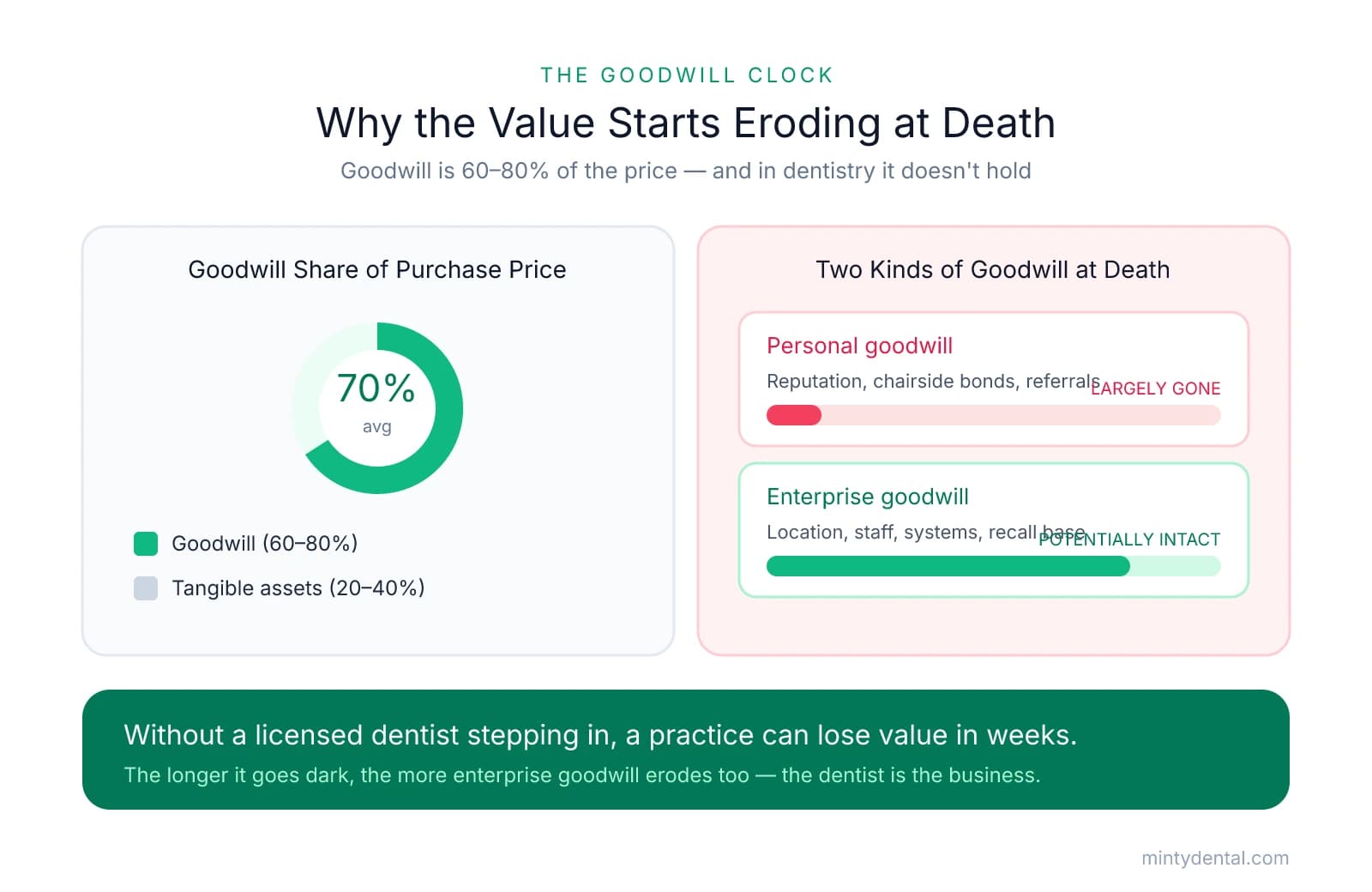
Goodwill typically accounts for 60–80% of a dental practice's total purchase price, representing the accumulated value of patient loyalty, staff continuity, referral relationships, and the practice's reputation in the community. In most businesses, goodwill is relatively stable in the short term. In dentistry, it isn't. Patients are loyal to a person, not a location — and understanding what that patient base is actually worth becomes especially urgent when no one is actively treating those patients.
As Practice Impact, a dental practice brokerage that has guided families through these sales, puts it plainly: "Without another dentist quickly stepping in after the owner's death, the practice can quickly become worthless." That's not hyperbole — weeks of closure, unreturned calls, and unanswered appointment requests translate directly into patients finding a new provider.
This is what makes estate sales structurally different from a planned transition. In a standard acquisition, the selling dentist has spent months — sometimes years — preparing the practice, grooming staff, and managing patient communication. In an estate sale, the "seller" is a legal entity represented by someone who may have no dental industry knowledge, no ability to speak to clinical history, and no patience for a drawn-out negotiation.
That creates real risk. But it also creates real opportunity. Executors are typically motivated to close efficiently and often lack the leverage — or the inclination — to hold out for top dollar the way a living seller might. Estate-sale practices are frequently underpriced relative to what a well-planned sale would yield, precisely because the estate's priority is resolution, not optimization.
Buyers who understand these mechanics — the goodwill clock, the executor's position, and the absence of a seller who can support a transition — are the ones positioned to act with both speed and confidence.
Understanding Who You're Actually Buying From — and What That Changes
When you make an offer on an estate-sale practice, the entity accepting that offer isn't a dentist — it's a legal construct. The "seller" is the estate itself, represented by an executor named in the will or, when no will exists, a court-appointed administrator. That distinction reshapes nearly every interaction throughout the process.
The executor's fiduciary duty runs to the estate's beneficiaries — not to the practice's patients, its staff, or you as the buyer. Their legal obligation is to maximize value for the heirs and close the estate efficiently. The person across the table may have no dental industry background, no knowledge of the practice's clinical history, and no ability to speak to why certain patients left or how the hygiene schedule was structured. Questions a living seller would answer in five minutes may go unanswered entirely.
This is where having your own attorney — not just the broker's recommended counsel — becomes especially valuable. An attorney experienced in healthcare transactions can help you navigate what representations the estate can make versus what you'll need to verify independently through due diligence.
Probate Status Can Affect Your Closing Timeline
Depending on the state and how the estate is structured, the sale may require court approval before it can close. Some states grant executors full authority to sell estate assets without a formal hearing; others require a judge to confirm the sale, which can add weeks to the process. Many buyers assume the executor can sign and close on a normal timeline, only to discover mid-deal that court confirmation is required.
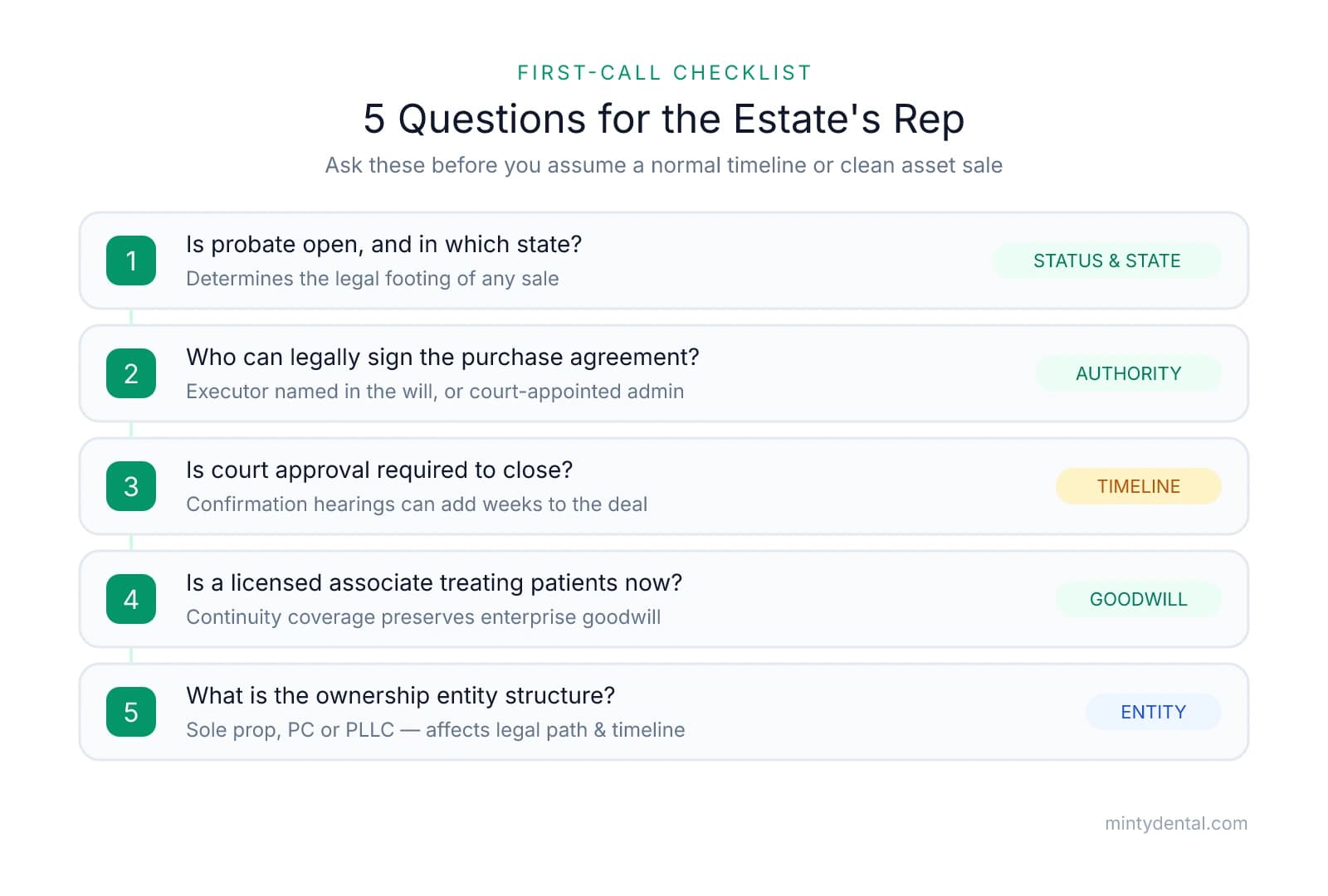
Ask these questions in your first conversation with the estate's representative or broker:
- Is probate currently open, and in which state?
- Who has legal authority to sign a purchase agreement?
- Is court approval required to complete the sale?
- Is a licensed associate currently treating patients?
- What is the ownership entity structure — sole proprietorship, PC, or PLLC?
That last question matters more than it might seem. As Practice Orbit notes, if the practice operated under a professional corporation or PLLC, the estate may need to dissolve that entity and transfer assets rather than execute a straightforward asset purchase — which affects both the legal structure of your deal and the timeline.
The Licensing Reality Creates Urgency on Their Side
In most states, only a licensed dentist can own and operate a dental practice. The estate cannot run the practice indefinitely — the longer it holds an operating practice with no licensed owner, the more regulatory exposure it accumulates and the more goodwill erodes. That urgency is worth understanding: a well-prepared buyer who can move quickly holds real leverage in these conversations.
Due Diligence Without a Seller: What to Verify and How
The absence of a seller doesn't just change the emotional tone of a deal — it shifts the entire due diligence burden. In a standard acquisition, a buyer can ask the selling dentist why collections dipped in Q3 or which staff member patients trust most. In an estate sale, those questions go to an executor who likely can't answer them. That gap gets filled through financial records, independent verification, and the people still showing up to work every day.
Start with Financials — But Read Them Carefully
Pull three years of tax returns and profit-and-loss statements, then pay close attention to trajectory. Collections may have declined during the owner's illness or in the months following death — and that recent dip often doesn't reflect the practice's true baseline. Many buyers see a distressed trailing twelve months and undervalue a practice that was genuinely healthy for the two years before it.
Weight the pre-illness period more heavily when assessing normalized revenue. If an interim associate has been in place, ask for their production numbers separately — they'll help you distinguish between structural decline and temporary disruption. Also review payer mix and any open insurance claims carefully. Pending EOBs and unresolved claims can represent real liability that won't surface in a P&L.
Assess the Goodwill That's Actually Left
Personal goodwill vs. enterprise goodwill is the most important distinction in any estate-sale valuation:
| Goodwill Type | What It Includes | Estate-Sale Status |
|---|---|---|
| Personal goodwill | Owner's reputation, chairside relationships, referral network | Largely gone at death |
| Enterprise goodwill | Location, staff, systems, brand, recall base | Potentially intact |
As mydentalbroker.com notes, practice goodwill derived from systems, staff, and brand is more transferable than personal goodwill because it doesn't leave when the dentist does. Your offer should reflect how much of each type remains — and the single biggest driver of that split is how long the practice has been without a treating dentist. A practice with a continuity associate in place retains far more enterprise goodwill than one that's been dark since the owner died.
Pull active patient counts (seen within the last 18–24 months), new patient flow, and hygiene recall rates. These numbers tell you what the patient base actually looks like today — not what it looked like when the owner was healthy.
Interview the Staff
The front desk coordinator, lead hygienist, and office manager collectively hold more institutional knowledge than any document in the data room. With the estate's permission, interview them directly. They can speak to patient relationships, clinical patterns, scheduling systems, and which patients are most at risk of leaving. According to the Journal of the Michigan Dental Association, staff continuity is one of the most critical — and most overlooked — factors in a successful transition after an owner's unexpected death.
Verify What the Estate Cannot Represent
With no seller making disclosures, independent verification is the only protection available. Check state dental board records for disciplinary history, pull court filings for malpractice actions, and review malpractice insurance history directly. A malpractice history review carries more weight in an estate sale because there's no seller warranty backing it up. Similarly, confirm the lease is assignable and has sufficient term remaining — the landlord may not have been formally notified of the owner's death.
Plan the Transition Before You Close
There is no seller transition period in an estate sale — no earnout, no employment agreement, no 60-day handoff. That's a structural feature of these deals, not a negotiating failure. Price it into your offer, and build your patient communication and staff retention plan before closing day. The buyers who navigate these acquisitions well treat day one as a launch, not a handoff.
Pricing, Negotiating, and Closing an Estate-Sale Practice
Everything covered so far — the goodwill clock, the executor's position, the due diligence gaps — ultimately converges on three decisions: what to offer, how to negotiate it, and what to build into the closing documents.
Pricing: Start with an Independent Valuation
The most important variable in pricing an estate-sale practice is how long it has been without a treating dentist. Every week without a licensed provider accelerates patient attrition and erodes the enterprise goodwill that makes the practice worth buying. An independent valuation — commissioned by you, not the estate — should account for this directly.
The estate may have its own appraisal. Treat it as one data point, not the answer. Executor-commissioned appraisals are often based on pre-death financials that don't reflect current patient retention or recent revenue disruption. One risk worth anticipating: lenders will order their own appraisal, and if that bank appraisal comes in below your agreed price, you face a financing gap that has to be resolved before closing. Understanding this before making an offer — not after — helps you structure a price that's both defensible to the estate and supportable by a lender.
Negotiating with the Estate
Executors have a fiduciary duty to maximize value for beneficiaries, which means they can't simply accept a lowball offer without exposure to liability. But they also face real time pressure: the estate can't operate the practice indefinitely, regulatory risk accumulates, and goodwill continues eroding while negotiations drag on.
Buyers who arrive pre-approved, move quickly, and present a clean offer often have more leverage than they expect — not because the estate is desperate, but because certainty of close has genuine value when the alternative is continued deterioration. A well-structured offer at a fair price frequently outperforms a higher offer with contingencies and delays. As the ADA notes on practice sale costs, the most frictionless transactions tend to be those where both parties trust the process and move with purpose.
What the Purchase Agreement Should Include
Because there's no seller to make representations, the purchase agreement carries more weight than in a standard acquisition. Look for:
- Estate representations about known liabilities, pending claims, and regulatory history — even if limited, they should be explicit
- Clear acknowledgment that no seller transition period is included, and that the buyer accepts the practice in its current operational state
- Indemnification provisions covering pre-closing clinical or legal issues that surface after the sale
For retreatment liability and pre-closing malpractice exposure specifically, the purchase agreement is often the only protection available — there's no seller employment agreement to fall back on.
Plan the First 90 Days Before You Close
Without a seller to hand off relationships, the buyer has to build them from day one. Before closing, draft patient communication letters, have retention conversations with key staff, and prepare a clear introduction strategy for the patient base. A patient retention guarantee isn't available in an estate sale — which makes proactive communication even more important.
Estate-sale practices attract less buyer competition than standard listings. Many dentists avoid them because of the complexity or the emotional weight of the circumstances. Buyers willing to do the work often find better pricing, more negotiating flexibility, and a clearer path to ownership than they'd encounter in a typical acquisition. The complexity is real — but so is the opportunity.
Sources & References
The data and claims in this article are drawn from the following sources. We prioritize government data, peer-reviewed research, and established industry publications to ensure accuracy.
- Dental Practice Goodwill: How It's Valued and Why It Matters— www.usdentalpractices.comIndustry
- Death and the Owner Dentist— practiceimpact.comIndustry
- Can a Dentist's Wife Sell Her Deceased Husband's Dental ...— practiceorbit.comIndustry
- Understanding the Role of Goodwill in a Dental Practice ...— mydentalbroker.comIndustry
- A Survivor's Survival Kit— commons.ada.orgIndustry
- What Does It Actually Cost To Sell A Dental Practice?— www.ada.orgIndustry
Ready to acquire a dental practice?
Purchasing a dental practice from an estate involves unique legal and financial considerations. Minty's acquisition experts guide you through every step of the buying process, from initial search to closing.