Is Your Dental Practice Ready for a Second Location?

Co-Founder, Minty Dental

In Summary
- A full schedule is not the same as a true capacity ceiling. Scheduling inefficiency, poor recall systems, or a hygiene backlog can all make a practice feel busier than it actually is.
- Lenders evaluate second-location financing as an expansion of an existing business, not a startup. Your first practice's cash flow is the primary underwriting factor.
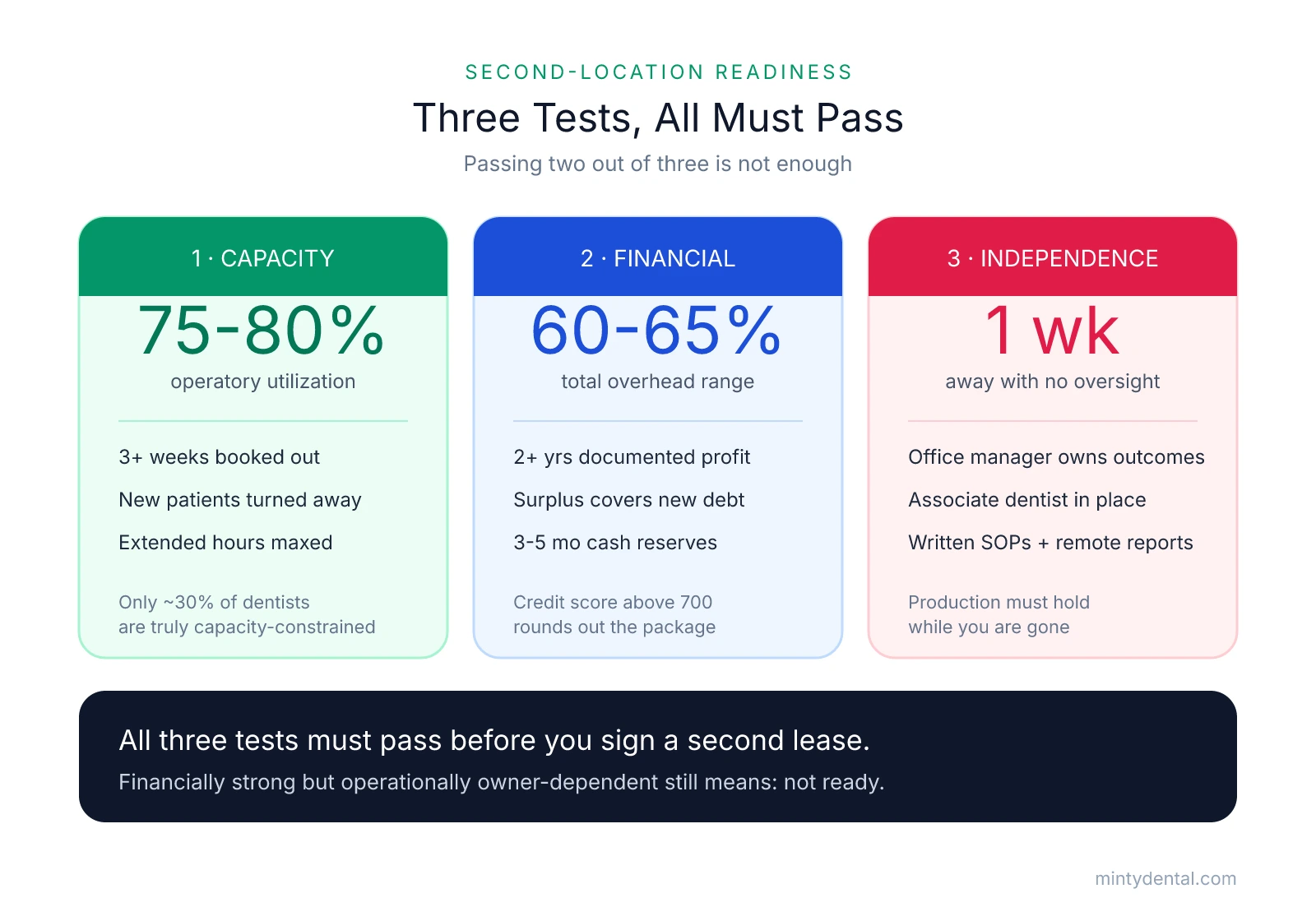
- Readiness requires passing three tests: genuine capacity constraints, solid financial health, and a first practice that can operate without you present.
- Passing two out of three is not enough. A practice that is financially strong but operationally dependent on the owner is not ready for a second location.
- The goal of the assessment is to distinguish real structural growth from ambition driven by a busy schedule or peer pressure.
Three Tests Determine Whether a Second Location Will Strengthen or Strain Your Practice
Second-location readiness means your first practice can sustain itself financially and operationally while your attention is split. It does not mean your schedule is full and you are feeling optimistic.
That distinction matters because "feeling busy" and "hitting a genuine ceiling" are different problems with different solutions. A packed appointment book can reflect real patient demand that has outgrown your current structure. It can also reflect scheduling inefficiency, a poor recall system, or a hygiene backlog that has never been properly worked down. Before you sign a second lease, you need to know which one you are actually dealing with. If the constraint is operational rather than structural, adding a chair or correcting your scheduling model may relieve the pressure without the complexity and cost of a second location.
Before expanding, you need to verify three concrete readiness tests: whether you have hit a genuine capacity ceiling at the first practice, whether your financial position can carry expansion debt, and whether the first practice can function without you in the building. All three need to pass. A practice that clears two out of three still has a real problem. Strong collections and a true capacity ceiling mean nothing if your systems and team collapse the moment you are not present.
The financial bar matters more than most owners expect, and lenders treat second-location financing differently from a first-practice loan. Because they see it as an expansion of an existing business rather than a startup, the underwriting centers on your first practice's actual cash flow and profitability history. They want evidence that the first location generates enough surplus, after your draw and existing debt service, that it could carry additional debt even if the second location has a slow start. That framing should shape how you evaluate your own readiness before you ever sit down with a banker.
Many owners who pursue a second location are motivated by genuine growth, competitive pressure, or the sense that they have built something worth replicating. Those are reasonable instincts, but they come down to a narrower question: has your practice genuinely outgrown its current structure, or does it just feel that way right now?
Capacity: Confirming the First Practice Has Hit a Real Ceiling
The clearest signal of a genuine physical constraint is a combination of two things happening at once: your operatories are running above 75 to 80 percent utilization across all rooms, and your schedule is booked out three or more weeks consistently. Either one alone can have other explanations. Together, they are hard to dismiss.
Operatory utilization is simply the hours each room is in active clinical use divided by the total hours it is available. If you have four rooms open from 8 to 5 and three of them are running procedures from roughly 9 to 4, your utilization is somewhere in the low-to-mid range and you likely have room to grow without adding a location. If all four are running close to capacity and patients are still waiting three weeks for a routine visit, the physical space is the limiting factor.
The stronger signal, though, is new patients being turned away or referred out. There is a meaningful difference between "we don't have openings this week" and "we genuinely cannot accommodate the demand coming through the door." If your front desk is regularly telling new patients your next available appointment is more than three weeks out and some of them are walking away, that is structural. A full schedule that is turning away revenue is a different problem than a full schedule filled with long-standing patients who were easy to retain.
Roughly 30 percent of dentists report being capacity-constrained, which means a meaningful share of owners who feel busy are not actually hitting a physical ceiling. Before a second address enters the conversation, extended hours should already be in play and still insufficient. If you have not offered evenings or Saturdays, that is the next step, not a second lease.
It is also worth ruling out single-location fixes before committing to the fixed-cost stack that comes with a second building. A second location does not just add rent; it re-buys every fixed-cost line you already carry: staff, equipment, insurance, utilities, build-out debt. If the constraint is actually a hygiene backlog, adding hygiene days may resolve the pressure entirely. If the schedule has open blocks scattered through the week, the issue may be template design rather than space, and block scheduling optimization is worth testing before construction.
Other scheduling or conversion problems can also mimic a physical ceiling: a high no-show rate masking available time, low case acceptance reducing booked production, or a schedule template that is not optimized for your provider mix. By contrast, if two providers are competing for the same room alongside high utilization, a three-week wait, turned-away new patients, and maxed-out extended hours, your first practice has likely hit a real ceiling. If you are honest and the evidence points to scheduling or conversion issues instead, fixing the first location is the more efficient investment and carries far less downside risk.
Financial Health: What Your P&L and Cash Flow Need to Show
When you apply for financing, projections for the new site carry essentially no weight. What matters to underwriters is whether the practice you already own has produced consistent, documented profitability.
Consistent means at least two years. One strong year can reflect a single favorable condition, a good insurance renegotiation, or a temporary spike in case acceptance. Two years of clean tax returns showing real net income, after owner compensation and existing debt service, is what moves an underwriter. That net income figure is not the same as the gross production number on your practice management software, and it is not the same as the profit line that shows up before your draw. Lenders want to see what actually remains after you have been paid a reasonable salary and your current obligations are covered.
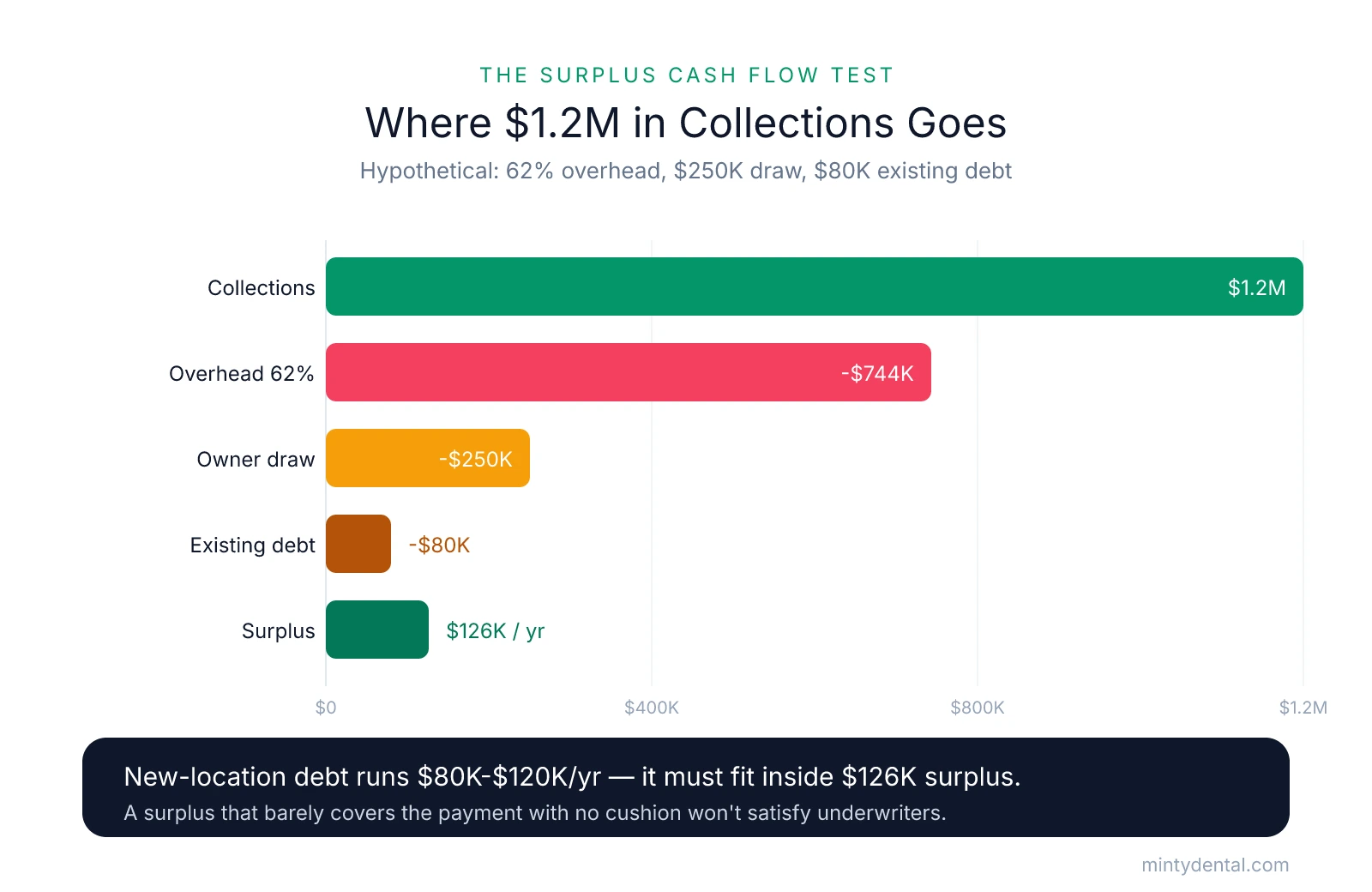
The specific test is surplus cash flow. If your first practice collects $1.2 million with total overhead running at 62 percent (hypothetical), your operating expenses are roughly $744,000. That leaves approximately $456,000 before your draw. If your draw is $250,000 and your existing debt service is $80,000, your surplus is around $126,000 annually. A second-location loan large enough to cover a buildout and equipment might carry debt service of $80,000 to $120,000 per year. The question the lender asks is whether that surplus covers the new payment if the second location produces nothing in year one. A surplus that barely covers the new debt with no cushion will not satisfy most underwriters, and it should not satisfy you either.
That 62 percent overhead figure in the example matters on its own. Total overhead (all expenses except owner compensation) should sit in the 60 to 65 percent range before you consider adding a second fixed-cost structure. If overhead is running at 72 or 75 percent at your first location, expansion will not fix that. It compounds it, because you are replicating every fixed-cost line: rent, staff, equipment, insurance, utilities. If you are uncertain whether your overhead is in a healthy range, working through what to cut first at the existing practice is the prerequisite, not the follow-up.
For context, solo general practices average roughly $942,000 in annual gross billings, based on ADA survey data. A practice collecting meaningfully above that figure with well-controlled overhead is in a stronger underwriting position, but collections alone are not the measure. A practice producing $1.5 million with 75 percent overhead has less actual capacity to carry new debt than one producing $1.1 million at 60 percent.
Beyond the P&L, lenders will ask for three to five months of operating expenses sitting in cash reserves, held separately from any down payment or working capital earmarked for the new location. This is not the same pool of money. If your operating expenses at the first practice run $62,000 per month (hypothetical), you need $186,000 to $310,000 in liquid reserves that remain untouched after you fund the expansion. A practice whose P&L shows profit that the bank account never reflects will struggle to satisfy this requirement.
Personal financial statements and a credit score above 700 round out the package. Scores in the high 600s may still qualify, but at worse terms. Clean personal books matter because many dental lenders require a personal guarantee on practice loans, which means your personal balance sheet is part of the underwriting picture alongside the business financials.
Operational Independence: Can the First Practice Run Without You?
This is the readiness test most owners underestimate, and it is the one most likely to be underbuilt even when the capacity and financial numbers look solid. The moment you open a second location, your attention is no longer at one address. It is split by default, and often not evenly. If your first practice depends on your daily presence to make decisions, resolve problems, and keep production moving, both locations will feel that strain quickly.
As Dr. Tim McNamara put it, "as soon as you are not physically there managing, you're dependent on really dialed-in leadership and systems."
To test this in practice, take a full week away from the first practice with no same-day phone consultations and no approving decisions remotely. Then look at what happened to production, collections, and patient experience. If production dropped significantly, or if your team called repeatedly to get approval on things that should be handled without you, the practice is not ready. That week of data tells you more than any spreadsheet.
Passing that test comes down to five markers worth assessing honestly.
Start with an office manager who owns outcomes, not just tasks. This is the single most important infrastructure piece before expansion. A manager who tracks down missing insurance payments, holds the team to scheduling standards, and escalates only genuine exceptions is a different role than one who keeps the calendar moving and avoids conflict. If your manager needs you to make calls, the gap is in authority and accountability, not in effort. Understanding whether your office manager is managing or just staying busy is worth evaluating before you start building a second location around a similar model.
You also need an associate dentist at the first location. If your production disappears when you are gone, the second location will be funded by a practice that stops generating revenue the moment you walk out the door. Many owners need to hire and ramp an associate at the first location before expansion makes financial sense, and that ramp takes longer than most expect.
Pair that staffing with written SOPs for scheduling, collections, and clinical workflows. Verbal knowledge does not transfer across locations. What your front desk does because they learned it from watching you is not a system. In multi-location growth, documented SOPs are a foundational requirement before scaling, precisely because consistency across sites depends on written protocols, not institutional memory.
From there, look for a reporting cadence that works remotely and a team that resolves routine decisions without escalating. You need to be able to look at production, collections, and scheduling metrics for the first practice from anywhere, ideally on a weekly basis. If you currently learn about problems when someone tells you in the hallway, that is not a reporting system. Likewise, constant calls for approvals are a signal that decision authority has not been delegated, not that you have a particularly difficult team.
The management infrastructure you build to pass this test is not just a prerequisite for expansion. It becomes the template for the second location. How you document clinical workflows, how you structure the office manager role, how you track performance remotely, all of it gets replicated. If it does not exist yet, build it at the first practice before signing a second lease. The alternative is building two locations with the same operational dependency, which compounds the problem rather than solving it. A practical guide to reducing your practice's dependence on your daily presence is a reasonable starting point for identifying where the gaps actually are.
Sources & References
The data and claims in this article are drawn from the following sources. We prioritize government data, peer-reviewed research, and established industry publications to ensure accuracy.
- Financial Infrastructure You Need Before Adding a Second Dental ...— duckettladd.comIndustry
- Roughly 30 percent of dentists report being capacity-constrained— dentalez.com
- Business side of dentistry: 7 steps for success in starting your own practice— ada.orgIndustry
- Average Dental Office Revenue: 2026 Data & Benchmarks - DentiMax— dentimax.comIndustry
- Opening a Second Dental Practice: Why 1-to-2 Breaks Most Owners ...— bulletproofdentalpractice.comIndustry
- The Ultimate Guide to Growing Your Dental Practice From 0 to 20+ ...— deodentalgroup.comIndustry
Take the Next Step Toward a Second Location
If your evaluation points toward expansion, Minty can guide you through finding and acquiring the right second location. And if your first practice still needs tighter systems before you scale, Minty Operations handles the business side so you can focus on the move.